Home


Menu

Close

Why Trust in Business Intelligence Became the Biggest Bottleneck
Published:
June 17, 2026
Why Trust Is the New Bottleneck in Business Intelligence
Business intelligence has always been about turning data into decisions. But in 2026, something has shifted. You can have the fastest dashboards, the smartest AI models, and the most advanced data analysis tools on the market. If people don't trust the numbers, none of it matters.

Here's the hard truth. According to McKinsey's 2026 AI Trust Maturity Survey, only about one-third of organizations have reached a maturity level of three or higher in responsible AI practices. That means most companies are still building business intelligence on shaky ground. Synthetic drift — the distortion of truth as data moves through digital systems — is real. And the ethics crisis around scraped, permissionless data is making it worse.
We are seeing an erosion of confidence across the board. A recent survey found that only 51% of data leaders trust AI-generated insights. That is barely a coin flip. When your business intelligence rests on outputs that half your team doubts, you have a bottleneck. Not a technology bottleneck. A trust bottleneck. Whether you rely on Zoho Analytics, Microsoft Power BI, or a custom stack, the problem cuts across all business analytics tools.
So what do we do about it? This article explores advanced strategies to embed trust into every layer of business analytics and intelligence. We look at ways to ensure ethical sourcing, reduce synthetic drift, and tie data back to real human flourishing. The goal is not just better insights. It is insights you can actually act on.
In the sections ahead, you will learn how to build a BI foundation that balances speed with reliability. And you will see how emerging systems — like the Value Reinforcement System — are changing the game by capturing permissioned, high-fidelity behavioral data from the start.
Let's fix the bottleneck.
The Trust Deficit in Modern Business Intelligence
Here is the reality check. You can pour millions into the latest data analysis tools and build beautiful dashboards in Zoho Analytics or any other platform. But if the people using those tools do not believe what they see, your investment stalls.
The numbers back this up. A recent 2026 AI trust survey from insightsoftware found that only 51% of data leaders trust AI-generated insights. Almost half of the people responsible for business intelligence decisions are not sure the outputs are correct. That is a massive trust deficit.

Why is it so low? One major reason is synthetic drift. As data moves through multiple systems, it gets distorted. Small errors compound. AI models trained on scraped public data or outdated internal records produce answers that look right but are wrong. When your business intelligence relies on those outputs, you start making decisions on shaky ground.
Another root cause is weak governance. According to the Grant Thornton 2026 AI Impact Survey, 78% of business executives are not confident they could pass an independent AI governance audit within 90 days. If leaders cannot prove their data is clean and their models are fair, why should anyone trust the results?
This lack of trust leads to decision paralysis.
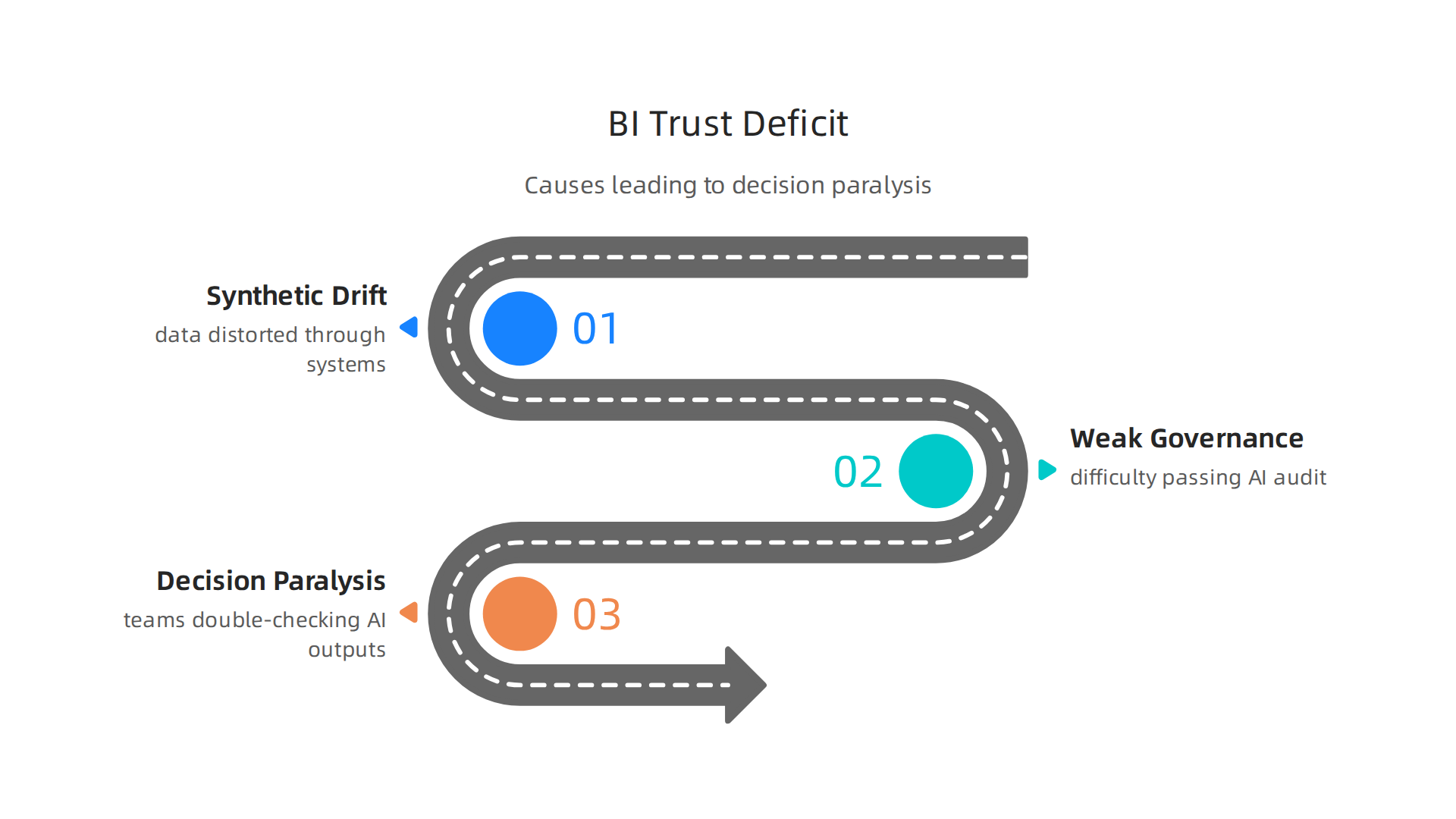
Teams spend hours double-checking AI outputs instead of acting. They lose the speed that good business analytics is supposed to deliver. And all that investment in tools and infrastructure becomes a sunk cost.
The first step to fixing this is understanding where the distrust comes from. It is not just about bad data. It is about broken systems that distort truth before it ever reaches your dashboard. Once you see that clearly, you can begin to rebuild confidence from the ground up.
Understanding Synthetic Drift and the AI Bottleneck
To rebuild confidence in your business intelligence, you need to understand one of the biggest hidden problems: synthetic drift. This is when AI models learn from data that has been twisted as it moves through different systems. The data often comes from public sources scraped without permission. It may be old, biased, or just wrong. The AI picks up those mistakes and spreads them further. A recent survey found that McKinsey's 2026 AI trust survey shows almost 60% of organizations say knowledge and training gaps keep them from putting responsible AI practices in place. When teams cannot tell if their training data is clean, synthetic drift gets worse.
The root cause is often called the AI bottleneck. It is the lack of ethical, permission-based private data. Most AI models today are trained on whatever is publicly available. That data is messy and distorted. Without access to clean, consented human data, models keep guessing. And guesses are not good enough for reliable business analytics.
According to the future of business intelligence in 2026, strong data governance is now an essential pillar of any BI strategy. Companies that ignore it risk flawed decisions and lost trust.
Here is the takeaway. Synthetic drift and the AI bottleneck are not just technical glitches. They are trust killers. If your business intelligence systems rely on distorted data and guesswork, your dashboards will always feel shaky. The fix starts at the source: getting clean, ethical data before it ever touches your AI models.
The Cost of Mistrust: Impact on BI Adoption and ROI
Here is a scenario you might know. Your team builds a beautiful dashboard. It shows sales trends, customer churn, and revenue forecasts. But when you present it to the leadership team, they nod politely and then ask for a second opinion. They do not trust the numbers. So they ignore the dashboard and make decisions based on gut feelings or old reports.
This hesitation is expensive. When decision-makers do not trust your business intelligence, they stop using it. They log in less. They question every data point. Your analytics platform becomes a shelf-ware project that cost thousands but delivers almost nothing. The ROI of your entire BI investment drops.
It is not just a feeling. Survey data shows the damage clearly. According to the 2026 AI trust survey by insightsoftware, only 51% of organizations trust AI-generated insights. That means nearly half of all decision-makers are skeptical of the data in front of them. And when trust is low, adoption falls.
The result is a cycle of wasted potential. Companies pour money into data analysis tools. They hire analysts. They build pipelines. But if the people at the top do not believe what they see, none of it matters. The platform gets used at 30% capacity. The predictions sit in a drawer.
Strong business analytics only work when people act on them. That action depends entirely on trust. Fixing synthetic drift and the AI bottleneck is not just a technical task. It is a financial one. Every dollar you spend on clean, ethical data is a dollar that protects your BI adoption and your return on investment.
Permission-Based Data Strategy: The Foundation of Trustworthy BI
So how do you fix the trust problem? It starts before you ever build a dashboard. It starts with where your data comes from and how you get it.
The most trustworthy business intelligence systems are built on a permission-based data strategy. That means collecting data only with explicit, informed user consent. Not scraping data from public sources. Not buying third-party datasets with unclear origins. Not tracking people without telling them.
When you collect data with permission, two things happen. First, your data quality goes up. People who opt in are more likely to give accurate information. They are not being tricked or forced. Second, your regulatory risk goes down. Laws like GDPR and CCPA already require consent for many data types. A permission-based approach keeps you ahead of those rules.
But here is the bigger win. Permission-based data builds real trust. When users know exactly why you are collecting their data and how you will use it, they feel respected. That respect carries into your analytics. Decision-makers trust insights more when they know the source data is clean and ethically sourced.
Many organizations skip this step. They rush to collect as much data as possible, hoping volume will make up for quality. But volume without consent creates noise. According to the Enterprise BI security guide from Domo, strong data governance with role-based permissions and audit trails is a must for large organizations. Permission-based sourcing is the backbone of that governance.
Think of it this way. Your data analysis tools are only as good as the data you feed them. If that data comes from consenting users who understand its purpose, your analytics reflect real behavior, not distorted signals. Your business analytics become more accurate. Your forecasts become more reliable.
Companies that adopt permission-based strategies do not just reduce risk. They gain a competitive edge. Their insights are cleaner. Their decisions are faster. And their customers and stakeholders trust the numbers from the start.
This is not a nice-to-have. It is the foundation of trustworthy business intelligence.
Moving Beyond Scraped Data: Building First-Party and Collaborative Datasets
Once you have permission-based data as your foundation, where does the data actually come from? Many teams in 2026 still default to scraping public data because it is easy and cheap. But for accurate business intelligence, first-party data you collect yourself is far more valuable. You know its origin. You know the context. Public scraped data often comes with hidden biases and inaccuracies. It may not reflect your actual audience at all.
So before you pick your data analysis tools, make sure your data sourcing is solid. Comprehensive enterprise business intelligence tools thrive on high-quality inputs. First-party data gives you that quality.
But what if you need a bigger dataset than your organization can build alone? Ethical data cooperatives and marketplaces let you share data with trusted partners. Everyone brings clean, consented data to the table. Everyone benefits from richer, more complete insights. Setting up secure access for these shared pools requires strong governance. Following a structured Power BI report access permissions strategy helps keep shared data safe while maximizing its value.
As you collect and organize this data, your proprietary datasets become one of your biggest competitive advantages. They hold insights no one else has. You can spot trends and make decisions faster than competitors who rely only on generic public data. Applying robust enterprise xP&A governance ensures the data stays reliable and actionable at scale across your organization.
When you move beyond scraped data and invest in ethical, proprietary datasets, your entire analytics practice gets stronger. Your business analytics become truly unique to your organization. And your decisions rest on a foundation of trustworthy information that everyone can believe in.
Once you have high-quality, ethical data, the next question becomes: what are you actually measuring with it? Most business analytics dashboards in 2026 still track clicks, page views, and conversions above all else. But those numbers only tell part of the story. They show what people do, not how they feel.
Human-centric analytics takes a different path. Instead of optimizing for engagement, it measures human flourishing. Things like employee well-being, psychological safety, and a sense of belonging become key numbers to watch.
This shift changes the entire purpose of your business intelligence. You stop asking "how do we keep people clicking?" and start asking "how do we help people thrive?"
Behavioral science helps you design dashboards that make ethical decisions easier. When you put well-being metrics right next to financial performance, teams naturally consider the human side of every choice. Frameworks like the 12 competencies people-centric metrics framework give you a structured way to track health and well-being across your organization. You can measure everything from burnout levels to manager support in a consistent, transparent way.
Tools like Zoho Analytics now let you build custom dashboards that center these human factors. You can track employee engagement and workload balance alongside revenue growth. This gives you a fuller picture of organizational health. Instead of optimizing for short-term clicks, you optimize for long-term trust.
Research backs this approach up. The 2026 Gallup workplace report found that workers who feel their work has purpose report stronger well-being and higher engagement. Companies that listen to these signals build deeper trust with both employees and customers.
Enterprises adopting human-centric business analytics see a real advantage. Stakeholders notice when you genuinely care about their well-being. That trust pays off in loyalty, better retention, and a stronger brand reputation over time. Your data decisions become ethical by design, not by accident.
Ultimately, human-centric analytics turns your business intelligence into a force for good. It helps you make smarter decisions while also improving the lives of the people you serve.
Applying Behavioral Science to BI Dashboards
Numbers on a dashboard look neutral. But how you present them shapes every decision that follows. Cognitive biases like anchoring, confirmation bias, and framing can quietly steer people toward poor or unethical choices. Behavioral science offers a way to fix that.
Nudge design makes small, intentional changes to how data appears. For example, you can place well-being metrics right next to revenue figures. This simple shift helps decision-makers weigh human impact as seriously as financial performance. It reduces the pull of short-term thinking and encourages transparency.
Transparency also comes from showing where data originates. Features like source badges, collection method notes, and update timestamps build trust. When a dashboard reveals data provenance, users feel confident the numbers are honest. This is especially valuable for people-centric metrics like employee engagement or psychological safety.
Behavioral insights also help you avoid manipulative visuals. An urgent red alert might drive clicks but also spikes anxiety. A calmer design using context and explanation respects the user while still guiding action. The goal is ethical persuasion, not forceful nudging.
Organizations adopting these principles see stronger engagement and trust. The HR data analytics trends for 2026 highlight ethical AI analytics as a growing priority. Dashboards built with behavioral science reflect that commitment.
When you apply behavioral science to your business intelligence dashboards, you move from manipulating attention to enabling good judgment. That shift is what makes data truly useful.
Verification and Truth Assurance in Analytics
All the behavioral design in the world means little if the data itself is not trustworthy. Without solid verification, even the most ethical dashboard can lead to bad decisions. That is why verification and truth assurance are the foundation of responsible business intelligence. They turn data analysis tools from black boxes into transparent systems you can trust.
Data Provenance and Lineage
The first step is knowing where your data comes from. Data provenance means tracking every piece of information back to its original source. This includes noting who collected it, when, and using what method. Lineage tools show how data moves and changes as it travels through your systems. When you can trace a number on a dashboard to its origin, you build confidence in what you see.
A Data Verification practitioner's guide for BI teams explains that cross-source triangulation is a powerful way to confirm accuracy. You pull the same metric from two independent sources and compare them. Where the sources agree, your trust grows. Where they differ, you investigate the method behind each number. This simple technique catches many hidden errors before they cause harm.
AI Fact-Checking Against Misinformation
The rise of AI-generated content makes verification even harder. Bad data can spread fast through automated systems. Smart organizations now use AI to fact-check against trusted sources automatically. These checks compare numbers and claims against curated databases and known reference points.
11 Essential Data Validation Techniques from Twilio includes statistical validation and business rule checks that flag odd patterns. For example, if an employee engagement score jumps 40 percent in one month, a rule check will flag it for review before it reaches the dashboard. This kind of automated cross-referencing catches errors before decision-makers ever see them. It acts as a safety net for your entire data pipeline.
Human-in-the-Loop Final Review
But automation is not enough. People must still review the most important findings. Human-in-the-loop validation adds judgment, context, and common sense that machines lack. An experienced analyst can spot a strange trend that passes every automated check. They can ask the right questions about context and intent.
Data validation guidance from IBM helps teams build this human review into their workflows. The combination of machine speed and human wisdom creates the strongest safety net. A good rule of thumb is to automate routine checks and reserve human review for high-impact or unusual results.
For organizations committed to ethical AI, this layered approach to verification is essential. It aligns with the Value Reinforcement System's mission to capture authentic human truth before digital systems distort it. When your data is verified at every step, your business intelligence becomes a tool for real understanding, not just pretty charts.
Combating Misinformation in BI Outputs
Verification alone does not stop every false story from reaching your business intelligence dashboard. Misinformation often hides inside synthetic data or appears as a strange spike that looks real at first glance. You need specific tools and habits to catch these threats before they spread.
Synthetic data detection tools help you spot manipulated inputs. These tools scan for data that was generated or altered by AI in ways that do not match natural patterns. When a dataset contains numbers that look too perfect or follow an unnaturally smooth curve, detection tools raise a flag. They act as a first line of defense against fake data sneaking into your reports.
Anomaly detection algorithms go a step further. They learn what normal behavior looks like across your metrics and flag anything that breaks the mold. For example, if your weekly sales suddenly jump 300 percent in a single region with no clear cause, the algorithm calls it out. This gives your team a chance to investigate before the number distorts a quarterly review. The popular data validation techniques shared by Amplitude include distributional tests that alert you when datasets do not match expected inputs. These tests work great for catching unusual patterns early.
Even with automation, people still need to check the findings. Best practices for human-in-the-loop review include setting up regular sign-off meetings where analysts look at flagged items. A simple rule is to review any outlier that passes automated checks but feels odd to an experienced team member. Context and intuition catch things machines miss. For example, knowing that a big client just ended their contract helps explain a sudden drop in engagement. A machine would flag it as an anomaly, but a human can confirm it is valid.
To make this work, build a simple review workflow. Automate the detection of synthetic data and anomalies. Then route the most surprising results to a person for final judgment. This layered approach keeps your business intelligence honest and helps your team make decisions based on real truth, not manufactured noise.
Integrating Ethical AI Frameworks into BI Strategy
You have built a system that catches bad data and flags strange spikes. That is a solid start. But there is a bigger layer you need to add: making sure your entire business intelligence pipeline runs on a foundation of trust and ethics. Without that, even verified data can lead to biased decisions or regulatory trouble.
Think of an ethical framework as the rulebook that guides how your team collects, processes, and acts on data. The most forward-thinking organizations in 2026 are adopting standards like ISO/IEC 42001, the first international standard for AI management systems. This standard gives you a clear structure for governing AI throughout its lifecycle, from training data all the way to the final report.
But a standard alone is not enough. You need to weave four core principles directly into your BI workflows: fairness, accountability, transparency, and ethics (often shortened to FATE).
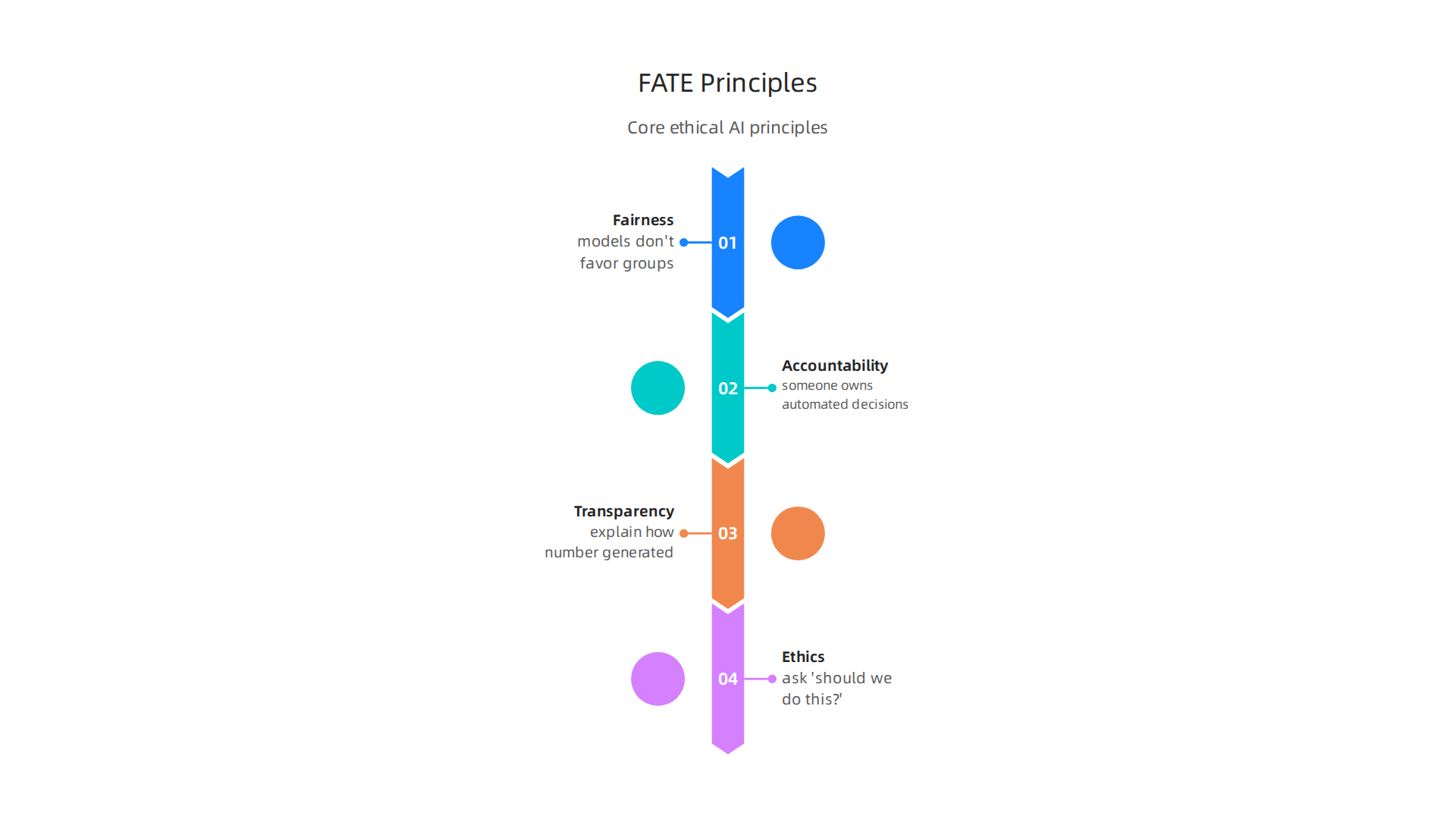
Fairness means checking that your models do not favor one group over another. Accountability means someone on your team owns every automated decision. Transparency means you can explain how a number was generated. And ethics means you ask "should we do this?" not just "can we do this?"
When these principles live inside your data analysis tools, they become automatic. For example, a tool like Zoho Analytics now includes built-in fairness checks on predictive models. Every time your business analytics team runs a report, the system flags any metric that could be biased or misleading. This turns ethical review from a once a year audit into a daily habit.
Regulatory bodies are also moving fast. Instead of expecting companies to check boxes after they build a system, regulators now demand trust-by-design methodologies. You need to show that trust was baked into your process from day one, not added as an afterthought. The shift is clear: organizations that are transparent about their data and can explain how their models work earn stronger trust from customers and employees alike.
Embedding these frameworks into your business intelligence strategy does not slow you down. It actually makes your insights more reliable. When your team knows every number has passed an ethics check, they can act with confidence. And in 2026, confidence is everything. The companies that treat governance as a growth accelerator, not a brake, are the ones pulling ahead.
So take your review workflow from the last section and add an ethics layer on top of it. Standardize with ISO/IEC 42001, embed FATE principles, and design for trust from the start. That is how you build a BI strategy that is not just smart, but responsible.
Future-Proofing BI: Trust as a Competitive Advantage
You have built an ethical framework and embedded it into your daily workflows. That puts you ahead of many teams. But here is the truth about 2026: trust is no longer just a nice to have label on your website. It is becoming the single most important factor that separates winning organizations from the rest.
Research backs this up. The organizations that invest in trust, transparency, and mature data governance make faster decisions and make better ones.

They do not get stuck second-guessing their own numbers. When an executive asks "can we trust this forecast?" the answer is already built into the system. That speed adds up fast. Over a quarter, those organizations act on insights days or even weeks before competitors even finish arguing about which data set is correct.
Analysts are paying close attention to this shift. Multiple industry reports now predict that trust will become a key differentiator in BI platform selection by the end of 2026. Companies will choose one platform over another not because of fancier charts or faster dashboards, but because they trust the data pipeline feeding those dashboards. The focus is moving from output to input, from "how fast can we measure?" to "how smart and how responsibly can we respond?"
A deep look at the most important trends in BI, AI, and data for 2026 confirms that mature organizations no longer see governance as a bureaucratic safety net. They treat it as a growth accelerator. Trust becomes the new currency, both internally among employees and externally with customers who must feel safe sharing their data. Organizations that are transparent about their data and can clearly explain how their models work earn stronger loyalty.
Building a culture of data trust does not happen overnight. It requires continuous investment in governance, ethics training, and the right tools. The business analytics teams that thrive in 2026 will be the ones that treat trust as muscle, not a checklist. They exercise it every day. They reward transparency. They make it easy for anyone in the company to question a number and get a straight answer about where it came from.
So take your ethics layer from the last section and start thinking bigger. Trust is not just a safeguard. It is your competitive edge. The business intelligence leaders of tomorrow will be the ones who understand that principle today.
Summary
This article argues that the biggest bottleneck in modern business intelligence is not speed or AI capability but trust: when users doubt numbers, BI stalls. It explains how synthetic drift, scraped or permissionless data, and weak governance corrupt insights and create decision paralysis, and it shows why permission-based, first‑party datasets restore confidence. The piece walks through practical fixes—data provenance and lineage, automated fact‑checking, anomaly detection, and human‑in‑the‑loop review—and explains how behavioral science and human‑centric metrics shift priorities from clicks to flourishing. It also lays out how to embed ethical AI frameworks like FATE and ISO/IEC 42001 into daily BI workflows so teams can act on verified insights. By treating governance as a growth lever rather than a checkbox, organizations can improve adoption, protect ROI, and make trust a competitive advantage.
Related Blogs
No Similar Blogs found
