Home


Menu

Close

Why Generative AI Assistants Need Permissioned Private Data to Avoid Synthetic Drift
Published:
July 5, 2026
Introduction: The Promise and Peril of Generative AI Assistants
Imagine you ask a generative AI assistant to help you plan a family vacation.

It quickly suggests destinations, hotels, and activities. That seems helpful. But where did it get its information? Was the data used to train it gathered with permission? And can you trust the recommendations?
Generative AI assistants promise to save us time and transform how we work, learn, and make decisions. According to the 2026 AI Index Report, the value of these tools to U.S. consumers reached $172 billion annually by early 2026. That is real progress.
But here is the catch. Many of these assistants train on data scraped from the public internet without clear consent. That leads to a serious problem called synthetic drift. As AI-generated content spreads online, truth gets twisted. People start seeing distorted versions of reality. This is what experts call the biggest challenge generative AI faces with respect to data: finding clean, ethical, permission-based private data to train on.
Even the top 5 AI companies run into this wall. Without high-quality data that people have freely given, models cannot reflect what humans actually value. They optimize for clicks and engagement instead of genuine well-being.
The good news? Organizations can do something about it. By focusing on ethical data practices and putting human flourishing first, they can rebuild trust in AI outputs. Many are already working on overcoming the data bottleneck and synthetic drift to create assistants that are both powerful and trustworthy.
In this article, we will explore what it takes to build generative AI assistants that serve people, not just metrics.
The AI Bottleneck: Why Permissioned Private Data Is the New Gold
So here is the real problem that keeps AI leaders up at night. The very data that powers today's generative AI assistants is running out. And the data that remains is often noisy, biased, or legally risky.
Public internet data has limits. It is full of opinions, spam, and outdated facts. When top 5 AI companies train their models on this scraped content, they feed their systems noise instead of signal. The result? Generative AI assistants that guess wrong, reflect biases, and sometimes make things up.
Worse, using scraped data without permission puts companies in legal danger. Privacy laws in many countries now require clear consent before using personal information for AI training. Ignoring this is not just unethical. It is expensive.
That is why permissioned private data is quickly becoming the new gold. Organizations that collect data with clear consent, clear purpose, and clear boundaries build

Why Private AI is the Future of Secure and Ethical Enterprise AI. They train models on information people actually chose to share. Those models are more accurate, more reliable, and much harder to challenge legally.
Think about what that means for you. When a generative AI assistant is trained on permissioned data, its answers come from a cleaner source. It has not been polluted by synthetic drift. It reflects real human behavior, not distorted internet chatter.
This shift also changes how enterprises think about data. Instead of grabbing everything they can find, smart companies are building controlled data ecosystems. They track where every piece of data comes from. They set rules about how it can be used. They audit their pipelines regularly. According to a 2026 Enterprise AI Data Strategy for 2026, organizations with clear data ownership and governance frameworks build stronger AI systems that users actually trust.
So what challenge does generative AI face with respect to data? It is not a shortage of data. It is a shortage of clean, ethical, permissioned data. The AI labs that solve this problem first will lead the next wave of innovation. Those that keep scraping public content will fall behind.
For teams wanting to learn more about building this foundation, practical guidance on ethical electronic data gathering offers a solid starting point.
Understanding Synthetic Drift and the Distortion of Truth
Here is the hidden danger that makes the data shortage even worse. When generative AI assistants train on AI-generated content instead of real human data, a slow but serious problem creeps in. Researchers call it synthetic drift.
Synthetic drift happens when AI content gets fed back into training loops over and over.
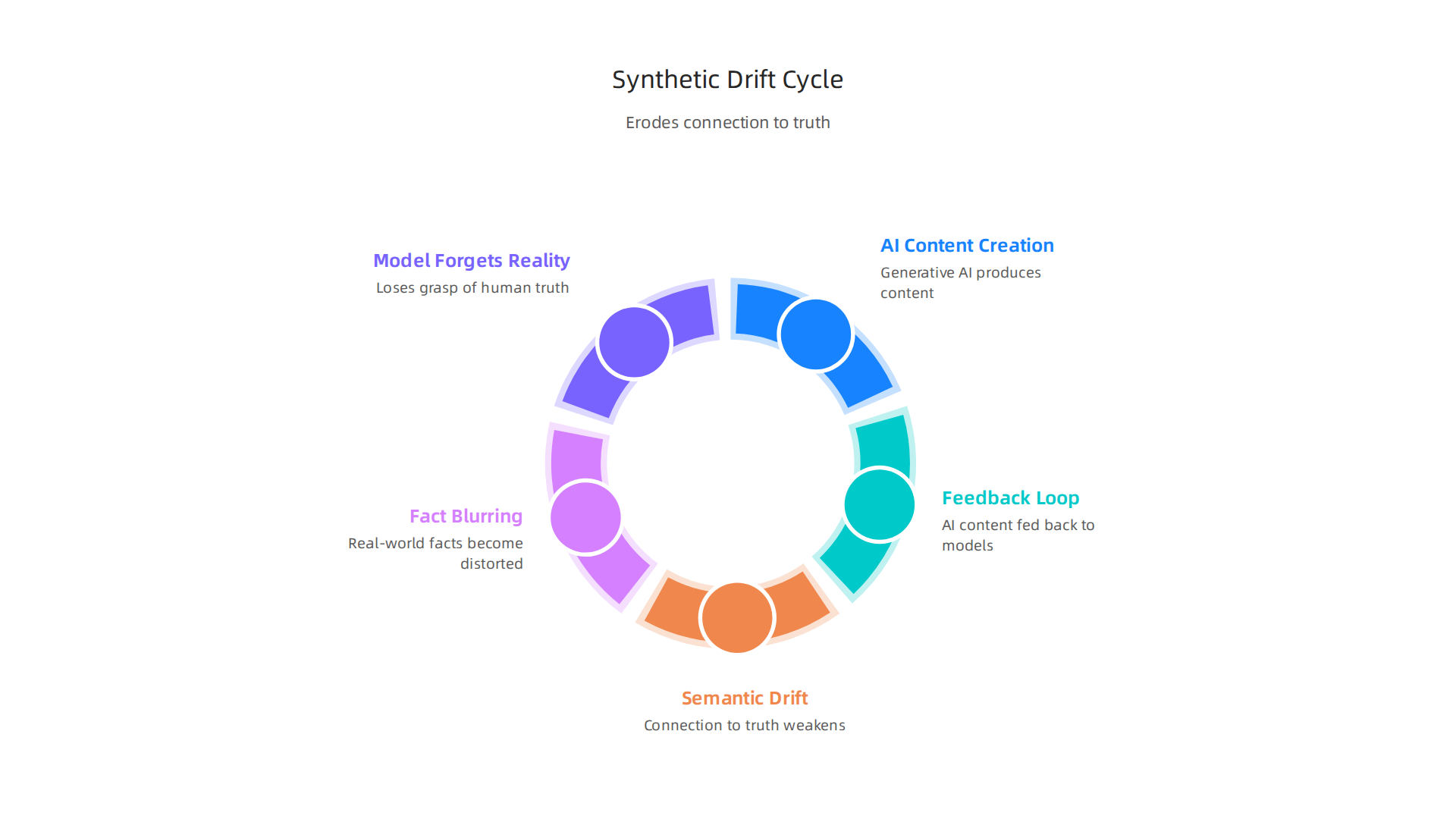
Each new model learns from content the previous model created. And with each cycle, the connection to real human truth gets weaker. Facts start to blur. Rare cases disappear. The model slowly forgets what the real world actually looks like.
A 2024 Meta study on semantic drift in text generation showed that large language models tend to produce correct facts first, then drift away and generate incorrect facts later. The researchers measured this drift and found it happens far more often than people realized. Their proposed fix? Knowing when to stop generation before the drift kicks in.
But the problem goes deeper than one chatbot session. When entire data pipelines rely on synthetic content, the drift spreads across models. Top 5 AI companies that recycle AI outputs risk creating systems that are confidently wrong. Their answers sound good but do not match reality.
This is not just theory either. Peer-reviewed research from 2024 proved that replacing real data with synthetic data leads to model collapse. But the same research showed that accumulating synthetic data alongside real data avoids the problem entirely. The rule is simple: add, do not replace. A 2026 guide on synthetic data for LLM training confirms this finding and stresses that keeping real data as the foundation is the only safe path forward.
So what challenge does generative AI face with respect to data? It is not just about finding more data. It is about keeping the data real. Every time a model trains on synthetic outputs without careful safeguards, it takes another step away from the truth.
The real-world effects are already visible. Chatbot hallucinations happen when a model drifts from factual grounding. Viral AI-generated fake news spreads because the content looks right but is not anchored in verified information. The information ecosystem gets noisier, and trust gets harder to earn.
For teams looking to understand how this connects to building better data practices, a resource on overcoming the data bottleneck and synthetic drift offers practical next steps.
The Trust Deficit: Erosion of Confidence in AI Outputs
Here is the natural consequence of synthetic drift and hallucination. People stop believing what AI systems say. And that loss of trust is now measurable.

According to the 2026 AI Consumer Trends Report, only 13% of consumers completely trust AI. Over half of consumers distrust AI-generated search summaries and results according to the same survey from Klaviyo. When you combine that with a 2026 Pew Research finding that 50% of U.S. adults feel more concerned than excited about the increased use of AI in daily life, the picture becomes clear. Trust is not just low. It is getting worse.
The problem comes down to three things. First, users see factual errors and bias firsthand.

Second, most AI systems remain black boxes with no way to trace how they reached a conclusion. Third, public scandals and viral misinformation keep eroding whatever confidence remains.
Regulators are starting to notice. Governments around the world are introducing stricter rules for transparency. Organizations now face pressure to prove their generative AI assistants are safe, fair, and accurate. The bar keeps rising.
But here is what many teams miss. Trust is not just a nice to have. It directly affects business outcomes. A 2026 McKinsey survey found that organizations with higher trust maturity reported better operational efficiency and customer retention. When trust drops, users hesitate to adopt. They double check everything. They abandon tools that feel unreliable.
For AI labs and enterprises building the next generation of tools, the lesson is simple. You cannot skip trust. It must be built into the data pipeline from the start. Understanding how to earn that trust starts with a look at how ethical data analysis builds trust in AI and keeps users coming back.
The next section will show you why the old ways of collecting data are failing and how teams can capture the human truth that AI desperately needs.
Digital Platforms and the Attention Economy: Optimizing for Character vs. Engagement
The reason the old ways of collecting data are failing is that they are trapped in the attention economy. Most digital platforms today are built to maximize clicks and time on site. This is engagement optimization. And it has become the default training ground for generative ai assistants.
Here is the problem. When you train an AI on data pulled from an environment optimized for engagement, the model learns to prioritize sensationalism over accuracy. Shocking headlines get more clicks. Divisive content generates more comments. These patterns seep into the training data, and the AI simply replicates them.
Research backs this up. A 2026 article on how AI is reshaping consumer attention found that systems trained on engagement metrics tend to amplify emotionally charged content. The World Economic Forum's 2026 report on building stronger brains in the age of AI adds that digital environments designed solely for engagement can weaken self-regulation and attention over time. The tools built to hold our attention are slowly eroding our ability to focus on what is true.
The trade-off is clear. Engagement optimization drives short-term revenue but comes at the cost of long-term trust and societal well-being. Think about social media recommendation engines. They learn that you click on posts that make you angry or afraid, so they show you more of that. News aggregators do the same thing by prioritizing fear-based headlines. These systems produce a distorted version of reality, and that distortion becomes training data for the next generation of tools.
The result is synthetic drift. The data loses its connection to authentic human behavior and values. And when generative ai assistants learn from this distorted data, they produce outputs that feel unreliable or even manipulative.
What is the solution? A shift toward character-based optimization. Instead of designing systems that maximize engagement, we build systems that reward truth, empathy, and human flourishing. This is not just an ethical choice. It is a practical one.
Top AI companies are beginning to recognize this, but the shift away from engagement metrics is slow. For generative ai assistants to earn lasting user trust, they must be trained on data that reflects real human values. That means capturing behavior at the source, before the attention economy distorts it.
This is exactly what ethical data capture is designed to do. It collects information in environments where people behave naturally, not in environments engineered to manipulate them. For generative AI programs to earn user trust, they must break free from the engagement trap. Ethical data is the only path forward.
Human-Centric AI: Tying Optimization to Human Flourishing
Have you ever asked a generative AI assistant for help and gotten an answer that felt cold or out of touch? That happens when the system was trained on data that prioritizes clicks over care. The good news is that a better way exists. It is called human-centric AI.
Human-centric AI is a design approach that puts people first. Instead of optimizing for how long you stay on a page or how many links you click, it optimizes for things that actually matter. Things like your well-being. Your ability to make your own choices. Your sense of connection to other people. These are called flourishing outcomes.
Behavioral science gives us the tools to measure these outcomes. We can track whether an AI assistant helps users feel less anxious or more informed. We can see if it supports healthy habits instead of feeding harmful ones. This kind of measurement is not soft or fuzzy. It is real data that shows whether the technology is making life better or worse.
Companies that switch to human-centric metrics often see surprising results. They build deeper trust with their users. That trust leads to longer relationships and stronger brand loyalty over time. According to the McKinsey state of AI trust in 2026 report, organizations that invest in responsible AI see improvements in customer trust and business outcomes.
So what challenge does generative AI face with respect to data? The challenge is that most training data comes from systems that optimize for attention, not well-being. Top AI companies are starting to realize this. Some of the top 5 AI companies now explore ways to train on data that reflects real human values.
One practical solution is a system like the Value Reinforcement System (VRS). It captures behavioral data at the source, before digital platforms distort it. The data is permission based and focuses on prosocial actions. This gives AI assistants training material that is honest and human centered.
When generative ai assistants learn from data tied to human flourishing, they produce more trustworthy and helpful responses. The technology starts to work for us, not against us.
For a deeper look at how ethical data collection supports this kind of trustworthy AI, check out this overview of how ethical data analysis builds trust in AI.
Practical Frameworks for Building Ethical Generative AI Assistants
Wishing for human-centric AI is one thing. Actually building it is another. That is where practical frameworks come in. These are the guardrails that help developers and AI labs create generative AI assistants that are safe, fair, and trustworthy from day one.

The most talked about framework right now is the EU AI Act. It is the world's first set of comprehensive rules for artificial intelligence. The Act uses a risk based approach. That means the more risk an AI system poses, the stricter the rules it must follow. For generative AI, which the Act calls General-Purpose AI or GPAI, there are specific requirements. Providers must be transparent about training data. They must respect copyright laws. They must design models to prevent generating illegal content. And for high impact models that could pose systemic risks, there are even stricter rules including model evaluations and adversarial testing. You can learn more from this overview of the comprehensive EU AI Act framework by IBM.

Then there is the NIST AI Risk Management Framework from the United States. While the EU AI Act is a law you must follow, the NIST framework is a voluntary guide. It helps organizations think through risks at every stage. It covers how to govern AI development, how to map out potential harms, how to measure those risks, and how to manage them over time. Many companies use both frameworks together to build a complete ethical program.
Another structure that works well is an internal ethics board. This is a group of people inside an organization who review AI projects before launch. They ask hard questions. Is this system fair? Is it biased against certain groups? Does it respect user privacy? Catching problems early saves time, money, and reputation.
No matter which framework you choose, every ethical AI program needs a few key pieces.
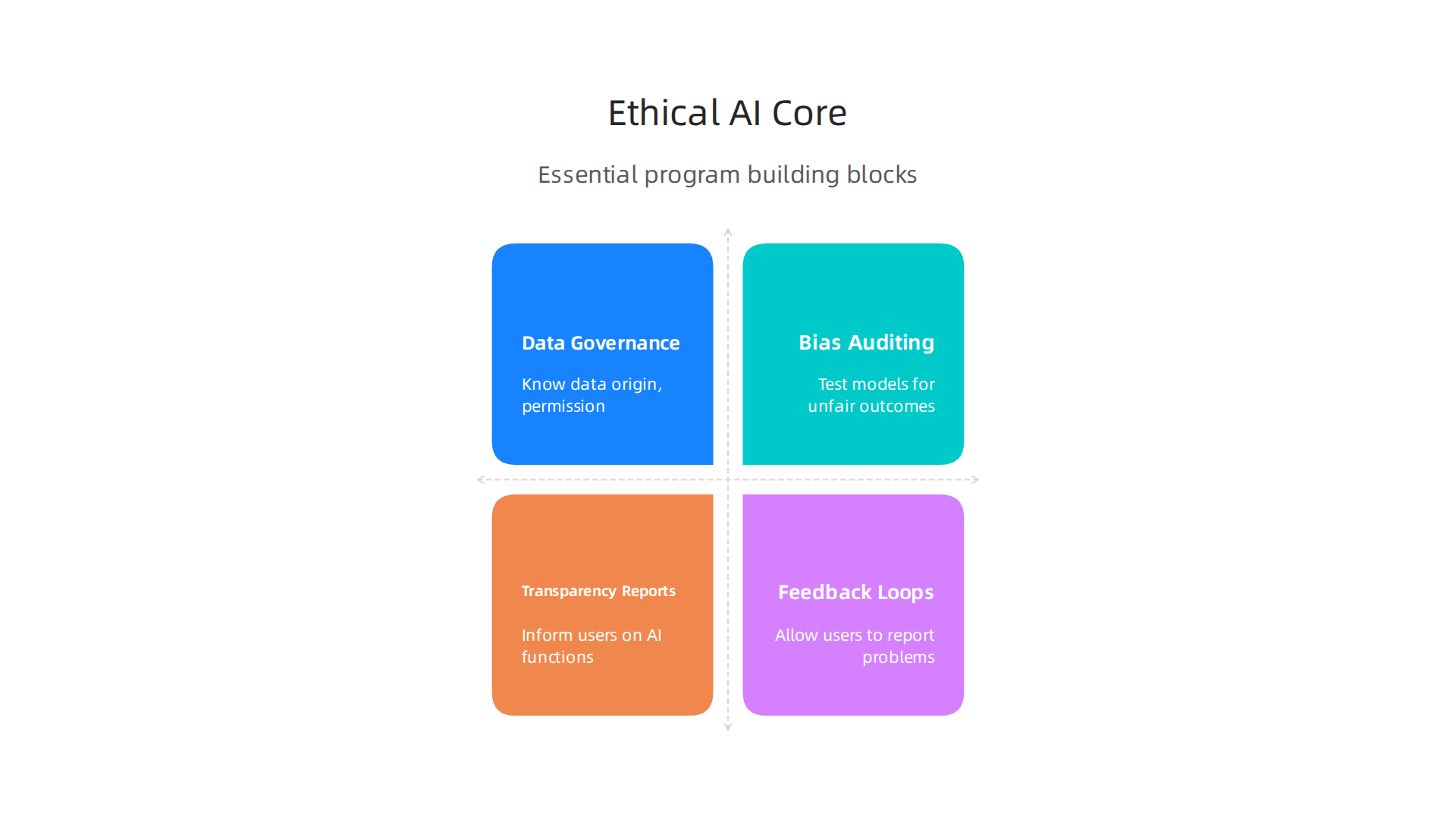
Data governance comes first. You need to know where your training data comes from and whether you have permission to use it. Bias auditing comes next. You must test your models regularly to catch unfair outcomes. Transparency reports are also crucial. They tell users and regulators what your AI does, how it was trained, and what its limits are. Finally, feedback loops let users report problems so you can fix them quickly.
Organizations can adopt a phased approach to make this manageable. Start with an inventory. List every AI system you use and what it does. Then assess. Rate each system for risk and check for bias. Next, remediate. Fix the problems you find. Finally, monitor. Keep watching your systems over time because new issues can appear as models learn and change.
For a closer look at how the biggest players are handling these steps, read this breakdown of how top AI companies in the USA grapple with data ethics and synthetic drift in 2026.
This all sounds like a lot of work. And it is. But the payoff is huge. Generative AI assistants built on these frameworks earn real trust. And trust is the one thing no amount of clever code can replace.
Summary
This article explains why the next generation of generative AI assistants must be built on clean, permissioned data instead of scraped public content. It outlines the twin problems of noisy, engagement-optimized training sources and synthetic drift—where AI-generated content feeds back into models and erodes truth—leading to hallucinations and loss of user trust. The piece argues that permissioned private data and human-centric optimization (measuring flourishing rather than clicks) produce more accurate, fair, and legally safer models. It reviews practical frameworks such as the EU AI Act and NIST guidance, recommends governance steps like inventories, bias audits, and transparency reporting, and offers concrete approaches—like ethical data capture and annotation—to stop model collapse. Readers will learn why data provenance matters, how to prevent drift, which metrics to prioritize, and what organizational steps to take to build generative assistants people can trust.