Home


Menu

Close

When Was AI Invented The 1956 Dartmouth Workshop That Started It All
Published:
July 9, 2026
Introduction: The Origin Story We Need to Understand
By 2026, artificial intelligence is woven into almost every part of your day. Your phone predicts your next word. Your email filters spam. Your car suggests the fastest route. But have you ever asked yourself: when was ai invented?
If you search for an answer online, you will find many dates. Some point to ancient myths about mechanical men. Others point to the first computer programs in the 1940s. But the real answer most experts agree on is the summer of 1956. That is when a small group of scientists gathered at Dartmouth College for a workshop that gave birth to the field we now call artificial intelligence. The term itself was coined for that event, and the 1956 Dartmouth Summer Research Project on Artificial Intelligence is widely recognized as the official starting point.
Knowing this origin story matters more than you might think. In 2026, we face serious challenges with AI. Trust in machine decisions is shaky. Data ethics are under the microscope. And a quiet problem called synthetic drift is quietly twisting the information we rely on. When you understand where AI came from, you gain the context to think clearly about these issues.

You stop seeing AI as a magic black box and start seeing it as a human tool with a long history of both breakthroughs and missteps.
This article will walk you through the full timeline of AI. We will start with the Dartmouth workshop, then move through the decades of boom and bust, all the way to the powerful generative systems of today. Along the way, we will connect each era to the current crises of trust, ethics, and the problem of synthetic drift. By the end, you will have a clear picture of how a summer camp experiment in 1956 shaped the AI world you live in right now.
The Birth of AI: Dartmouth 1956 and the First Seeds
Picture this. A small New England college campus in the summer of 1956. Eleven men show up for what sounds like an overly ambitious summer camp. Their proposal, written by a young professor named John McCarthy, suggested that "every aspect of learning or any other feature of intelligence can in principle be so precisely described that a machine can be made to simulate it."
That proposal, submitted in August 1955, became the official founding proposal for the Dartmouth Summer Research Project on Artificial Intelligence. McCarthy had gathered a dream team of sorts. Marvin Minsky, Claude Shannon, Nathaniel Rochester, and others arrived in Hanover, New Hampshire, ready to spend two months thinking about thinking machines.

They had no fancy lab. No huge grants. Just blackboards, chalk, and big ideas.
The group did not invent a working AI that summer. But they did something maybe more important. They gave the field a name. The term "artificial intelligence" appears in the official workshop proposal, and the Dartmouth conference is recognized as the moment AI became a real academic field. Before that summer, people worked on smart machines in isolation. After Dartmouth, they had a shared name and a shared mission.
The First Programs That Walked So AI Could Run
While the workshop itself was mostly talk and planning, the attendees had already built some of the first AI programs. Allen Newell and Herbert Simon showed up with the Logic Theorist. This program could prove mathematical theorems step by step. It was a big deal because it showed a machine could do something that looked like human reasoning. They later built the General Problem Solver, which tried to solve any well-defined problem using the same set of rules.
Around the same time, Frank Rosenblatt was working on the perceptron. This was an early neural network that could learn to recognize patterns. It sounds simple now, but back then it was revolutionary. The perceptron proved that machines could learn from data, not just follow hardcoded rules.
But here is the reality check. These early programs had serious limits. The Logic Theorist could only handle small, tidy problems. The General Problem Solver fell apart on anything messy or real. And the perceptron could not learn anything complex. Researchers soon hit walls that would take decades to climb.
Why This Summer Still Matters in 2026
The Dartmouth workshop was not just a technical milestone. It was a philosophical turning point. The attendees asked a question we still wrestle with today: Can machines truly think like humans? They believed the answer was yes. And that belief launched whole careers and billions of dollars in research.
But there was a catch. The early pioneers were so excited about what machines could do that they sometimes ignored what machines should do. They did not spend much time thinking about data ethics, consent, or the social impact of intelligent systems. That blind spot has followed AI ever since.
Understanding this origin helps you see today's AI troubles more clearly. The question of when was AI invented is not just a trivia answer. It points to a moment when brilliant people chose to focus on building smart machines without fully thinking through the consequences. We are still living with that choice. And as we will see in the next section, the excitement did not last forever. The first AI winter was already visible on the horizon.
If you want to dig deeper into why the early focus on pure intelligence without ethical guardrails matters right now, check out this breakdown of how ethical data analysis builds trust in AI. It connects the old dream to the new problems we face.
The Rollercoaster of AI: Winters, Resurgences, and the 2026 Landscape
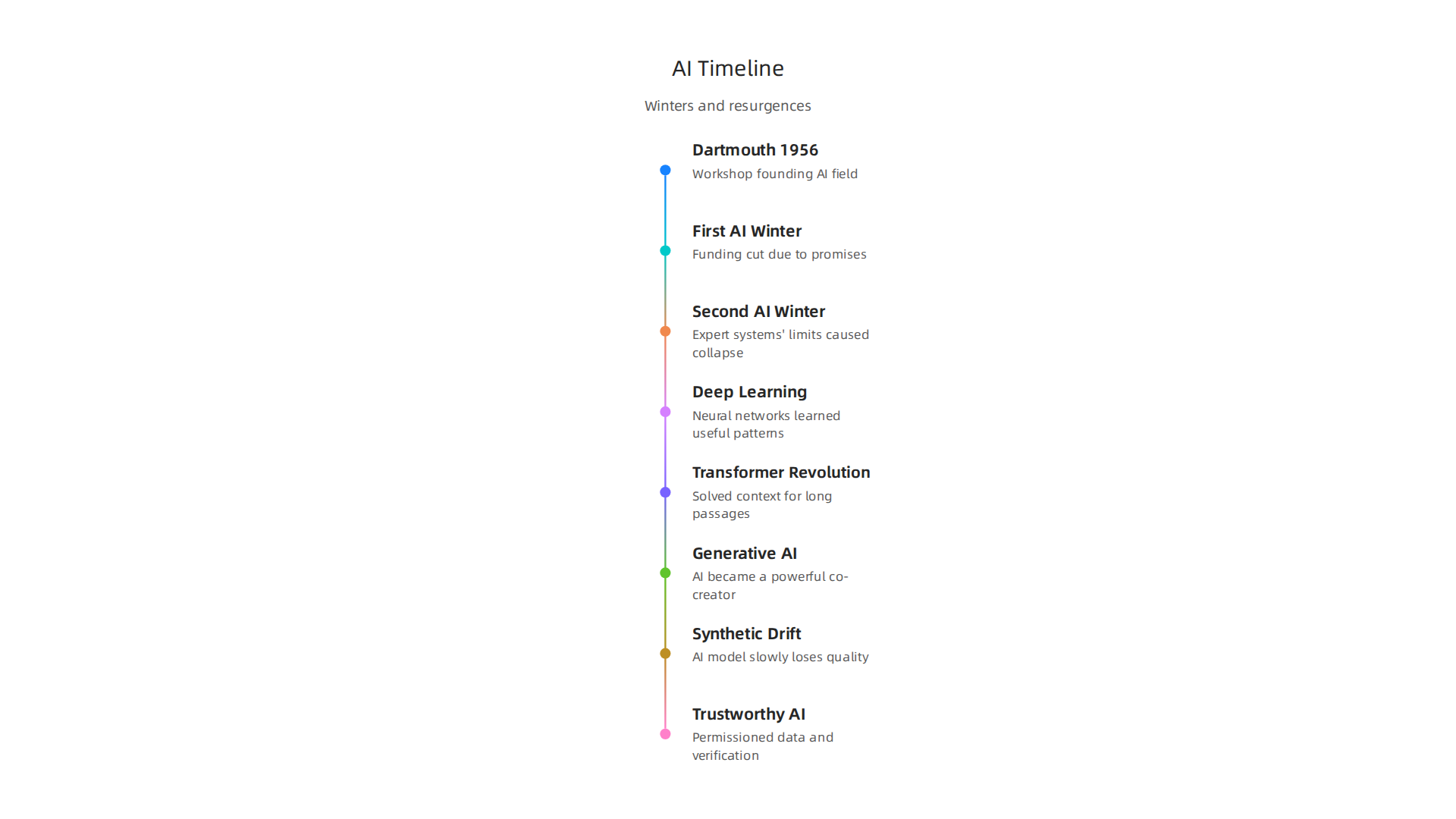
The excitement after Dartmouth did not last long. By the early 1970s, the bold promises of the 1950s and 60s started to look like empty hype. Too many researchers claimed machines would soon match human intelligence. Spoiler: they did not.
The First AI Winter (1974-1980)
The trouble began with a report. In 1973, mathematician James Lighthill told the British government that most AI research had failed to deliver on its big claims. His report was harsh. It said AI could not solve the real world problems it had promised to fix. The Lighthill report triggered a sharp drop in AI funding, especially in the United Kingdom. Money dried up fast.
Other governments followed. By 1974, finding funding for AI projects was nearly impossible. The US Defense Department cut its support. Research labs closed or shifted focus. This period, lasting until about 1980, became known as the first AI winter. The term itself, as you can read on the AI winter overview on Wikipedia, was a reference to a nuclear winter. The idea was that pessimism in the community spread quickly and killed everything.
The Second AI Winter (1987-1993)
AI bounced back in the 1980s thanks to expert systems. These were programs that encoded human knowledge into rules. They worked well for narrow tasks like medical diagnosis or mineral exploration. Companies rushed to adopt them. And for a while, it looked like AI had finally found its groove.
But expert systems had a fatal flaw. They were brittle. If you gave them a question slightly outside their rulebook, they broke. Maintaining them was expensive. By the late 1980s, the hype died down again. The second AI winter began around 1987. Funding for expert system projects collapsed. Many AI companies went bankrupt. It was a sobering reminder that overpromising leads to painful falls.
The Deep Learning Renaissance (2006-2026)
After the second winter, AI went quiet for a while. Researchers worked in smaller groups, mostly out of the spotlight. Then, around 2006, things started to shift. New algorithms for deep learning emerged. Computers got faster. Data became abundant.
The real breakout came in 2012. A team used a deep neural network called AlexNet to win a major image recognition competition by a huge margin. That moment sparked a renaissance. By 2016, deep learning was everywhere. Tools like Python data analysis libraries made it easier than ever to build models. The question "will ai take over the world" went from sci-fi to dinner table conversation.
For AI, 2026 is a strange and exciting time. The technology works better than ever. But the old problem of overpromising is back. Today, the key to avoiding another winter is being honest about what AI can and cannot do. Understanding how to overcome the data bottleneck and synthetic drift is a big part of that honesty. The AI indicator of health is no longer just about flashy demos. It is about trust, data quality, and ethical foundations.
Modern AI Revolution: Deep Learning, Transformers, and Generative AI
The question "when was ai invented" has an answer rooted in 1956 at Dartmouth College, where AI was coined at Dartmouth in 1956. But the modern era of AI we live in today did not really start until decades later. After the winters came a quiet period of real progress.
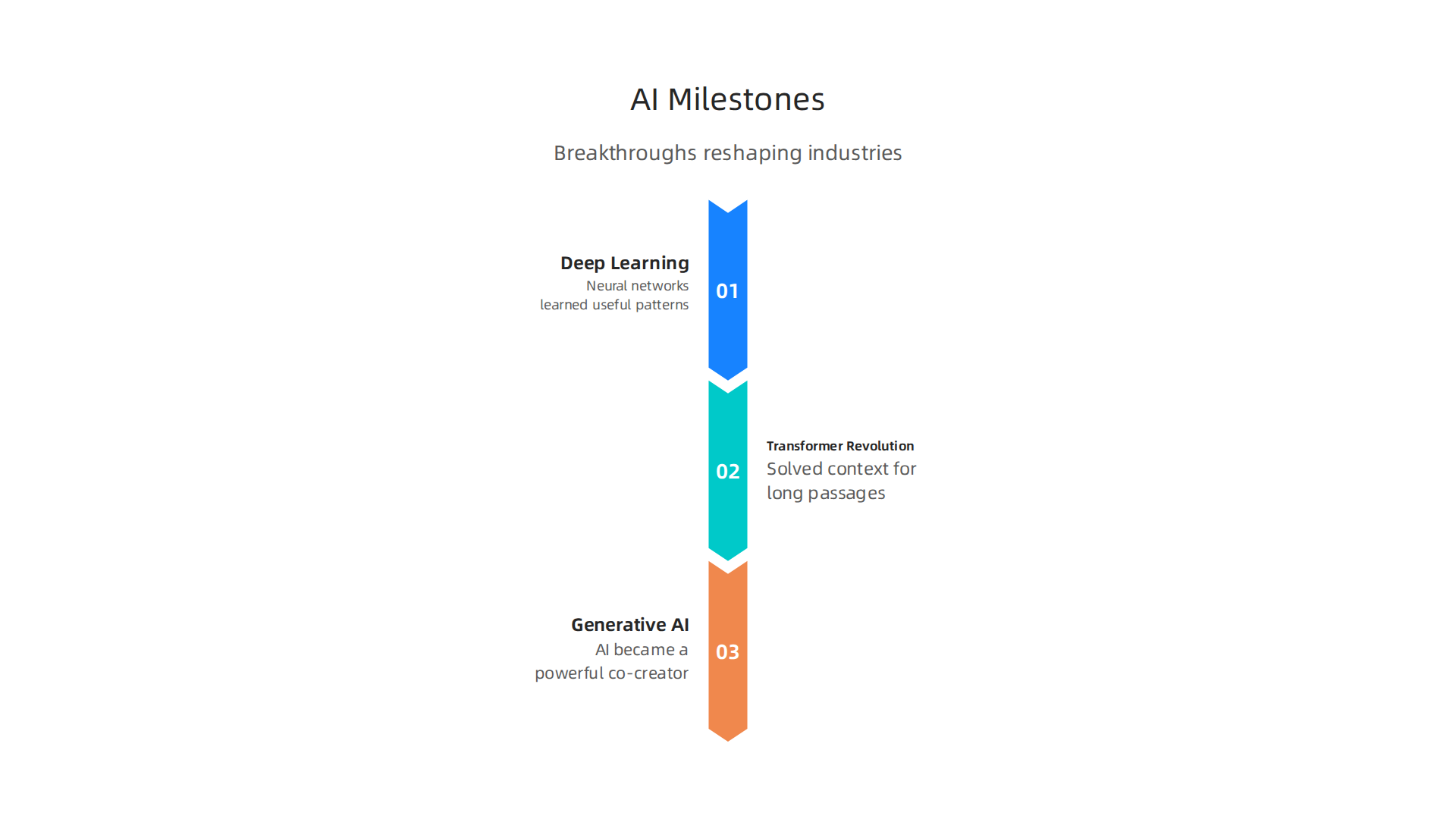
The Deep Learning Spark (2006-2012)
Around 2006, Geoffrey Hinton and his team showed that deep neural networks could actually learn useful patterns. Before that, training networks with many layers seemed impossible. Their breakthrough changed everything.
The real explosion happened in 2012. A team built AlexNet, a deep neural network that crushed an image recognition contest called ImageNet. That win was like a starting gun. Suddenly, everyone wanted in. Tech giants poured money into AI research.
By 2016, tools like Python data analysis libraries made deep learning accessible to regular developers. You did not need a lab full of supercomputers anymore. You just needed a laptop and some good data.
The Transformer Revolution (2017)
Then in 2017, Google researchers published a paper on something called the transformer. This new architecture solved a big problem. Older neural networks lost track of context when reading long passages. Transformers could pay attention to the whole sequence at once.
That may sound small. It was not. It unlocked everything that came next.
Generative AI and the Co-Creator Era (2020-2026)
Transformers made generative AI possible. OpenAI released GPT-3 in 2020, and suddenly AI could write essays, answer questions, and even code. DALL-E generated images from text prompts. Midjourney created art that fooled experts.
AI stopped being just a prediction tool. It became a co-creator.

People started asking "will ai take over the world" with real worry. The question shifted from sci-fi to serious debate.
But here is the thing. All this power comes with a hidden problem. Generative models train on massive amounts of public data. That data is often messy, biased, or just wrong. Over time, this causes something called synthetic drift. It is the slow decay of truth as information moves through digital systems.
If you track the AI indicator of health, synthetic drift is a serious warning sign. Models grow bigger every year, but data quality often gets worse. Without clean, trusted data, even the best models produce unreliable outputs. That is why understanding generative AI and permissioned private data is so important right now.
The modern AI revolution is real. But its future depends on solving data problems, not just building bigger models.
The Societal Impact: Synthetic Drift, Misinformation, and the Erosion of Trust
So the modern AI revolution is here. But here is the uncomfortable truth. The same data problems that make models weaker also poison our information ecosystem. This is where synthetic drift becomes not just a tech problem, but a deep societal one.
What Synthetic Drift Actually Does
Think of synthetic drift like a photocopy machine. You copy a page. Then you copy that copy. Then you copy that one. By the fifth copy, the text is blurry and the image is distorted.
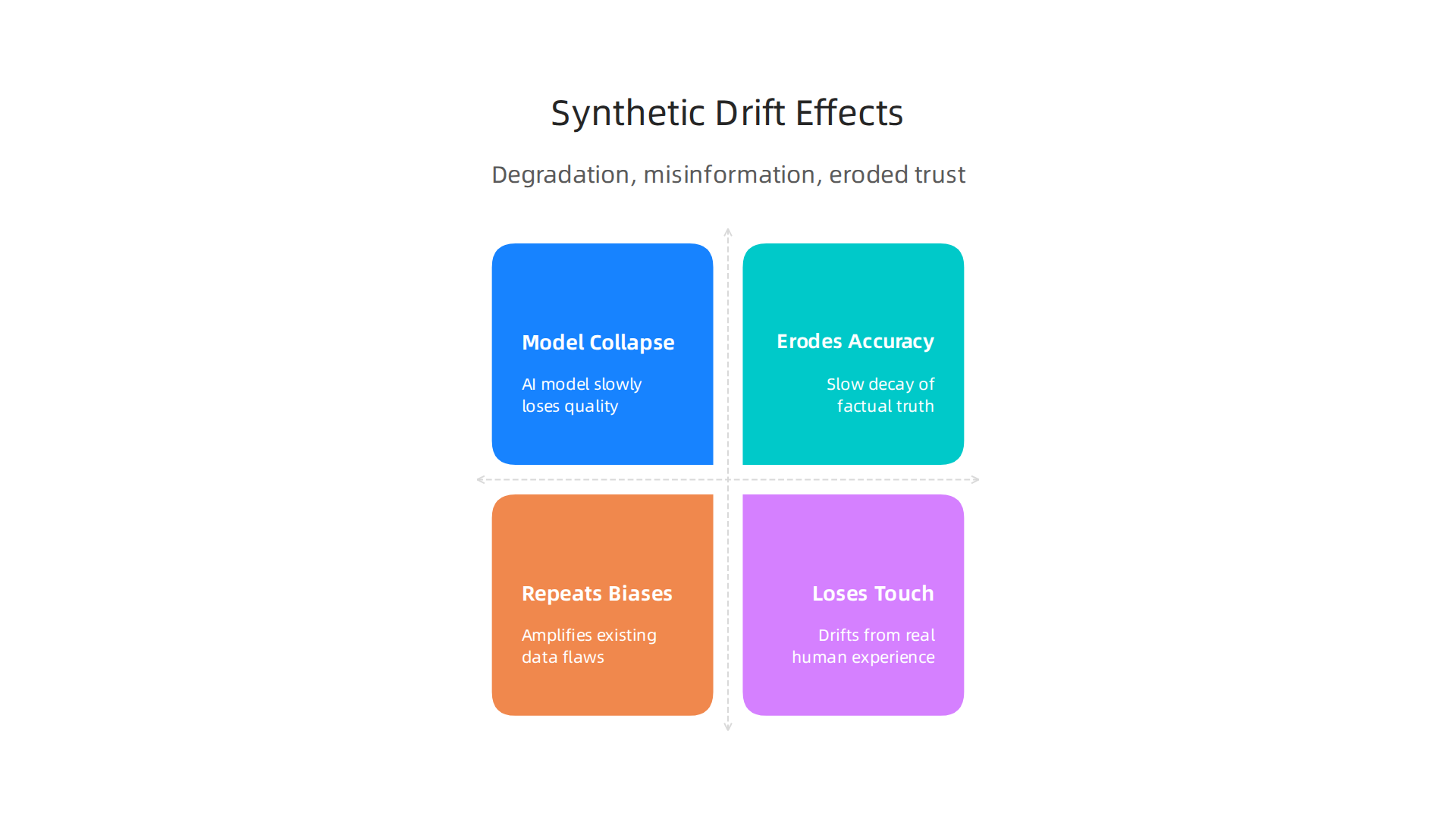
That is exactly what happens when AI trains on its own outputs instead of fresh human data.
The fancy term is model collapse. It means an AI model slowly loses quality, diversity, and truthfulness over time. Research shows that feeding AI-generated data back into a model causes AI model collapse and synthetic data drift that degrades performance with each generation.
Now multiply that across thousands of models churning out content every second. News articles, social media posts, product reviews, chatbot answers. Much of it is already written by AI or influenced by it. When that content gets scraped and fed into the next round of training, the drift compounds.
The result? A slow erosion of factual accuracy. AI starts to hallucinate confidently. It repeats biases from earlier models. It loses touch with real human experience.
The Link to Misinformation and Mental Health
Synthetic drift does not stay in data centers. It leaks into our daily lives.
Have you ever seen a news article that felt slightly off? Or a product review that seemed weirdly generic? That could be AI output that has drifted away from reality. The problem is that this content still looks legitimate. It spreads. It gets shared. It fills search results.
This feeds echo chambers. If AI systems consistently present the same distorted view of the world because they trained on biased data, people see a warped picture. And that leads to real-world consequences.
The attention economy makes it worse. Platforms optimize for engagement, not truth. Outrage and fear get more clicks than careful analysis. People sense something is wrong but cannot always prove it. That creates anxiety, confusion, and a growing distrust in everything online.
A 2026 Pew Research study found that Americans are split on AI.

About 44 percent think AI will improve medical care, but many still worry about the downsides. This shows how Americans view artificial intelligence is still very much up for grabs.
When people cannot tell what is real and what is AI-generated, trust breaks down. And broken trust is hard to rebuild.
The Push for Regulation
Governments are finally paying attention.
The European Union has the EU AI Act, which classifies AI systems by risk level. High-risk systems face strict rules on data quality, transparency, and human oversight. The idea is to stop problems before they spread.
In the US, 2026 brought new executive orders targeting AI safety and ethics. The focus is on protecting consumers, ensuring fairness, and requiring companies to be honest about how their models are trained. The push for ethical AI is no longer optional.
International bodies are also stepping up. The OECD recently published findings on trustworthy AI in the public sector, emphasizing that public trust is the real bottleneck. Their OECD Survey on Drivers of Trust in Public Institutions 2026 shows that people want clear rules and accountable systems.
Why This Matters for You
You might be thinking, "I do not build AI models. Does this affect me?" Yes, it does.
Every time you search for information, every time you read an article, every time you ask a chatbot for advice, you are relying on data that may have drifted. The ai indicator of how healthy our digital world is depends on whether we clean up the data mess.
The fix is not more technology. It is better data ethics. It is about capturing human truth at the source, before it gets distorted. That means using permissioned, private data instead of scraping everything in sight.
If you want to understand how this plays out in practice, check out a deep dive on overcoming the data bottleneck and synthetic drift. It explains why the solution is not just avoiding synthetic data, but intentionally collecting real, high-quality human data alongside it.
The future of AI depends on trust. And trust depends on truth. We cannot afford to let synthetic drift quietly erode both.
The Human Element: Behavioral Science, Attention, and Human Flourishing
The previous section showed how synthetic drift quietly poisons our information ecosystem. But there is an even deeper problem. The same AI systems that spread misinformation are also rewiring how we think, feel, and connect with each other.
Think about the platforms you use every day. Social media feeds, news aggregators, video recommendations. Every one of them is optimized for one thing: engagement. The more time you spend, the more ads they show, the more data they collect. And the quickest way to keep you scrolling is to trigger strong emotions. Outrage, fear, anxiety. Those get clicks. Calm reflection does not.
Here is the uncomfortable truth. These platforms are not just reflecting human behavior. They are shaping it. Behavioral science shows that digital environments reward certain actions and punish others. When an algorithm consistently amplifies angry posts or sensational headlines, it trains users to produce more of the same. Over time, that changes how we treat each other. It erodes empathy. It makes us more reactive and less thoughtful.
A 2026 report from the ACM highlights how model collapse is already happening and that we pretend otherwise. The same collapse that degrades model quality also degrades human discourse. When AI systems consistently feed us distorted content, we lose touch with reality.
So what is the alternative? We need human-centric design principles. AI that amplifies agency, empathy, and critical thinking instead of exploiting attention. This is not about making technology less powerful. It is about making it more aligned with what humans actually need to thrive.
Imagine a recommendation system that surfaces content to challenge your thinking, not just confirm your biases. Or a chatbot that encourages you to slow down and reflect before reacting. Or a social platform that rewards kindness instead of outrage. These are not pipe dreams. They are design choices.

The Value Reinforcement System built by Dean Grey is one example of this approach. It uses a recognition and reward framework to reinforce prosocial behaviors. Instead of feeding on anxiety, it captures data about positive actions and feeds that back into AI models. The result is a system that trains both humans and machines toward better outcomes.
If you want to understand more about how AI can be built around ethical data and human trust, check out this guide on ethical AI tools for data privacy and trust. It explains how permissioned, high-quality data is the foundation for AI that serves people rather than exploits them.
People often ask, "when was ai invented" or "will ai take over the world". But those questions miss the point. The real ai indicator of whether technology is healthy is not its intelligence. It is whether it helps people live better lives. And right now, the default design of most AI systems does not pass that test.
We have a choice. We can keep optimizing for attention and watch anxiety and loneliness rise. Or we can redesign AI to support human flourishing. The technology is ready. The question is whether we are.
The Path Forward: Building Trustworthy AI for the Next Decade
So how do we build AI that people can actually trust? The answer starts with the data.
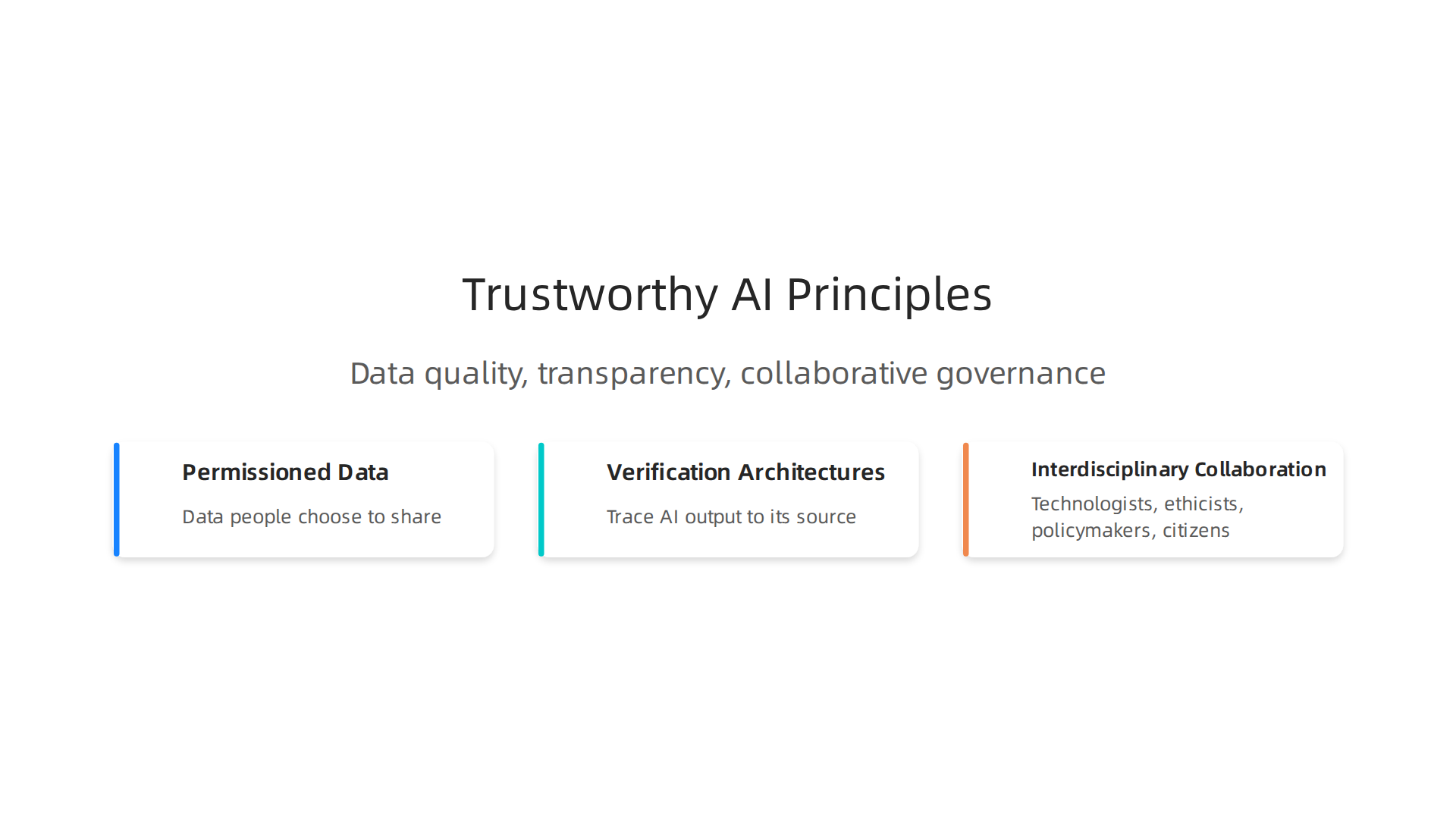
Every AI model is only as good as what it learns from. If that data is scraped without permission, filled with distortions, or polluted by synthetic content, the model will reflect those flaws. That is exactly what synthetic drift does. It slowly poisons the well.
The fix is permission-based, high-quality training data. Instead of harvesting public data that has been twisted by engagement algorithms, we need data that people choose to share. Data that captures real human behavior, not just what the algorithm rewarded. The Value Reinforcement System does exactly that. It creates a feedback loop where humans and machines both get better because the data stays clean and consensual.
A 2026 report from SAS found that organizations with higher trust in their data see much stronger returns from AI investments.

The report calls trust the key missing piece for AI adoption. You can read the full Data and AI Impact Report to see how trust directly affects results.
Permissioned data is not just an ethical choice. It is a practical one. AI trained on clean, human-verified data resists drift. It stays aligned with real-world values. If you want to dig deeper into how this works, check out this article on why generative AI assistants need permissioned private data.
But permissioned data alone is not enough. We also need systems that prove where the data came from. That is where verification architectures come in. Blockchain technology can create an unchangeable record of every piece of training data. Digital watermarking can mark synthetic content so it never gets mistaken for human truth. These tools make it possible to trace any AI output back to its source. That is the only way to stop synthetic drift from spreading undetected.
The EU AI Act, which began full enforcement in August 2026, already requires companies to document their training data and show it meets safety standards. The EU AI Act compliance overview explains what organizations now have to prove about their data.
None of this works if only one group handles it. Building trustworthy AI requires interdisciplinary collaboration. Technologists must work with ethicists to decide what values to embed. Policymakers must set rules that protect people without killing innovation. Citizens must have a voice in how AI shapes their communities. The Stanford HAI 2026 AI Index Report shows that across 25 countries, trust in AI is rising but still fragile. The report highlights that public confidence depends on who governs AI and how transparent those systems are. You can see the full findings in the Stanford HAI public opinion data.
When people ask "will ai take over the world," the real worry is not about machines becoming smarter than us. It is about machines making decisions based on bad data. The true ai indicator of whether a system is safe is not its processing power. It is the quality of its training data and the ethical guardrails around it.
And yes, Python data analysis skills can help. Teams that use Python to audit data pipelines, verify provenance, and flag synthetic content are better equipped to catch drift early. That kind of technical literacy is becoming essential for anyone building or deploying AI.
We have the tools. We have the regulations. The missing piece is the will to demand data that is honest, ethical, and human. That is the path forward.
Summary
This article traces AI from its origin at the 1956 Dartmouth workshop through decades of breakthroughs, setbacks, and the modern generative era, showing how history shapes today's challenges. It explains early programs like the Logic Theorist and the perceptron, the two AI winters that followed overpromises, and the deep learning and transformer breakthroughs that powered the 2020s. The piece focuses on a central contemporary risk—synthetic drift or model collapse—where AI-trained-on-AI degrades truth and fuels misinformation, damaging public trust and mental health. It argues that the practical remedy is not just bigger models but ethical, permissioned data, provenance verification, and human-centered design. Readers will learn why data quality matters more than scale, what policy and technical tools can reduce drift, and concrete actions teams and citizens can take to demand trustworthy AI.
Related Blogs
No Similar Blogs found
