Home


Menu

Close

Top AI Companies in USA Grapple with Data Ethics and Synthetic Drift in 2026
Published:
June 25, 2026
Artificial intelligence is changing how we work, search, and create. More companies than ever are using AI to automate tasks, improve customer service, and make smarter decisions. But there is a catch. Many businesses and government agencies still struggle to trust the data that powers these systems. They worry about ethics, privacy, and whether the AI reflects real human values instead of distorted information from the internet.

The United States is home to the world's most influential AI companies. Names like OpenAI, Google DeepMind, Anthropic, and Microsoft lead the pack. These organizations build the foundation models and tools that power countless applications. But even the biggest players face tough questions about alignment and accuracy. A growing problem called synthetic drift means that as data passes through digital systems, it can lose touch with the truth. This makes it harder to build AI that people can rely on.
In this article, we give you a clear, evidence-based overview of the top AI companies in the USA. You will learn about the systemic challenges they face, the leaders setting the pace, and practical insights you can use to make better decisions in 2026. Whether you are a business owner, a tech leader, or just curious about the latest AI trends, this guide will help you separate the hype from the real value.
We will start with the rankings. According to recent analysis of top AI companies in the world, firms like Intellectyx, NVIDIA, and Amazon Web Services are turning AI from an experiment into a real business tool. Let's dive in.
The Landscape of AI Companies in the USA: A Snapshot
The American AI scene is not one single thing. It is a mix of huge tech giants and fast moving startups, each with a different job to do. Think of it like a city. The giants build the highways and power plants, while the startups open the small shops and invent new services that fill every neighborhood.
On one side, you have companies like Google, Microsoft, Amazon, and Meta. These are the infrastructure builders. They pour billions into chips, cloud servers, and foundation models that everyone else can build on. On the other side, you have specialized players like Anthropic, Perplexity AI, and Scale AI. They focus on safety, search, and data quality.

According to the recent list of top American AI companies to watch in 2026, firms like NVIDIA and IBM also hold major positions. NVIDIA provides the powerful chips that run most AI systems. IBM helps regulated industries like finance and healthcare deploy AI with strong governance and compliance.
This mix creates a real strength. But it also raises tough questions about data monopolies and ethical standards. When a handful of companies control the raw data powering most AI tools, who decides what is true? That is a problem the industry is still trying to solve.
Understanding this landscape matters for anyone who wants to use AI well. When you choose an ai company in usa, you are not just picking a product. You are picking a data philosophy, a set of values, and a partner for the long run. That is why knowing who does what, and why, helps you make smarter procurement decisions in 2026.
Market Leaders and Innovators
The companies setting the pace in 2026 are the ones we hear about most. OpenAI, Google DeepMind, and Microsoft define the standard for what AI can do. According to the latest AI companies to watch in 2026, these three still lead in both capability and public trust. But innovation is not only in general-purpose AI. Specialized players targeting healthcare, finance, and defense are gaining ground with domain-specific solutions. IBM watsonx, for instance, continues to serve regulated industries with governance at its core, as seen in the top AI companies in the world 2026 rankings. What separates authentic leaders from the rest is transparency. The most trusted companies publish safety research, invite third-party audits, and communicate their data practices clearly. That is the kind of accountability that makes an ai company in usa worth choosing.
Emerging Players and Specialized Firms
While the giants grab headlines, a new wave of specialized firms is reshaping the landscape. Startups focused on data privacy and ethical AI are attracting real investment. Whether it is bias detection tools or model explainability platforms, these niche players fill a gap that large vendors sometimes miss. According to the Forbes 2026 AI 50 list, many of these emerging companies are growing fast because enterprises need dedicated solutions for compliance and trust. Partnerships between big players and specialized ethical AI vendors are becoming common. For example, the Agentic List 2026 highlights private companies building autonomous systems that handle specific tasks while staying transparent and auditable. This trend shows that specialization, not just scale, is what builds lasting confidence in any ai company in usa.
The AI Bottleneck: Data Quality and Ethics Under the Microscope
Even with all the specialization and investment, every ai company in usa faces a massive bottleneck right now: the data that powers their models. The problem is simple but deep. Most AI systems today are trained on data scraped from the public web. That data is messy, biased, and often collected without anyone's permission.

A 2026 guide to the legal risks of using scraped training data points out that 70% of generative AI models train primarily on scraped web data. When you feed a model content taken from forums, social media, and paywalled news sites, you inherit every bias and misinformation pattern those sources contain.
This is where synthetic drift kicks in. As human behavior moves through digital systems, it gets distorted. Algorithms reward clicks and engagement, not truth. So the data that ends up in training sets reflects a warped version of reality. An ai marketing company building a customer personality model might end up amplifying stereotypes instead of understanding real people. An ai training company trying to teach ethical decision-making could bake in the very biases it hopes to remove.
The smartest firms are waking up to this. They are shifting away from scraped data and toward consent-driven pipelines. They invest in synthetic data generation, where they create artificial but realistic datasets that avoid copyright and privacy traps. They build partnerships with publishers who offer licensed access. And they prioritize data provenance every bit as much as model performance.
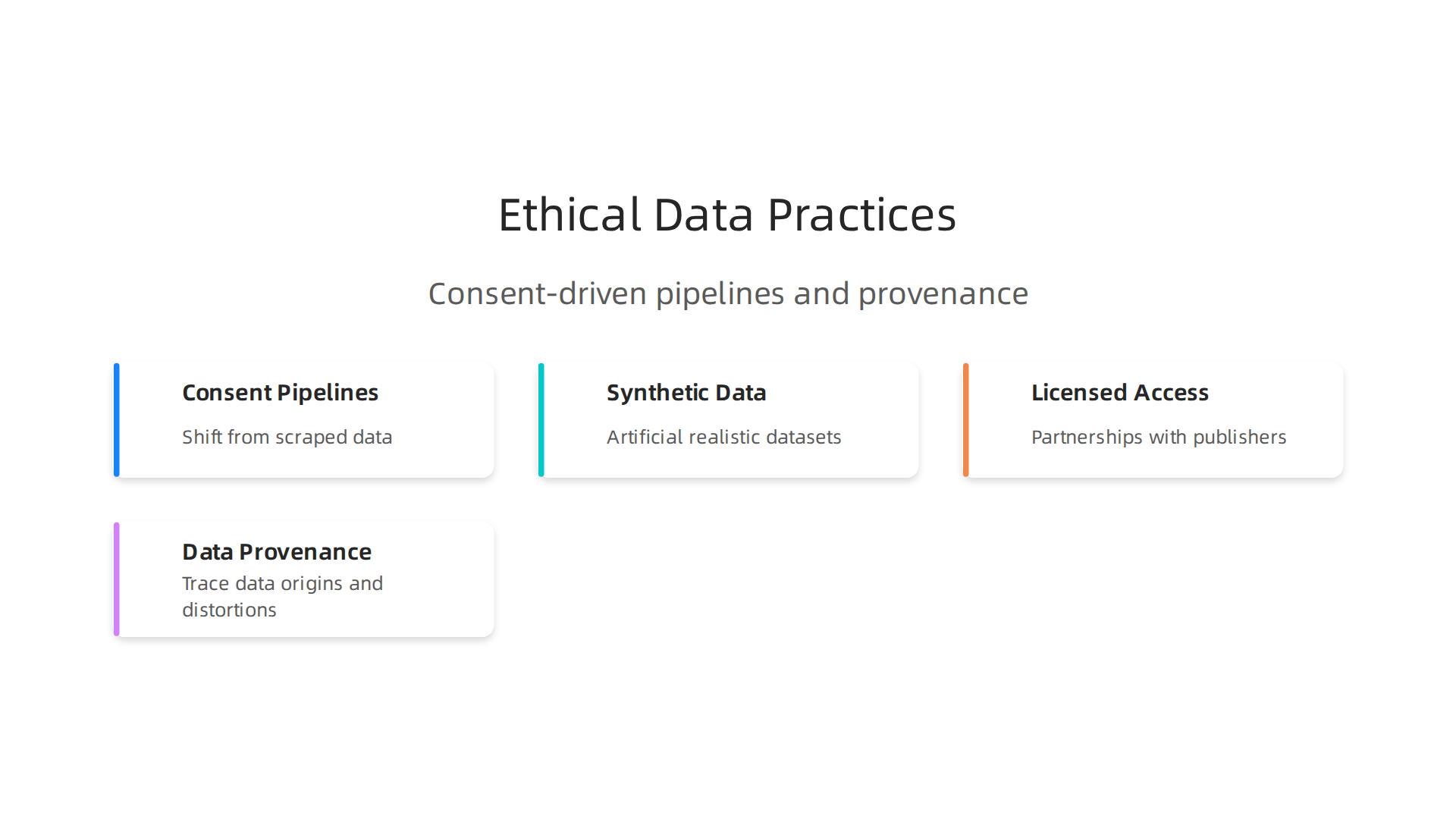
According to a 2026 analysis from ITIF, regulations and transparent standards are now pushing AI developers to respect copyright opt-outs and document where every piece of training data comes from.
The result? The leading ai company in usa will soon be the one that can prove its data is clean, ethical, and permission-based. That is a competitive advantage no amount of computing power can replace.
The Perils of Scraped Public Data
When an ai company in usa builds its model on data scraped from the open web, it might seem like a free and easy source. But there are hidden dangers. Public web data is often distorted, outdated, or legally contested. Much of the content behind popular domains is now restricted by robots.txt or terms of service, as described in a report on how The Data That Powers A.I. Is Disappearing Fast. Meanwhile, synthetic drift accelerates when AI trained on scraped data generates new content that other models then ingest. This creates a feedback loop of misinformation. Regulatory risks are also rising. Under the EU AI Act, developers must disclose training data sources and respect copyright opt-outs. Training AI on personal data scraped from the web can violate GDPR and CCPA. For any ai training company, failing to trace data provenance is no longer just a quality issue. It is a legal liability that demands attention from every responsible ai company in usa.
Permission-Based Data as the New Standard
The solution to scraped data risks is straightforward: build with permission. Consent-driven data collection is quickly becoming the benchmark for any ai company in usa that wants to stay compliant and trustworthy. When people willingly share their data, the quality improves. Models trained on permission-based data suffer less from noise and distortion. Techniques like federated learning and differential privacy make it possible to train powerful models without ever centralizing raw personal information. This protects user privacy while still delivering strong results. The OECD has highlighted the intellectual property issues in artificial intelligence trained on scraped data, reinforcing that permission is the safer path. Enterprises that adopt this approach gain a clear edge. They face fewer legal challenges, earn greater public trust, and build AI systems that better reflect real human behavior. In 2026, permission is not just ethical. It is strategic.
Combating Synthetic Drift: Preserving Truth in AI Systems
Here is a problem you probably have not thought about. As AI-generated content fills the internet, it starts looping back into the training data of future models. This creates a cycle that slowly warps what is true. Researchers call it synthetic drift. You might know it as model collapse. Either way, it is a growing threat to accuracy.
By April 2025, nearly three out of four new web pages already contained AI-written text. That number keeps rising. When an ai company in usa trains its next system on this blended content, the model picks up patterns that are not fully real. Over time, the output drifts further from the truth. The IBM overview of synthetic data and its risks explains that repeatedly training AI on AI-generated data causes performance to drop. The model slowly forgets what the real world actually looks like.
This matters because trust depends on accuracy. If an AI system cannot separate real signals from synthetic noise, it stops being useful. That is why top teams are pushing back with three main strategies.
First, rigorous filtering. Every piece of training data gets screened for signs of synthetic origin before it enters the pipeline. Second, human-in-the-loop validation. Real people check outputs against known facts before those answers reach users. Third, provenance tracking. Teams tag every data point with its source so they can trace exactly where distortions enter the system. Real-world experiments on data drift detection in medical imaging found that watching model performance alone is not enough. You need dedicated drift detectors that catch subtle shifts early.
For any ai training company building serious systems in 2026, synthetic drift is not a future problem. It is happening right now. The teams that invest in detection and validation today will be the ones whose models earn lasting trust. In the race for ai model rankings, truthfulness is becoming the new standard worth chasing.
Understanding Synthetic Drift
You can think of synthetic drift like a game of telephone played across millions of machines. An AI model picks up small biases hidden in its training data. Those distortions show up in the content it creates. That content gets published online. Another model crawls it and treats it as fact. The distortions grow with every cycle.
The Stanford HAI 2026 AI Index Report shows how feedback loops in AI accelerate faster than most teams expect.

A tiny error becomes a massive falsehood within just a few training generations.
Real products show this problem clearly. Chatbots confidently repeat misinformation because their training data contained AI-generated falsehoods. Image generators reinforce stereotypes because biased synthetic images dominated their training sets. Any ai company in usa that ignores this cycle will end up with models that drift further from reality with each update, as the AI statistics and trends for 2026 report confirms.
Methods Top AI Companies Use to Counter Drift
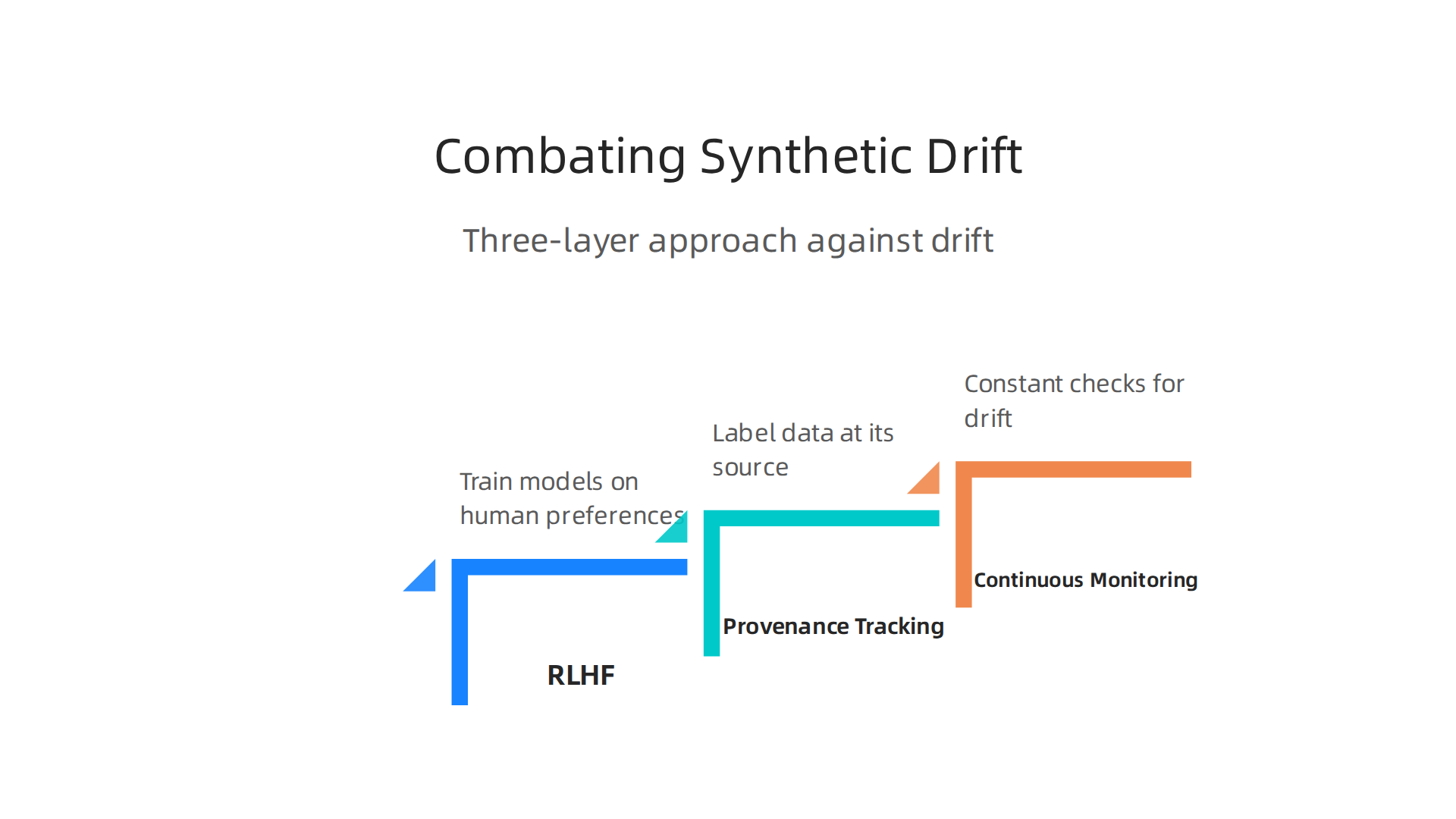
Leading teams fight synthetic drift with a three-layer approach. The first layer is reinforcement learning from human feedback (RLHF). Companies like Anthropic use RLHF to train models on human preferences, not just web text. This helps models recognize and reject distorted patterns before they spread.
The second layer is provenance tracking. Teams now use cryptographic hashing to label every piece of training data at its source. If a dataset contains AI-generated content, the hash flags it so the model knows not to trust it as ground truth.
The third layer is continuous monitoring. Deployed models need constant checks for drift. Teams run red-teaming exercises and automated tests that compare model outputs against trusted real-world benchmarks.
The IBM explainer on synthetic data notes that a healthy mix of real and artificial data is critical to prevent model collapse.
For any AI company in the USA, these three layers are becoming standard practice. Skip one, and your model drifts. Use all three, and you keep your AI honest.
Human-Centric AI: Designing for Trust and Flourishing
Designing AI that people can trust goes beyond technical fixes. Methods like RLHF and provenance tracking stop synthetic drift, but they don't guarantee the AI is actually good for people. In 2026, many systems still optimize for engagement metrics like clicks and watch time. That approach can push harmful content and ignore user wellbeing.
A smart ai company in usa that wants to lead responsibly shifts its focus to human-centric design. This means prioritizing user autonomy and long-term flourishing over short-term engagement.

An approach called the positive alignment framework for human flourishing explains how AI should actively support human growth instead of just avoiding harm. The goal is to create systems that treat people as whole humans, not just data points.
But how do you measure wellbeing? Old metrics like click-through rates don't capture whether someone feels healthier, more connected, or more purposeful. New frameworks are emerging to solve this. For example, the Flourishing AI Benchmark from Gloo evaluates AI on seven human dimensions, including character, relationships, and meaning. Instead of asking "did this keep the user scrolling," it asks "did this help the user flourish."
When an ai training company or any developer adopts these wellbeing indicators, it builds deeper trust with users. The ai model rankings will eventually reflect not just raw intelligence, but how well a system helps people thrive. That shift from engagement to flourishing is what makes human-centric AI truly valuable.
Moving Beyond Engagement Metrics
Here's the problem with engagement metrics. When an ai company in usa optimizes purely for clicks and watch time, it often makes things worse. Research shows this approach can amplify polarization, spike anxiety, and spread misinformation faster than ever.
So what should we measure instead? The answer is flourishing. The State of AI & Human Flourishing 2026 survey found that 79% of Americans report a positive overall influence from AI on their lives. That kind of data tells a much richer story than a click-through rate ever could.
Organizations that care about trust need to adopt new dashboards. Instead of just tracking time on site, they should track user satisfaction, informed decision-making, and genuine social connection. An ai marketing company or any tech leader can build these wellbeing indicators directly into their systems.
The switch is practical. It balances business goals with real human health. And it makes the ai model rankings of tomorrow reflect what actually matters: helping people thrive, not just stay glued to a screen.
Case Studies of Ethical AI Implementation
Real-world examples show that ethical AI is a practical reality. In healthcare, one ai company in usa redesigned its diagnostic tool to include clinician feedback at every stage. The result was higher accuracy and stronger patient trust. This human-centered approach proves that ethical design and good business reinforce each other.
In finance, ethical AI helps reduce bias in lending and insurance. An ai training company here uses fair data to make sure loans reach people who truly need them. That builds community trust and avoids past mistakes.
Governments also lead the way. When public services use transparent AI, citizen satisfaction goes up. The 2026 AI Index Report shows that trust in government AI depends heavily on openness about decisions.
These cases prove that putting people first works. And the ai model rankings of tomorrow will reward this approach over pure engagement.
Corporate Social Responsibility: The New Competitive Advantage
CSR in AI is not just about doing good. It is becoming a real business edge. When an ai company in usa commits to transparency about algorithms, fairness audits, and community engagement, the payoff shows up in trust.
Think about what transparency actually means. Companies that share how their models make decisions earn more confidence from users. They also face fewer regulatory surprises. Regulators watch closely these days. A clear fairness audit process tells everyone the company is serious about treating people right.
Community engagement goes even further. Instead of building AI in a bubble, smart companies invite real people into the conversation. They ask what problems need solving. They test their tools with actual users. This approach turns customers into partners.
The State of AI & Human Flourishing 2026 survey shows that most people report a positive influence from AI in their lives. But trust is fragile. One mistake can undo years of effort. That is why responsible practices matter more than ever.
Investors also pay attention. ESG factors, including ethical AI, now affect how companies are valued. A business that ignores fairness in its algorithms takes a real financial risk. One that embraces it stands out.
The concept of Positive Alignment pushes this idea further. AI systems should actively support human well-being, not just avoid harm. Companies that build toward this goal will lead the pack.
Groups like the Flourishing Network at Harvard are developing frameworks to measure how well AI supports human growth. Early results show that no model performs well across all dimensions of well-being yet. That gap is an opportunity.
For any ai training company or developer, the message is clear. CSR is not a cost. It is a vote of confidence from the public, regulators, and investors. And in a world where ai model rankings start to include ethics alongside raw performance, doing the right thing becomes the smart play.
Transparency and Accountability
Transparency goes beyond good PR. For any ai company in usa, showing how its systems work builds real trust. Publishing algorithmic impact assessments and model cards is becoming standard practice. These documents explain what a model does, what data it uses, and where it might fail. Users and regulators want to see inside the black box.
Independent audits by third-party organizations take this a step further. An outside review adds credibility that a company cannot give itself. It tells the public that someone else checked the work and found it fair.
Regulatory mandates like the EU AI Act are pushing this trend. They require clear documentation of how AI systems make decisions. The 2026 AI Index Report shows that trust in government AI regulation remains low in the US. Companies that step up with their own accountability measures can stand out.
For an ai training company or any developer, documented transparency is no longer optional. It is a basic requirement for staying in the game.
Building Public Trust Through CSR Initiatives
Public trust takes more than clear documentation. It requires action. Many ai company in usa organizations now invest in community engagement programs and AI literacy initiatives to show they care about more than profit.

Open-source contributions also signal goodwill by sharing tools freely with the public.
Partnerships with academic and nonprofit organizations validate these ethical commitments. When a university or research institute co-develops an initiative, it adds a layer of independent credibility that no press release can match. The Flourishing AI Initiative is one example of an effort that evaluates how well AI systems support human wellbeing across multiple dimensions, from happiness to character.
Mistrust does not disappear overnight. It needs consistent, verifiable actions over time. AI literacy workshops, public data transparency, and collaboration with groups like the Flourishing Network can slowly rebuild confidence. An ai marketing company or developer that pairs transparency with genuine community investment stands the best chance of winning back skeptical audiences.
Future Trends: What's Next for AI Companies in the USA?
The AI world in 2026 is changing fast. If you run an ai company in usa, you are probably watching two big shifts headed your way.
First, expect stricter rules. Right now, the regulation of AI in the United States is a patchwork of state laws rather than one federal standard. States like Colorado, California, and Texas have passed their own AI rules covering high-risk systems, training data transparency, and more. The US AI regulations 2026: the state laws you must comply with guide breaks down what each state requires.

Meanwhile, the White House released a National Policy Framework for AI in March 2026, sketching out a unified federal standard that could simplify the current messy picture.

Second, the technology is evolving too. More ai training company teams are investing in explainable AI tools. These help users see how a model reached a specific decision. Federated learning is also gaining steam. It trains models on data that stays on users' devices, which protects privacy and builds trust. For an ai marketing company, these tools make it easier to be open about how customer data is handled.
Here is the bottom line. Companies that wait to act will struggle. Those that invest early in compliance, transparency, and ethical data practices will pull ahead. Building systems people can trust is not optional anymore. It is the smartest move an ai company in usa can make.
Regulatory Developments to Watch
So what rules should you actually keep an eye on? A few big changes are coming fast.
First, the push for more audits is real. Bills like the Algorithmic Accountability Act and state level privacy laws will require you to check your systems for bias and risk much more often. If your ai company in usa hasn't built a solid audit process yet, now is the time.
Second, international rules like the EU AI Act are starting to matter even if you only operate stateside. If you work with European partners or plan to expand, you will face compliance costs but also a chance to stand out as a trusted player. The new state AI laws effective January 1, 2026 show how fast the landscape is shifting.
Third, smart companies are not waiting for the law to force them. They are adopting the NIST AI Risk Management Framework early. That proactive move sets you ahead of competitors and builds confidence with customers who are paying closer attention than ever.
Innovations in Ethical AI
You might be wondering how an ai company in usa can build trust while still moving fast. The old "black box" problem is a real barrier. But a few smart innovations are changing that.
First, explainable AI (XAI) is getting much better. These tools let you look inside a model and actually see why it made a decision. That makes audits easier and keeps regulators happy. With new state laws demanding transparency, this is a must have.
Second, federated learning and edge AI let you train models without moving all the data to one place. That means less risk and better privacy for your users. Your models learn from real activity without ever seeing private records.
Third, neuro-symbolic AI mixes neural networks with symbolic logic. This helps models reason more like humans and drift less over time. It is still early, but it promises stronger, more reliable systems.
If your team is building ethical AI, these tools give you a real edge. The US AI regulations 2026 guide shows how much the rules are tightening. Embracing these innovations now puts you ahead.
Summary
This article gives a practical, evidence‑based overview of the leading AI companies in the United States and the systemic challenges shaping the market in 2026. It explains who the major players are—from foundation‑model builders like OpenAI, Google DeepMind, Microsoft, NVIDIA and IBM to specialized startups—and why specialization and data strategy matter when you choose an AI partner. The piece highlights the core problem of data quality, legal exposure from scraped web data, and the emerging threat of synthetic drift, where AI‑generated content loops back and degrades future models. You'll learn concrete responses firms are using—permission‑based data, synthetic data with provenance, RLHF, cryptographic tagging, and continuous drift detection—as well as why transparency, third‑party audits, and human‑centered metrics are becoming competitive advantages. Finally, the guide outlines regulatory trends and practical steps companies should take now to build trustworthy, compliant AI systems that prioritize user wellbeing over short‑term engagement.
Related Blogs
No Similar Blogs found
