Home


Menu

Close

Pick the Right AI Consulting Business for Trustworthy Enterprise AI in 2026
Published:
August 13, 2026
Artificial intelligence, or AI, is changing how businesses and organizations work in 2026. It promises to make things faster and smarter. But there's a big problem that many groups are facing right now. It's like a traffic jam slowing everything down, and we call it the "AI bottleneck."
The Core Problem: Bad Data and Lost Trust
Imagine AI as a student. For AI to learn well, it needs good, clean study materials, or "training data." The problem is, a lot of AI today learns from "permissionless training data." This means it uses information found online without asking for permission. This data can be messy, wrong, or even made up.
When AI learns from this kind of data, a worrying thing happens called "synthetic drift." Think of it like a game of telephone. As information gets passed around online, it changes little by little. What started as true might end up very different. Synthetic drift is when AI uses this changed or warped information, making its answers less reliable. This causes an erosion of public trust. People start to wonder if they can really believe what AI tells them.
This isn't just about small mistakes. When trust in AI goes down, it can affect important decisions.

It makes it hard for large organizations to use AI effectively. This is where an expert AI consulting business can help.
High Stakes for Big Organizations
For large enterprises, government agencies, and nonprofit groups, solving this AI bottleneck is not just a good idea, it's a must-do.
Their future success depends on it.
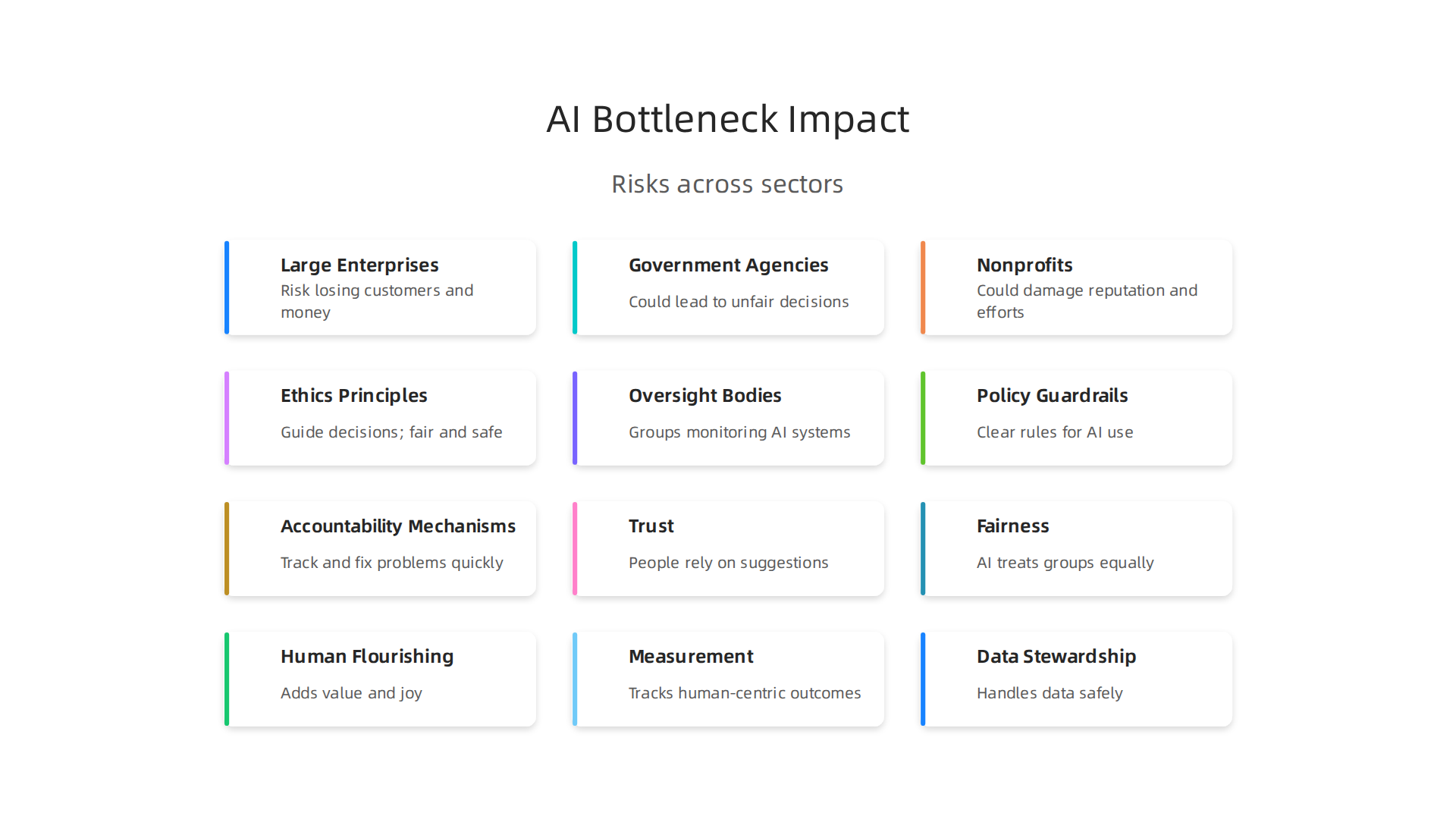
- Large Enterprises: Big companies use AI for many things, from helping customers to making new products. If their AI systems are not trustworthy, they risk losing customers and money. They need to ensure their AI solutions, whether they're using software as a service (SaaS) or platform as a service (PaaS) tools, are built on strong, ethical foundations.
- Government Agencies: These groups use AI for public services, safety, and making important policies. If the AI is based on bad data, it could lead to unfair decisions or even harm.
- Nonprofits: These organizations rely on trust to do their work. If their AI is seen as unreliable, it could damage their reputation and make it harder to help people.
Choosing the right partners is key. When these organizations look for help, they often need to carefully evaluate potential solutions. For example, knowing the important things to look for in an AI partner is crucial for enterprise RFPs, as outlined in guides for 6 AI Vendor Evaluation Dimensions for Enterprise RFPs. This helps them pick ai consulting firms that can truly provide reliable and ethical AI solutions. Failing to fix these data problems now means risking a future where AI does more harm than good, leading to lost money, damaged trust, and missed chances to grow.
The risks from using permissionless data and the ongoing problem of synthetic drift are very real for businesses and other large groups. When AI learns from data it just finds online without clear rules, it can make big mistakes. These mistakes can cause two main kinds of harm: problems with how things work every day, and damage to how people view the organization.
Operational Risks: Running into Trouble
Imagine a big company using AI to help decide who gets a loan or what products to make next. If this AI has learned from faulty or biased data, its decisions will be bad. This leads to:
- Wrong Decisions: AI might suggest bad business choices, costing money or missing good chances.
- Wasted Efforts: Teams might spend a lot of time fixing AI problems that should not have happened in the first place.
- Legal Trouble: If AI makes unfair decisions because of bad data, the company could face lawsuits or have to pay fines. For example, AI might unfairly treat certain groups of people, which is against the law. Ensuring proper data governance for AI is crucial to avoid these outcomes.
Companies that use AI through software as a service (SaaS) or platform as a service (PaaS) tools also need to be careful. Even if they don't build the AI themselves, they are still responsible for the results.
Reputational Risks: Losing People's Trust
When AI makes mistakes or acts unfairly, people quickly lose trust.

This can hurt an organization's good name in many ways:
- Public Backlash: News stories about unfair AI can make customers angry and turn them away.
- Loss of Customers: If people do not trust a company's AI, they might stop using its products or services.
- Damage to Brand: A reputation for untrustworthy AI can be very hard to fix. It makes it harder to attract new customers or talent.
In 2026, the need for trustworthy AI is not just a nice idea; it's essential for survival. This is why many organizations are seeking help from an AI consulting business. These ai consulting firms can guide them in setting up proper rules and systems to make sure their AI acts fairly and reliably. They help make sure that things like generative AI assistants need permissioned private data to avoid synthetic drift, helping to build AI that truly serves its purpose without risking public trust or operational stability.
Building trusted AI means more than just being careful. It means having a clear plan for how AI is used in a big company. This plan is called an AI trust and governance framework. It sets out the rules and steps to make sure AI works well and fairly, and that people can rely on it. Think of it like a rulebook for all AI in your business.
A good AI governance framework, especially in 2026, helps large organizations handle the way AI systems are made, used, watched over, and even retired.
It makes sure these systems are trustworthy, follow rules, and can be checked at every step, from the very start of an idea to when they are no longer needed AI governance 101 what every enterprise needs to know in 2026.
Core Parts of an AI Governance Framework
To build a strong framework, you need a few key parts:
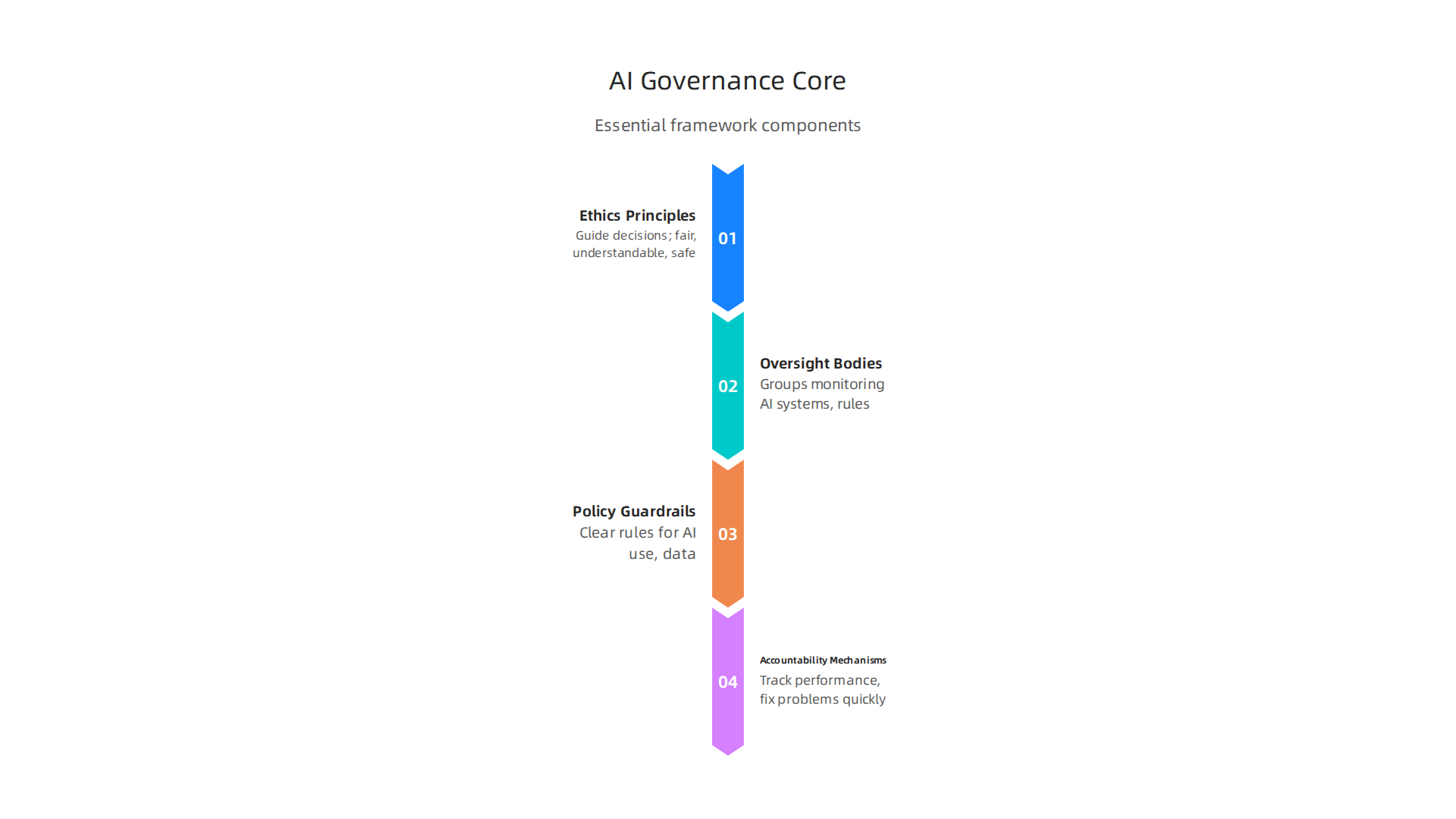
- Ethics Principles: These are the main ideas about what is right and fair for AI. They help guide all decisions. For example, AI should be fair to everyone, easy to understand, and always used in a way that keeps people safe.
- Oversight Bodies: These are groups of people who watch over the AI systems. They might be special committees or teams inside the company that make sure the rules are followed. They help decide if an AI project is good to go or needs more work.
- Policy Guardrails: These are the clear rules and limits for how AI is used. They cover things like how data is collected, how AI models are tested to avoid mistakes, and what steps to take before an AI system can start working for real.
- Accountability Mechanisms: These are ways to check if the AI is doing what it's supposed to and who is responsible if something goes wrong. This includes tracking how AI performs and having plans to fix problems quickly.
Having these parts helps organizations to ensure their building trustworthy AI combat synthetic drift with ethical data efforts are effective and long-lasting.
How Governance Works with Other Business Areas
An AI governance framework doesn't just sit by itself. It connects with many other parts of a large organization:
- Procurement: When a company buys new AI tools or
software as a service(SaaS) orplatform as a service(PaaS) from other companies, the framework helps make sure these new tools fit the rules. It prevents buying tools that might cause problems later on. - Vendor Oversight: Many companies work with outside
ai consulting firmsor other vendors to develop or manage their AI. The framework helps keep an eye on these partners. It ensures they follow the same ethical rules and standards for data and AI use. This way, the company stays protected even when others are helping. - Regulatory Compliance: Governments around the world are making new laws about AI. An AI governance framework helps companies make sure all their AI systems follow these laws, like the NIST AI Risk Management Framework, which is a common guide in the US for managing AI risks in 2026 Enterprise AI Governance Framework: 2026 Leader's Guide.
By building a strong AI governance framework, large organizations can manage risks better and build trust with their customers and the public. It's a smart way to make sure AI works for everyone's good.
Making sure AI works well and is trusted also means being very careful with the information it learns from. This is where "permissioned data" comes in. It's about building training datasets where you have clear permission to use the data. This helps keep things private and ethical.
Principles for Permissioned Datasets
When creating data for AI, think about these main ideas:
- Privacy First: Always put people's privacy at the top of the list.

This means collecting only the data you need and keeping it safe.
- Clear Consent: You must ask people nicely and clearly if you can use their data. They need to understand what you're using it for and agree to it. This is like getting a "yes" before you use someone's toy.
- Fair Use: Use the data in a way that is fair and doesn't hurt anyone. This goes hand-in-hand with the ethics principles mentioned earlier.
For companies, this means setting up clear rules about how data is handled. It helps to avoid problems later on, building trust with customers. Many ai consulting firms can help businesses set up these strict privacy rules for their data.
Roles, Consent, and Keeping Data Good
To manage permissioned data, big companies need special roles and good ways to work.
Data Stewardship Roles
Someone needs to be in charge of the data, like a librarian for information. This person or team is called "data stewards." They make sure the data is accurate, complete, and used correctly, always following the rules you set for privacy and ethics. Good data stewardship best practices for enterprise teams are very important in 2026 to ensure data is trustworthy. Assigning these roles early helps prevent issues before they become big problems.
Consent Models
Getting permission isn't a one-time thing. It's an ongoing process. Consent models are the different ways you ask for and manage permission from people for their data. This can include:
- Express Consent: When someone clearly says "yes" or ticks a box to agree.
- Implied Consent: When someone does something that naturally shows they agree, like using a service after reading the rules. But for AI, explicit "yes" is usually better.
It's vital to have systems that track who gave permission, for what, and for how long. This helps AI systems avoid using data in ways people didn't agree to, supporting the need for generative AI assistants to use permissioned private data.
Technical Approaches for Quality and Provenance
Even with permission, data needs to be high-quality and reliable.
- Provenance: This means knowing exactly where every piece of data came from. Was it collected from a customer survey? Was it given by a partner? Tracking this helps ensure the data is legal and proper to use. The CIO's playbook for enterprise AI strategy in 2026 highlights the importance of lineage and provenance to show where data came from and how it changed The CIO's Playbook for Enterprise AI Strategy in 2026.
- Quality: Making sure the data is correct and useful. This means checking for mistakes and making sure it's up-to-date. Bad data leads to bad AI decisions.
Companies often use special tools, sometimes as software as a service (SaaS) or platform as a service (PaaS), to help manage all this data. These tools can automate tracking permissions, checking data quality, and making sure all rules are followed. For complex setups, an ai consulting business might be hired to put these systems in place.
Building permissioned datasets with strong privacy and ethical guidelines is a core part of making AI trustworthy and responsible.
Building permissioned datasets with strong privacy and ethical guidelines is a core part of making AI trustworthy and responsible. But creating the data is just one step. For AI to truly help a company, it needs to be put into action carefully. This is where everyone in the company has to work together, from the people who build AI to those who make sure it's fair and legal. It's about smart planning, good tools, and making sure all teams are on the same page.
Integrating AI Responsibly: Change Management, Tooling, and Cross-Functional Adoption
Bringing AI into a company's daily work is a big change. It's not just about new tech, but also about how people work and make decisions. This is often called "change management." To make sure AI works well and is used wisely, different teams need to connect and understand each other's roles.
Aligning Teams for AI Rollout
Imagine a car. The engine (engineering) makes it go. The design (product) makes it look good and easy to use. The rules of the road (legal) keep everyone safe, and a good driver (ethics) makes sure the car is used for good things. For AI, all these parts need to work together smoothly.
- Engineering Teams: They build the AI models and make sure they run correctly. They need to understand the rules around data privacy and ethics.
- Product Teams: They decide what problems AI should solve for customers. They need to ensure the AI creates a good and fair experience.
- Legal Teams: They make sure the AI follows all laws, especially about privacy and how data is used. They help set the boundaries.
- Ethics Teams: These teams, or people, check that the AI is fair, unbiased, and doesn't cause harm. They often look at the bigger picture of how AI affects people.
When these teams talk and plan together from the very start, it helps avoid problems later.

It means thinking about ethics and rules, not just how powerful the AI is. For many companies, having a Trust First AI Strategy in 2026 is no longer an option, but a must-do.
Recommended Tools and Adoption Plans
Getting AI ready for use involves more than just team meetings. Companies need the right tools and a smart plan to roll out AI without too many risks.
- Toolchains and MLOps: These are like special toolboxes and ways of working for AI. "MLOps" stands for Machine Learning Operations. It helps teams build, test, and update AI models in a reliable way. These tools can make sure AI models are kept safe, work as expected, and can be changed easily when needed. Many companies use modern tools, often provided as
software as a service(SaaS) orplatform as a service(PaaS), to help manage their AI pipelines. - Phased Adoption: Instead of trying to put AI everywhere at once, it's smarter to do it step by step. This is called "phased adoption." You might start with a small test project, often called a "pilot," to see how the AI works and fix any issues. For example, large organizations typically take 3-6 months for a pilot project before a larger rollout Enterprise AI Adoption in 2026. This helps reduce big risks. Once a pilot is successful, you can then slowly bring AI to more parts of the company.
Finding the right way to integrate AI can be tricky, especially for big companies. This is where an ai consulting business can be very helpful. These ai consulting firms often have special knowledge about setting up AI in a safe and responsible way, helping companies pick the right tools and create a clear plan. They can guide businesses through the complexities of AI adoption, making sure it aligns with company values and rules.
Bringing AI into a company is a big deal. It's not enough for AI to just be fast or smart at its tasks. We also need to make sure it's doing good things for people and society. This means looking beyond simple measures like "accuracy" and thinking about how AI affects human feelings and lives.
Measuring human-centric outcomes: metrics beyond accuracy
When we think about AI working well, we usually think about how good it is at a certain job. For example, how well it can guess the weather or find a mistake in a factory. This is called "accuracy." But for AI to be truly helpful and responsible, we need to measure other things too. These are called "human-centric outcomes." They focus on how AI impacts people directly.
Here are some important things to measure:
- Trust: Do people trust the AI? This is super important. If people don't trust an AI system, they won't use it, or they might not believe what it tells them. We can measure trust by seeing if people rely on the AI's suggestions or if they accept its decisions. Researchers also look at how reliable an AI system is over time to build trust.
- Fairness: Is the AI fair to everyone? AI systems should not treat some groups of people better or worse than others. This means the AI should not have "bias." For example, an AI that helps approve loans should not make it harder for people from certain backgrounds to get a loan. There are many ways to check for fairness, like making sure the AI's mistakes are equally spread across different groups, not just affecting one group more often. In fact, experts have identified many different ways to measure fairness, like looking at how often different groups get positive results from the AI or how often the AI makes errors for those groups.
- Human Flourishing: Does the AI help people live better lives? This is about more than just avoiding harm. It's about seeing if the AI actually adds value and joy to people's daily work or personal lives. Does it reduce stress? Does it help them learn new things? This can be tricky to measure, but it's a key part of ethical AI.
- Societal Impact: How does the AI affect our communities and the world around us? This big picture view helps us understand if the AI is making society better. For instance, an AI that helps doctors might not just improve health for one person but could also help many people in a community.
Turning Feelings into Numbers: KPIs and SLAs
It can feel hard to measure things like "trust" or "fairness" because they are not simple numbers. But for businesses, these important ideas need to become clear goals. We call these goals Key Performance Indicators (KPIs). They are like scores that show how well the AI is doing in these human-centric areas.
For example, a company might set a KPI that says, "90% of users report feeling confident in the AI's advice after one month." Or, "The AI system must show equal error rates across all demographic groups."
These KPIs can then become part of Service Level Agreements (SLAs). These are formal promises that define what an AI system should do and how well it should perform. By putting human-centric goals into KPIs and SLAs, companies make sure they are serious about ethical and responsible AI. They help make sure the AI is not just accurate, but also trustworthy and fair, contributing to how ethical data analysis builds trust in AI.
Sometimes, figuring out how to turn these big ideas into numbers is tough. That's where an ai consulting business can step in. Expert ai consulting firms can help companies set up these special ways of measuring AI success, making sure that AI benefits everyone. Looking at the different ways to check if AI is trustworthy is a task many groups are focusing on in 2026, finding that ethical AI needs more than just simple checks.
Picking the right ai consulting business is a very important step. It's like choosing a guide for a big journey. You need a guide who not only knows the way but also cares about your safety and goals. When companies want to bring in AI, especially AI that focuses on human well-being, they often ask many ai consulting firms to show what they can do. This process is called a Request for Proposal, or RFP. It's how businesses officially ask for help and compare different companies.
When you're looking for an ai consulting business, you should ask them about more than just how smart their AI is. You want to make sure they can help you build AI that's good for people. Here are some key things to look for when you're evaluating different firms:
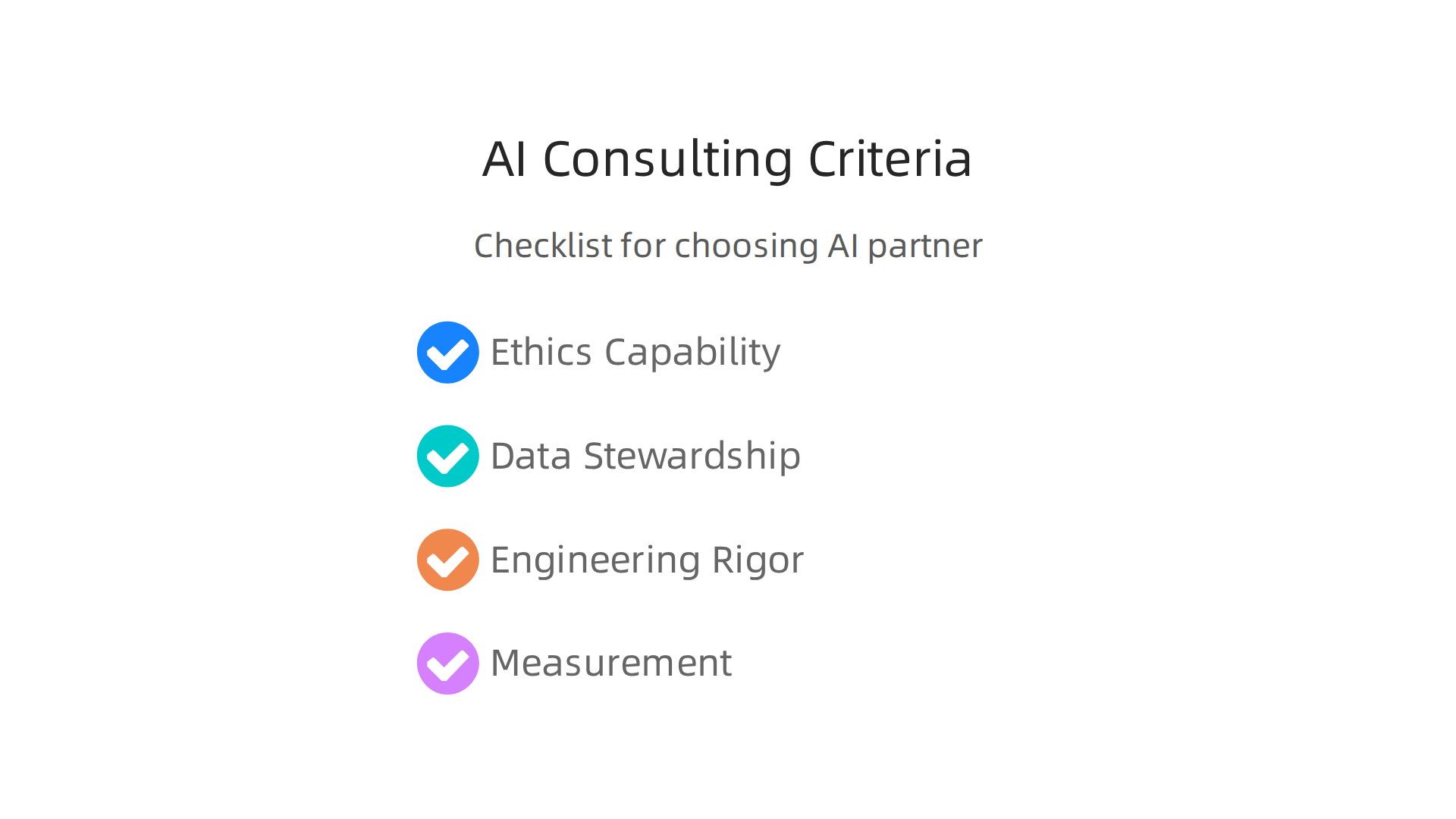
What to Look For in an AI Consulting Business
- Ethics Capability: Can the
ai consulting businessprove they understand and can build AI that is fair and good? Do they have clear ideas about how to avoid bias or treat all users equally? Ask them how they plan to ensure your AI will be ethical. - Data Stewardship: How will they handle your data? Data is super important for AI, and it needs to be protected. A good
ai consulting firmshould have strong rules for keeping data safe and private. They should also explain how they make sure the data used for AI training is fair and not misleading. This helps build trustworthy AI systems. - Engineering Rigor: This means how well they build their AI systems. Are their systems strong, reliable, and easy to fix if something goes wrong? They should show that their work is built on solid technical skills, whether they are making custom
software as a serviceor helping you set up aplatform as a service. - Measurement: Can they actually measure how well the AI is doing in terms of human-centric outcomes, like trust and fairness? As we talked about before, it's not just about accuracy. They should have a clear plan for how they will track these important goals. Experts suggest that a good RFP should include a clear measurement plan for the AI's impact and value 1.
Making a Good Contract
Once you pick an ai consulting business, the contract is very important. It's not just about how much you pay. The contract should make sure that the ai consulting business has the same goals as you. This means including special terms about those human-centric outcomes.
For example, your contract can use those Key Performance Indicators (KPIs) we talked about earlier. You can make sure the ai consulting firm promises to meet certain levels of trust, fairness, or positive impact on users. This helps align everyone to the goal of building responsible AI. You can also define what happens if the AI doesn't meet these human-centered goals. This protects your company and makes sure the AI works for everyone. Working with a specialized ai consulting business can help secure truly trustworthy enterprise AI.
It's all about making sure that the AI is not just smart, but also kind and helpful.
Summary
This article explains the 2026