Home


Menu

Close
Master Network Security for AI Systems: Protect Data Integrity
Published:
September 20, 2026
Why Network Security Matters Now (Especially for AI-driven Organizations)
Think about all the important information your company uses every day. Now, imagine a smart computer system, like AI, helping with that information. For big companies using AI in 2026, keeping their computer networks safe is more important than ever. Why? Because if the network isn't secure, bad things can happen that hurt both your data and how people trust your company.

A weak spot in your network can be like leaving a door unlocked. If someone gets in, they can mess with your data. For AI systems, this means they might learn from wrong or changed information. This can lead to what we call "Synthetic Drift," where the AI starts making bad choices because its understanding of truth is distorted. This is a big problem because it makes your AI less useful and people will stop trusting it. Laws like the Regulatory Guidelines for Government Information Security Management and policies for Architecture and Network Security are put in place to help prevent these issues, showing how vital security is for all organizations.
Without a strong network security key, your company's valuable information, including sensitive data used by AI, is at risk. This is why having good data security is key. When your network has holes, cyber attackers can find what are often called OWASP Top 10 vulnerabilities. These are common weaknesses that can let them steal or change your data. For example, the Technology and Cyber Risk Management Guidelines explain that network security protects computer networks from unwanted access and attacks. Strong defenses, including good DLP cyber security (Data Loss Prevention), are needed to keep your important information safe.
This article will help you understand the basics of network security. We will share easy-to-follow steps and practical controls you can use. Our goal is to give large organizations a clear plan to build and maintain a strong network security key and keep their AI systems safe. We'll show you how to better manage AI security challenges building trust for large organizations in today's digital world.
How Network Security Intersects with AI and Data Integrity
Your company's AI systems rely on good, clean information. If the computer network that handles this information isn't safe, it can cause big problems for the AI. Think of it this way: a weak network can mess up the data even before the AI sees it.
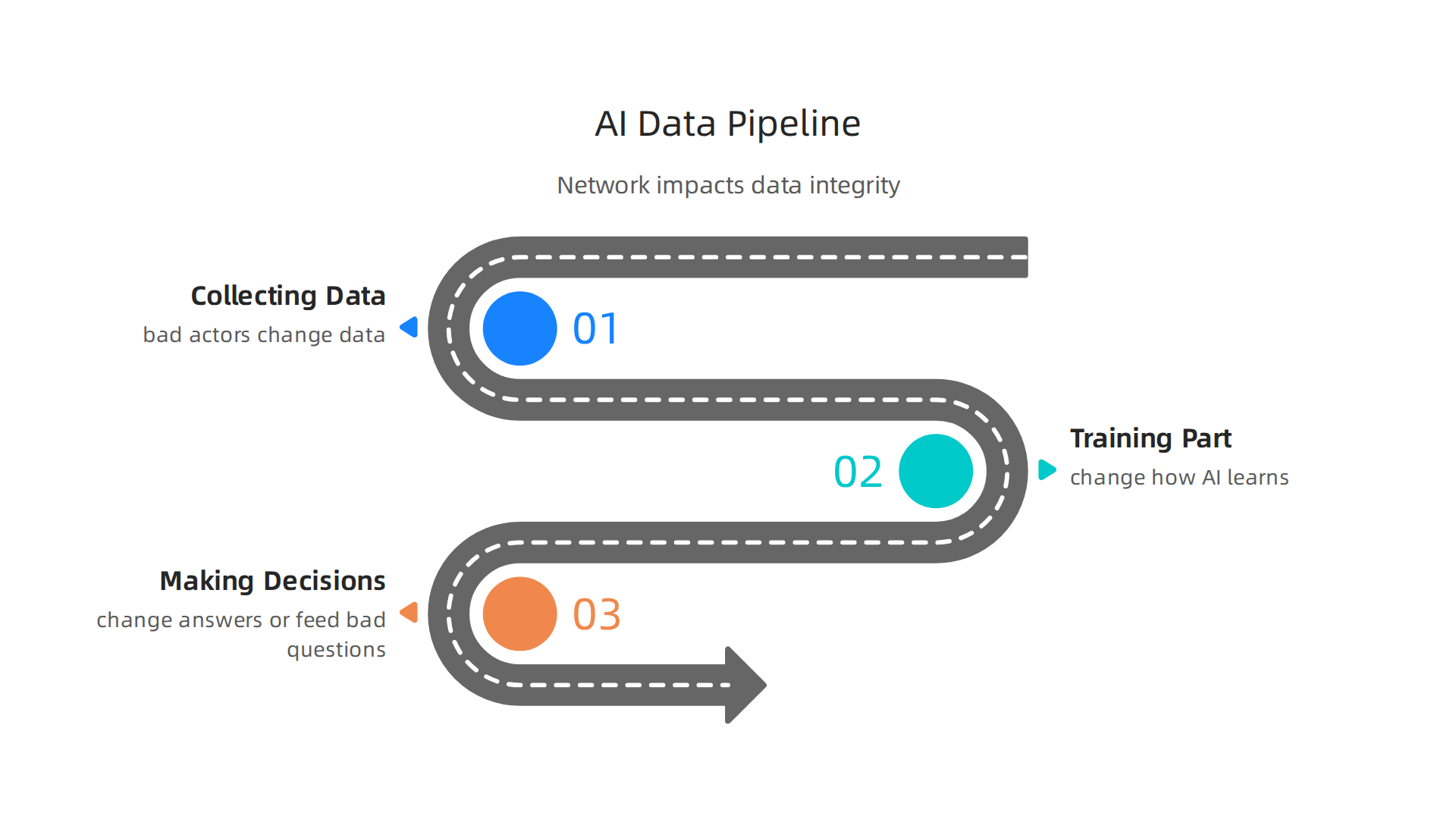
This can happen at every step where AI uses data: when it collects information, when it learns from that information (training), and when it uses what it learned to make decisions (inference).
First, let's talk about collecting data. AI systems need a lot of data to work well. If your network isn't secure, bad actors can get in and change the data as it's being gathered. This means the AI might start with wrong or dirty data. Imagine an AI meant to help people, but it learns from information that has been twisted or even made up. This bad start means the AI will never be truly helpful. To prevent this, it's wise to make sure data sources are checked and that information is kept secret when it moves or rests, meaning it's encrypted at rest and in transit.
Next is the training part. This is where the AI learns patterns and makes sense of the data. If the network allows someone to sneak in during training, they can change how the AI learns. This can make the AI faulty, causing it to misunderstand important facts. Experts suggest setting up special, separate areas on your network for AI training. These "zones" act like separate rooms, keeping sensitive training safe from general network traffic and outside threats. For example, some best practices recommend separating training environments from inference points using network segmentation and restricting storage access to only approved computing resources Secure LLM Infrastructure: Data Protection and Compliance for .... This is a crucial part of having a strong network security key.
Finally, when the AI is used to make decisions (inference), network weaknesses can still cause harm. If an attacker can get into the network where the AI gives its answers, they could change those answers or feed the AI bad questions. This would lead to wrong decisions being made by the AI. Keeping AI workloads isolated in dedicated network areas is a smart move. Virtual Private Clouds (VPCs) can keep your AI safe from the public internet, protecting important data and models from unwanted access and attacks, according to Generative AI security best practices.
When a network is not secure, it makes it easier for problems like "Synthetic Drift" to happen. This is a big name for when AI systems start making bad choices because their understanding of the real world gets skewed by misinformation or manipulated data. Network problems speed up this process, leading to AI systems that cannot be trusted and spread incorrect information. Building trustworthy AI requires not just secure networks but also focusing on overcoming synthetic drift building trustworthy AI through careful data handling and strong security practices. Protecting the journey of data through the network is as important as protecting the AI itself.
Core Principles of Network Security Every Team Should Adopt
A strong network security key is vital for your company, especially when working with AI. As we talked about before, a weak network can mess up your data and make your AI untrustworthy. To build truly reliable AI systems, every team needs to understand and use some basic rules for keeping networks safe.

These rules act like the foundation of a secure building.
The Big Three: CIA
These three ideas are the most important in data security:
- Confidentiality: This means keeping secrets. Only people or systems that are allowed should be able to see important information. Think of it like a locked diary; only you can read it.
- Integrity: This is about keeping information correct and complete. No one should be able to change data without permission. If data gets changed accidentally or on purpose, it loses its truth.
- Availability: This means that your systems and data should always be there when you need them. If a server goes down or an important file can't be reached, it breaks this rule.
These three work together to protect your digital world. You can learn more about how this works for AI systems by reading about the How the CIA Triad Cyber Security Model Protects AI Systems in 2026.
More Important Rules
Beyond the big three, other rules help keep things safe:
- Least Privilege: This simple rule means you should only give people or systems the minimum access they need to do their job, and nothing more. For example, a customer service person doesn't need to see everyone's paychecks. This greatly reduces risks.
- Defense-in-Depth: Imagine a castle with many walls, moats, and guards. That's defense-in-depth. It means having many layers of security, so if one layer fails, another one can catch the problem. Modern network security often combines tools like firewalls and network segmentation to create these layers, making your
network security keyharder to crack Network Security Fundamentals in 2026: Protocols, Firewalls .... - Secure-by-Design: This means building security right into your systems from the very beginning, instead of trying to add it later. It's like building a house with strong locks and alarms already in the plans, rather than adding them after the house is built. This helps avoid common mistakes and weaknesses, sometimes called
owasp top 10 vulnerabilities.
Putting Principles into Practice
Knowing these rules is one thing; using them is another. Here are some practical ways teams can adopt them in 2026:
- Policy Alignment: Your company's security rules need to match its overall goals. Everyone should know what the rules are and why they matter.
- Role-Based Access: This ties into least privilege. Instead of giving everyone the same access, you give it based on what their job role is. For example, the finance team gets access to financial data, but the marketing team does not. This also helps with
data securityby controlling who can see what. You can find more details on how to control access and protect data in a Security Classification Guide Master Data Protection and AI Access. - Network Segmentation: This means dividing your network into smaller, separate parts. Each part can have its own
network security keyand rules. If an attacker gets into one part, it's harder for them to move to other parts. This is a very powerful way to limit damage. Many experts suggest a "deny by default" approach, meaning traffic between segments is blocked unless it's specifically allowed Network Segmentation Against Ransomware: 13 Steps [2026]. - Zero Trust: This is a popular modern idea that brings many of these principles together. It means "never trust, always verify." No one, inside or outside your network, is trusted by default. Every person and device must prove they are who they say they are and that they have permission for what they want to do A Systematic Literature Review on the Implementation and .... This makes your network much safer.
- DLP Cyber Security: Data Loss Prevention (DLP) tools help watch and control where sensitive information goes. They stop important data from accidentally or purposely leaving the company's network.
Even with the best rules and tools like DLP Cyber Security, companies still face many dangers. Bad actors are always trying to break into networks and mess with data. It's like having a strong lock (your network security key) on your door, but someone tries to trick you into opening it or finds a hidden window. For companies using AI, these threats can be even more serious because they can make your AI models untrustworthy.
Here are some common ways attackers try to cause problems:
Phishing and Spear-Phishing
Imagine getting an email that looks real, maybe from your boss or your bank, asking you to click a link or give your password. That's phishing. Attackers use these tricks to steal your login details or put bad software on your computer. Spear-phishing is the same idea, but it's aimed at specific people and is often much trickier to spot because it's so personalized. In 2026, phishing remains one of the most common types of attacks reported Global Cybersecurity Outlook 2026 - World Economic Forum. These attacks aim to get around your network security key by fooling the human element.
Lateral Movement
Once an attacker gets inside a network, they don't usually stop there. They try to move deeper, from one computer or part of the network to another. This is called lateral movement. They might use stolen passwords or find weak spots to get to more important data or systems. This is why tools that divide networks into smaller parts are so important. It helps contain the damage if someone gets in. The goal is often to find your most valuable data security assets. You can learn more about protecting your systems by building a Mastering Cybersecurity Threats to AI Systems in 2026.
DDoS Attacks
DDoS stands for Distributed Denial of Service. Think of it like a huge crowd blocking the entrance to a store so no real customers can get in. A DDoS attack floods a network or a website with so much fake traffic that real users can't access it. This breaks the "Availability" rule we talked about earlier. These attacks can stop businesses from working and cost a lot of money. In the first half of 2026, network-layer DDoS attacks increased by over 36% compared to the previous year Radware H1 2026 Global Threat Report Shows Web DDoS Attacks.
Supply-Chain Attacks
This is when attackers target a company by attacking one of its partners or suppliers. Imagine you buy parts for your car from a trusted company, but a bad actor puts a faulty part into that company's supply line. For AI, this means attackers might put harmful code into software used to build AI, or into the data used to train it. The goal is to compromise the AI even before it's finished. This kind of attack is a big risk for many companies in 2026 Artificial intelligence and machine learning Supply chain risks and ....
Model and Data Poisoning
These attacks are very specific to AI systems.
- Data Poisoning: Attackers feed bad or biased data into an AI model during its training phase. This makes the AI learn wrong things, leading to incorrect or unfair decisions later on. It's like teaching a student with a textbook full of mistakes. This can really hurt the integrity of your AI. Poisoned data can cause an AI to misclassify things or make existing biases worse Securing the AI supply chain: Mitigating vulnerabilities in ....
- Model Poisoning: This is when the AI model itself is changed in a harmful way. Attackers might add hidden "backdoors" that they can use later, or make the model perform poorly under certain conditions. This can make an AI completely unreliable. For instance, attackers might change a model's architecture or embed triggers during training to create backdoors SC_report_structure_v5.
These types of attacks are especially dangerous for AI because they directly mess with the core of how AI works: its data and its learning process. They can lead to AI systems that are biased, unreliable, or even dangerous. This makes addressing potential weaknesses and common owasp top 10 vulnerabilities in AI systems more important than ever. Companies need to be ready for these threats to ensure their AI stays trustworthy.
Network Security Architecture and Technical Controls
After understanding the many ways attackers can cause problems, it's clear that companies need strong defenses. To make sure AI systems are safe and trustworthy, we must build a solid network security key from the ground up. This means using smart designs and tools to protect your networks and the valuable data security within them.
Strong Defenses at Every Turn
Think of your company's network like a busy city. You need good roads, clear signs, and police everywhere, not just at the city limits. Here's how businesses are setting up their network security in 2026:
-
Perimeter Defenses and Next-Gen Firewalls: These are like the city's gates and guards. They check everyone trying to come in or go out. Next-generation firewalls (NGFWs) are super smart. They do more than just block bad websites. They can look inside network traffic to spot tricky attacks that older firewalls might miss. These firewalls are a key part of protecting your network, creating strong borders to keep threats out, as highlighted in a 2026 guide on Enterprise Network Security 2026: SASE, ZTNA & NDR ....
-
Micro-segmentation: This is like dividing your city into many small, walled neighborhoods. If an attacker gets into one neighborhood, they can't easily jump to another. Instead of one big network, companies break it into tiny pieces. Each piece has its own rules about who or what can access it. This limits how much an attacker can move around if they get past the initial
network security key. Experts agree that micro-segmentation helps protect applications, workloads, and devices by isolating them, according to Zero Trust Microsegmentation Guidance. This approach greatly improvesdata security. -
Zero Trust Network Access (ZTNA): This is a new way of thinking: "never trust, always verify." With ZTNA, no one or no device is trusted by default, even if they are already inside the network. Every single request for access must be checked and approved. This is different from old VPNs (Virtual Private Networks) that gave broad access. ZTNA gives users only the exact access they need for a specific task, and for a limited time. It's a key part of modern network security fundamentals in 2026, replacing broad VPN access with identity-aware ZTNA, as explained by Network Security Fundamentals in 2026: Protocols, Firewalls .... For more on keeping your systems safe, check out how the CIA triad cyber security model protects AI systems in 2026.
-
Network Telemetry: This means constantly watching and logging everything that happens on your network. Imagine security cameras and sensors everywhere in your city, recording all activity. Telemetry collects data on network traffic, device behavior, and user actions. This helps security teams spot anything unusual or suspicious quickly. This continuous monitoring is a core part of
dlp cyber securityand supports the "verify explicitly" principle of Zero Trust, according to the Zero Trust Implementation Guideline Primer.
Choosing the Right Controls
Picking the best security tools is not a one-size-fits-all job. Companies must look at:
- Their Risk Profile: What kind of data do they have? How critical are their systems? A bank will need different levels of security than a small blog. High-value data, like that used in AI models, needs the strongest protection.
- Operational Constraints: What can the company afford? Do they have enough trained staff to manage complex systems? Security solutions need to fit into how the business already works without slowing it down too much.
In 2026, many organizations are working on building these strong Zero Trust frameworks, moving past basic steps like segmentation and identity management, as described in the State of Network Security 2026. It's about finding the right mix of technology and people to keep your network, data, and AI systems safe and trustworthy.
Putting the right technical defenses in place is only half the battle. To truly protect valuable information and ensure AI systems are trustworthy, large companies and government agencies need clear rules and smart ways of working. This is where good governance, strong policies, and solid everyday practices come in.

Governance, Policy, and Operational Best Practices for Large Enterprises & Agencies
Imagine our city from before. Even with the best gates and guards, you still need laws, a city council, and emergency services that know what to do. The same is true for cybersecurity. In 2026, big organizations focus on these key areas to make their network security key strong:
Clear Rules and Responsibilities
- Who Does What: Everyone needs to know their part in keeping things safe. This means clearly writing down who is in charge of security, who manages risks, and who makes sure the rules are followed. Without clear roles, things can get missed, leaving gaps in your
data security. The board of directors often plays a key role in reviewing incident response plans, as noted in a 2026 guide on The Board's Role in Cyber Incident Response. - Data Access Policies: These rules decide who can see what information and how they can use it. For example, not everyone needs to see sensitive customer data. Strict access rules help prevent unauthorized use and are vital for protecting your data. This is especially important for
data securityin AI systems that handle a lot of personal information. You can learn more about protecting personal information with a security classification guide to master data protection and AI access. - Vendor Management: Most companies work with outside businesses for different services. These partners might have access to your networks or data. Good practices include checking their security, making sure they follow your rules, and having clear contracts about how they protect your information.
- Audits and Compliance: This means regularly checking if everyone is actually following the security rules and if the rules meet official standards or laws. Many government agencies have specific guidelines they must follow, like the Regulatory Guidelines for Government Information Security Management or the Protective Security Policy Framework. Regular checks help find weaknesses, like potential
owasp top 10 vulnerabilities, before attackers do.
Handling Security Incidents
Even with the best defenses and rules, problems can still happen. So, companies need a plan for when something goes wrong.
- Incident Response: This is a step-by-step plan for what to do if there's a cyberattack or data breach. It covers how to find the problem, stop it, fix the damage, and learn from it. A good plan means reacting fast and reducing harm. Many organizations are improving their incident response, but a survey showed that 73% of them don't feel fully ready, as reported in 73% of Organizations Say They Are Not Fully Ready for a .... Having a clear plan is a strong
network security keyfor quick recovery. - Tabletop Exercises: These are like practice drills for a real emergency. Key people sit down and talk through a fake cyberattack scenario. They decide who does what and how they would communicate. This helps them find any gaps in their plan before a real event occurs. These exercises are very helpful for transforming how ready a company is to respond to problems, according to How Tabletop Exercises Transform Incident Response Readiness.
- Teamwork with Legal and Privacy: If there's a data breach, it's not just a technology problem. Legal teams need to know about laws and rules, and privacy teams need to protect people's personal information. These groups must work together closely from the very start. This coordination is important for managing things like
dlp cyber securityto stop sensitive data from leaving the company in unauthorized ways.
By having strong governance, clear policies, and practicing for bad events, large organizations can build more secure and trustworthy systems. This protects not just their data, but also the trust people place in their AI.
Building secure and trustworthy systems for AI is a big job. After setting up good rules and plans, the next step is making sure the AI's actual parts are safe on the network. Think of it like making sure not just a city has laws, but that each house has a strong lock and alarm system. For AI, this means protecting the data it uses and the models it runs every day.
Practical Controls for AI Networks
In 2026, large organizations use special ways to protect their AI systems. This includes making sure data and models are kept safe, checking who uses them, and seeing how they work.
-
Network Isolation for Data and Models: One key part of protecting AI is keeping its data and models separate from other parts of the company's network. This is called network isolation. Imagine having special, locked rooms for your most important AI data. Experts suggest creating different "zones" for different parts of AI work: one for raw data, one for training, and one for running the finished AI models. This way, if one part is attacked, the others are safer. This is a crucial
network security keyfor AI systems, helping to isolate AI workloads in dedicated network zones according to experts at Obsidian Security, and is also recommended by the OWASP Cheat Sheet Series for Secure AI Model Ops. Companies often use private network environments to deploy their AI models securely. -
Authenticated Model Endpoints and Rate-Limiting: When AI models are ready to be used, they often have "endpoints" where other systems can send them questions or data. These endpoints need strong locks. This means only allowed users or systems can talk to the AI model, which is called "authenticated access." Every request to the AI model should be checked to make sure it is coming from a trusted source, and all access should be logged. This is very important for services that use sensitive information, like medical AI, where every request must be authenticated, authorized, and logged for patient data. It is also smart to limit how many requests can come in at once. This "rate-limiting" helps stop attackers from flooding the system. This type of network attack has increased, with network DDoS attacks jumping more than 110% in the first half of 2026 compared to the previous year, as reported by Radware's H1 2026 Global Threat Report.
-
Telemetry for Model Inputs and Outputs: Keeping a close eye on what data goes into and comes out of the AI model, known as "telemetry," helps spot anything unusual. This watchful eye is another important
network security key. Checking these inputs and outputs can help identify odd behaviors, which might mean someone is trying to mess with the AI.
Keeping Data True: Provenance and Consent Controls
Ensuring data security for AI also means knowing where the data came from and if it is allowed to be used. This is called "data provenance" and "consent controls." Imagine a library where every book has a clear label showing who wrote it and if you are allowed to read it. For AI, this means tracking data from its start, through all the steps it takes, until it is used in a model. When people give their personal information, they should agree to how it is used. Making sure these rules are kept, even when data moves across different networks, is very important for building trustworthy AI.
This helps prevent problems like "data poisoning," where bad data is secretly put into the system to trick the AI, which is a rising concern in the AI supply chain. Such malicious modifications can change how an AI model behaves or lead to wrong outputs. Strong dlp cyber security measures can help stop sensitive data from going where it shouldn't. Learning to build trustworthy AI with robust data pipelines is key for protecting against these kinds of attacks. Companies also look out for common security weaknesses, sometimes listed as owasp top 10 vulnerabilities, to make sure their AI systems are not easily broken into. By focusing on ethical data handling and strong network defenses, organizations can better protect their AI systems and the trust they build with their users.
Making sure your AI systems are safe involves a step-by-step plan, just like building a house needs a good blueprint and regular check-ups. After setting up strong rules and practical protections, the next step is to put everything into action and then measure how well it all works. This journey often involves different phases, moving from understanding where you are now to constantly making things better.
Implementation Roadmap and How to Measure Effectiveness
To build truly strong and trustworthy AI systems, organizations follow a clear plan. This plan helps them tackle security piece by piece, ensuring data security and overall protection are always improving.
A Phased Approach to AI Security
-
Phase 1: Assess and Plan (Quick Wins) First, it's important to know what you have and what risks are present. This means looking at your current AI systems and understanding their weak spots. A good starting point is to make sure everyone knows their role in case something goes wrong. Experts suggest that organizations are often not fully ready for cyber incidents, and a key first step is clearly defining who does what before a crisis hits. You can run special exercises just to figure out roles and how quickly things need to be tracked, without even testing the technical parts at first, according to State of Incident Response Readiness 2026. A really helpful "quick win" is to do tabletop exercises. These are like practice drills where people talk through what they would do in a fake cyber attack. These exercises help find holes in your plans and make sure everyone understands what to do. Many companies, especially in 2026, use these exercises to test their readiness, with some even simulating ransomware attacks to validate their recovery plans, as discussed in How Tabletop Exercises Transform Incident Response Readiness.
-
Phase 2: Build and Strengthen (Medium-Term Changes) Once you know your risks and have a basic plan, the next step is to make bigger changes. This includes setting up the actual
network security keyparts we talked about before, like keeping AI data separate and making sure only authorized users can access AI models. This is also the time to fix common weak spots, often calledowasp top 10 vulnerabilities, to make it harder for bad actors to break in. Strengthening your overall security also means putting in stronger protections to prevent sensitive information from leaving where it shouldn't, usingdlp cyber securitymeasures. For deeper understanding and defense, consider learning about mastering cybersecurity threats to AI systems in 2026 enterprise defense. -
Phase 3: Monitor and Improve (Long-Term Continuous Care) Security is not a one-time job. It needs constant watching and updating. In this phase, you continuously check your systems to catch any new threats and make improvements. This means always looking at what data goes into and comes out of your AI, as well as keeping an eye on who is accessing it.
How to Measure if Your AI Security is Working
To know if your security efforts are making a difference, you need to track certain things:
- Maturity Indicators: This shows how advanced and complete your security program is. Are you just starting, or do you have a full, well-practiced system in place? The goal is to keep moving towards a more mature and robust defense.
- Mean Time to Detect (MTTD) and Mean Time to Respond (MTTR): These metrics tell you how fast you can find a security problem and how fast you can fix it. Shorter times mean your team is quicker and more effective at handling threats.
- Coverage of Segmentation Policies: Remember how we talked about keeping different AI parts separate? This metric checks how much of your important AI data and models are actually protected by these "locked rooms" or network zones. The more coverage, the safer your AI.
By following a clear roadmap and checking these measures regularly, organizations can build AI systems that are not only powerful but also trustworthy and secure.

This ongoing effort helps protect against attacks and builds confidence in how AI is used every day.
Summary
This article explains why network security is now essential for large, AI-driven organizations and how weak networks can degrade both data integrity and public trust. It describes how attackers can corrupt data at collection, training, and inference stages—causing
Related Blogs
No Similar Blogs found
