Home


Menu

Close

Master Data Annotation to Build Trustworthy AI
Published:
August 8, 2026
In 2026, artificial intelligence, or AI, touches many parts of our lives. From the apps on our phones to how businesses make choices, AI helps us every day. But for AI to be truly helpful and fair, it needs to learn from good, honest information. Think of it like a student: if a student learns from bad books or wrong facts, they won't do well. The same is true for AI. This is why how we prepare the data for AI, especially through something called data annotation, is super important for building AI we can trust.

So, what is data annotation? It's like putting labels on things.
Imagine you have a bunch of pictures of animals. Data annotation is the job of looking at each picture and saying, "This is a cat," or "This is a dog." These labels teach the AI what to look for. If someone accidentally labels a cat picture as a dog, the AI will learn the wrong thing. When AI models are trained on bad or biased data, they start to reflect those mistakes and unfair ideas. This is why getting it right from the start is key for all AI tools for data analysis and systems.
When data annotation is done poorly, big problems can pop up. One big worry is "synthetic drift." This is when AI starts to make up its own false ideas because the data it learned from was twisted or incomplete. It can also lead to the spread of misinformation, which means false or misleading information gets shared even more widely. When these things happen, people start to lose trust in AI and the information they get from it. This is a serious issue that experts are looking into to make sure AI training is fair and ethical, as noted in a report on developing artificial intelligence training datasets.
Making sure the data is properly labeled and clean is not just a technical step; it's about making sure AI helps everyone fairly. It means careful data mining and checking everything with a human eye. This focus on good, ethical data is how we build AI systems that truly serve us well and earn our trust. To learn more about how to make sure your AI applications are built on a solid ethical foundation, check out our guide on how to build apps with AI that earn trust through ethical data annotation.
Data annotation is like teaching AI by showing it many examples with clear labels. It's how we help AI understand the world around it. Imagine you're showing a child different types of fruit. You'd point to an apple and say "apple," then to a banana and say "banana." Data annotation does the same for AI. It gives the AI specific facts about data, making it easier for the AI to learn and make good decisions. This careful labeling is a core step for any digital intelligence platform unlocking trustworthy AI with human-centric data.

There are different ways to label data, depending on what the AI needs to learn:
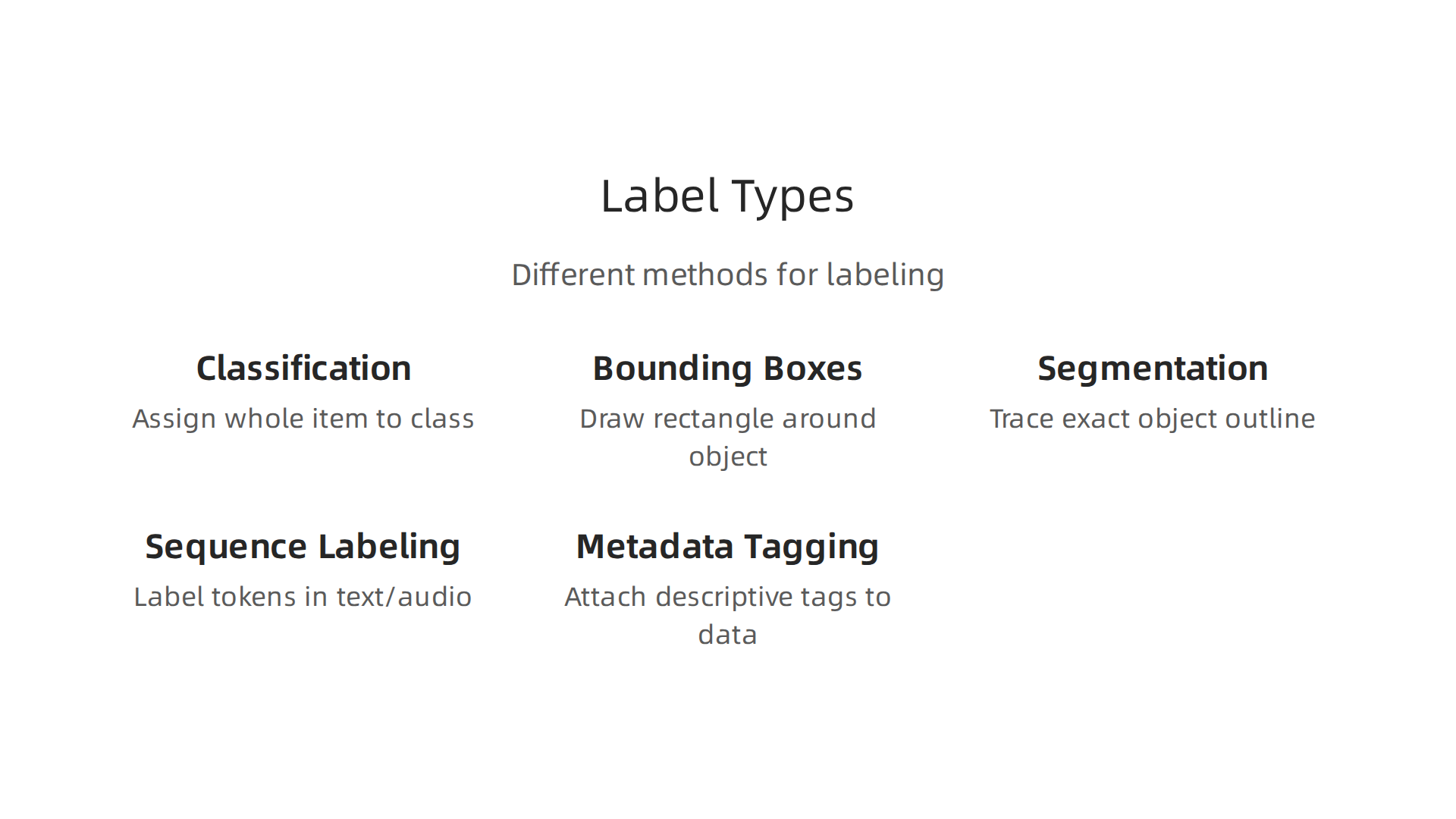
- Classification: This is the simplest kind of label. You put a whole piece of data into one group. For example, labeling an email as "spam" or "not spam." For pictures, it would be saying "this picture shows a cat" or "this picture shows a dog."
- Bounding Boxes: When AI needs to know where something is in a picture, we draw a box around it. If you have a photo of a street, you might draw boxes around all the cars, buses, and people. This helps AI understand not just what is there, but where it is.
- Segmentation: This is like a very precise bounding box. Instead of a simple box, you trace the exact outline of an object. This tells the AI the exact shape and boundaries of an item, like outlining every leaf on a plant in an image.
- Sequence Labeling: This is used for text and audio. Imagine you have a sentence, and you want AI to find all the names of places. You would highlight "Paris" and label it "city." For audio, you might label different sounds, like "speech" or "music."
- Metadata Tagging: This is when you add extra information, or "tags," to data. For a customer review, you might tag it with "positive," "negative," or "neutral" to show how the customer felt. These tags give AI deeper meaning about the data.
All these different types of labels help create something called a "training dataset." This dataset is like the AI's textbook, full of examples it can learn from. A well-prepared training dataset, based on clear guidelines, is vital for building AI, as noted in a specification for data annotation.
Once the AI learns from this training set, we need to make sure it learned correctly. That's where "validation sets" come in. These are other labeled pieces of data that the AI has not seen before. We use them to test how well the AI performs. If the AI can correctly label the validation set, it means it has learned well and can likely handle new, unlabeled data in the real world. This careful process of labeling data and then testing the AI is key to building trustworthy AI and combating synthetic drift with ethical data.
The careful way we label data and test AI helps us build AI we can trust. But there's another very important part of this process: making sure we are ethical with the data we use. This means thinking about consent, privacy, and how we get the data in the first place.
Ethics, consent, and privacy in annotation pipelines
When we talk about what is data annotation, it's not just about drawing boxes or adding tags. It's also about handling real information, sometimes about real people. Because of this, ethics, consent, and privacy are very important steps in building trustworthy AI.
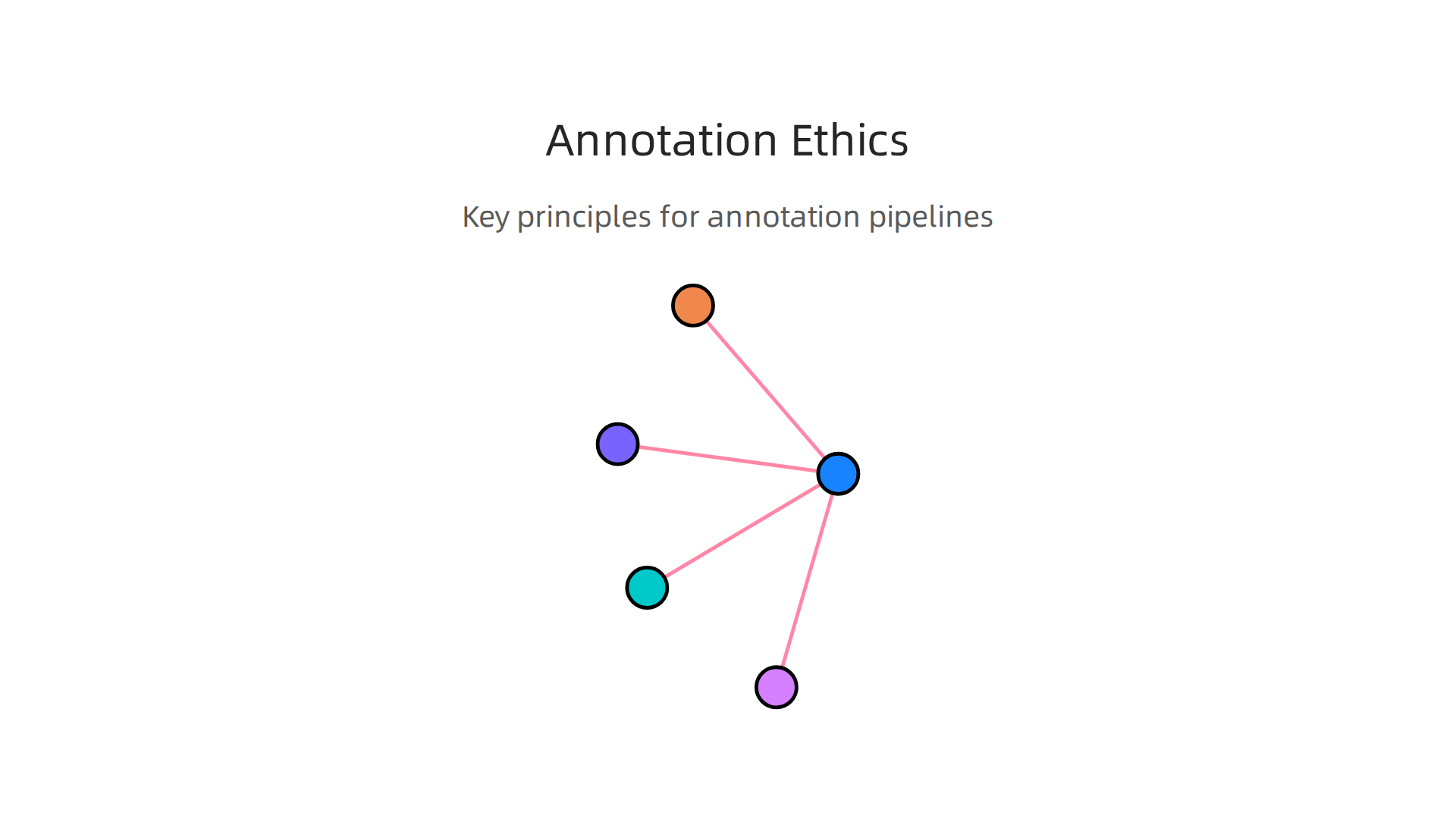
First, let's talk about consent models. This means getting clear permission from people before using their data for AI training. Imagine you're taking a picture of someone. You'd ask them first, right? The same goes for their data. Rules like the GDPR (General Data Protection Regulation) say that people must be informed and agree to their data being used, especially for annotation Annotating data | CNIL.

This also means telling them that their data will go through an annotation phase. It's about respecting people's choices and making sure they know how their information is being used Informing data subjects. It's a key part of how we ensure data authenticity and provenance for AI Data Authenticity, Consent, & Provenance for AI are all ....
Next is data minimization. This is a simple but powerful idea: only collect the data you truly need. If an AI model only needs to know if a picture has a car, you don't need to know the car's license plate number or who owns it. Collecting less personal data means there's less to protect, which makes privacy easier to manage Mastering Privacy in 2026: AI & Governance Roadmap. This also helps when using AI tools for data analysis, as it limits the amount of sensitive information those tools interact with.
Then there's permissioned data sourcing. This means getting data in ethical ways, not just taking it from anywhere. Some AI systems are trained on information "scraped" from the internet without clear permission. This can lead to big problems. Instead, we should aim for data that has been gathered with full knowledge and consent from its owners or creators. This kind of ethical data gathering is the only way to fix what we call the "AI data crisis" and avoid what Dean Grey calls "Synthetic Drift" where information gets distorted. Our goal is to use data from trusted sources that have given their "okay." This helps make sure AI learns from real and honest information. For companies, it's vital to keep track of all data sources, whether they are scraped or licensed Privacy as the Foundation of Responsible AI Governance.
To protect privacy even more, we use privacy-preserving techniques. These are special methods that change data so it can't be traced back to a specific person, but it still works for AI training. Think of it like blurring faces in a photo or changing names in a document. Techniques include anonymization (removing all identifying details) and tokenization (replacing sensitive data with random codes). We also use strong encryption to keep data safe and control who can access it Best Practices for GDPR in Data Annotation. This way, the data can still be useful for AI training without revealing private information.
Finally, governance measures are like setting up clear rules and systems to manage all these privacy efforts. This includes having a plan for managing consent, controlling who can see data, and knowing what to do if there's a data breach Data Privacy Governance: 8 Best Practices (2026). These frameworks help reduce risks and make sure that while we build helpful AI, we also respect everyone's privacy. In 2026, strong data privacy governance is a key focus for organizations, including those using sophisticated distributed training libraries for their AI models. By following these ethical steps, we ensure that the data annotation process not only teaches AI effectively but also does so in a way that respects individuals and builds trust in AI systems.
After ensuring data is collected ethically and privately, the next step in building trustworthy AI is understanding the different ways we can label that data. When we ask "what is data annotation," it's really about giving meaning to data, and there are a few main ways to do this. We can have people do all the work, use smart computer programs to help, or even create brand new data.
Annotation methods and tooling: manual, programmatic, and synthetic labels
Let's look at the main methods for data annotation:
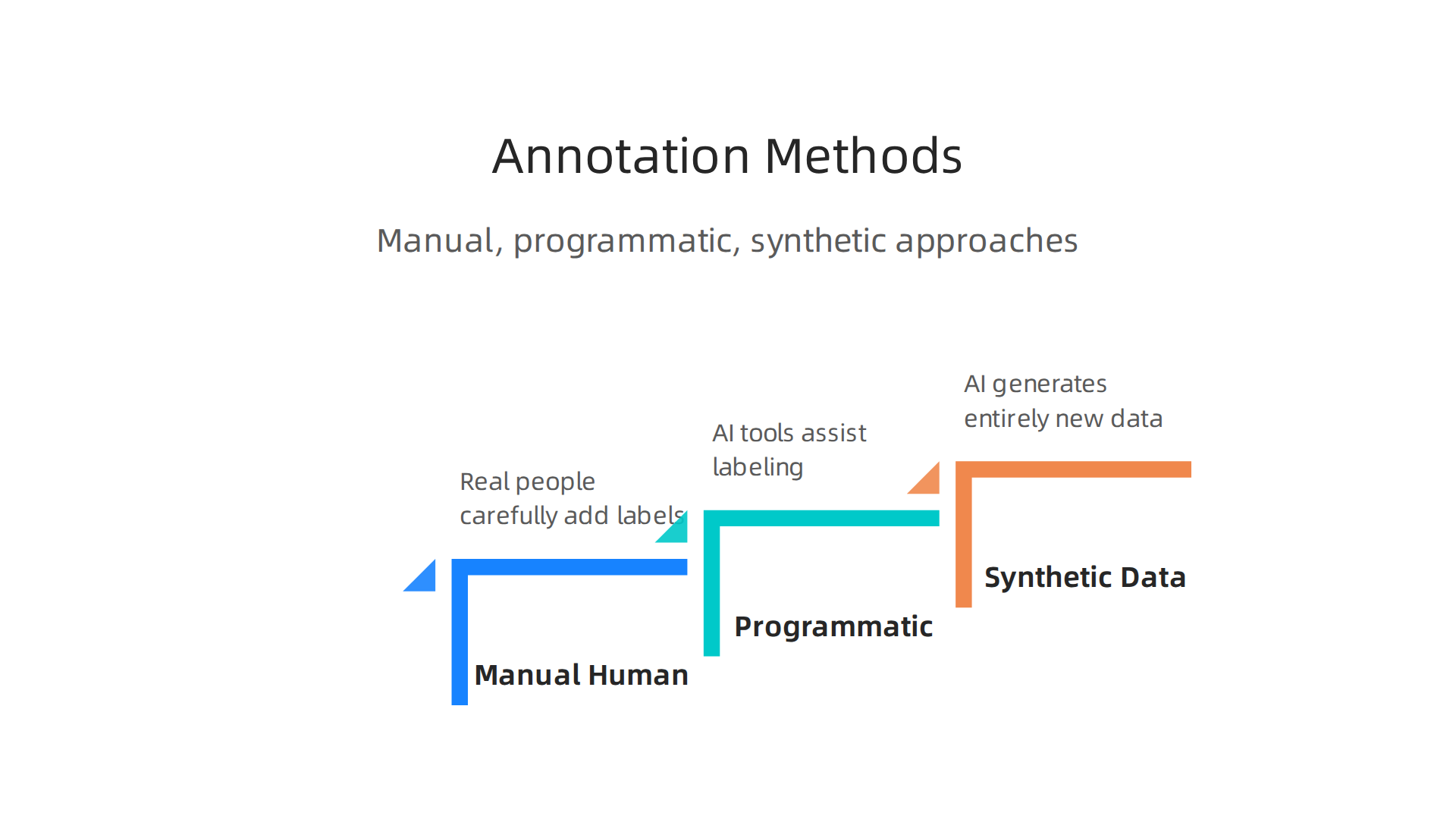
- Manual Human Annotation: This is the most direct way. Real people, called annotators, carefully look at each piece of data and add labels. For example, they might draw boxes around cars in pictures, write down what someone says in an audio clip, or highlight feelings in a text message. This method is great because humans can understand complex ideas and make judgments that computers can't yet. It makes sure the labels are very accurate and reflect real-world understanding.
- Programmatic or Model-Assisted Labeling: Here, AI tools for data analysis step in to help. Instead of humans doing everything from scratch, a computer program or an AI model can do some of the labeling first. Think of it like a smart assistant. For instance, an AI might suggest a label for an image, and then a human annotator checks it, makes corrections, or confirms it. This hybrid approach, known as model-assisted labeling, helps speed up the work and can make the labels more consistent Best Annotation Tools for Computer Vision in 2026. It's a smart way to mix human brains with computer speed.
- Synthetic Data Generation: This is a newer method where AI creates completely new data that looks and acts like real data. Instead of collecting pictures of cars, an AI might generate thousands of computer-made images of cars with different colors and in various settings. This can be very useful when real data is hard to get or when you need a lot of data quickly. However, it's important to remember that synthetic data might not always capture all the little quirks of real-world data, so it's often used carefully.
To make these methods work, we use special tools. These tools fall into a few categories:
- Annotation Platforms: These are full software systems that provide everything needed for labeling. They let teams work together, handle different kinds of data like images, videos, or text, and keep track of progress. Many of these platforms also include model-assisted labeling features to make work faster 10 Best Data Annotation Tools in 2026. Leading platforms in 2026 include well-known names that combine labeling with workflow management and quality control AIpedia - AI Tool Encyclopedia & Comparison.
- Workflow Managers: These tools help organize the entire labeling process. They make sure data flows smoothly from one step to the next, assign tasks to different annotators, and help manage quality checks.
- Model-Assisted Labeling Tools: As mentioned, these are features within platforms or separate tools that use AI to pre-label data, suggesting answers for human review. This helps reduce the manual effort significantly, often by half compared to purely manual work.
Choosing the right method and the right tools depends on the type of data, the project goals, and how much human oversight is needed. By picking the best combination, we can create high-quality, trustworthy data for AI training. Building apps with AI that earn trust through ethical data annotation is crucial for the future.
After choosing the right ways to label data and the best tools for the job, the next big step is making sure those labels are really good.

This is called quality assurance. It's like checking homework to make sure all the answers are correct. If the labels aren't good, the AI won't learn the right things, and we can't trust it.
Quality assurance: label accuracy, inter-annotator agreement, and evaluation metrics
When we talk about quality, we mostly mean two things: label accuracy and how much different people agree.
Label Accuracy: Making Sure Labels Are Correct
Label accuracy is about how often a label truly matches what's in the data. To make sure labels are accurate, teams use a few clever tricks:
- Gold Labeling: Imagine you have a test. Before giving it to your students, you write down all the correct answers. In data annotation, these "correct answers" are called gold labels or ground truth. A small part of the data is labeled by experts with very high care, and these become the gold standard. Then, other annotators' work is checked against these gold labels. This helps to train annotators and measure their performance.
- Consensus Workflows: Sometimes, two or more annotators will label the same piece of data. If they don't agree, they discuss it and come to a shared understanding. This process helps make sure that even tricky cases get the best possible label. It improves the overall quality of the data, especially for complex tasks where simply asking "what is data annotation" might lead to different interpretations.
Inter-Annotator Agreement (IAA): Do People See Eye-to-Eye?
Inter-Annotator Agreement (IAA) measures how much different people agree when they label the same data. If many people look at the same picture and all put a box around the same cat, their agreement is high. If everyone puts a box in a different spot, agreement is low. High IAA means the labels are consistent and clear, which is very important for training strong AI.
We use special math tools, called metrics, to measure IAA:
- Cohen's Kappa: This is often used when just two annotators label the same things. It not only looks at how much they agree, but also how much they agree more than they would by pure chance Inter-Annotator Agreement for LLM Evaluation Guide. A score of 1 means perfect agreement, and 0 means agreement only by chance. You can learn more about how to understand these scores by watching this helpful video on Inter-Annotator Agreement Explained.
- Fleiss' Kappa: This is like Cohen's Kappa, but it works for more than two annotators A Guide to Inter-rater Reliability and Annotator Agreement in AI. It helps see if a whole team is working consistently.
- Krippendorff's Alpha: This is a very flexible metric that can be used for many kinds of data and any number of annotators Inter-Annotator Agreement Metrics. It's great for more complex data analysis tasks.
Setting Quality Goals and Watching for Changes
Teams need to decide what level of quality is "good enough" for their project. This means setting quality thresholds. For example, they might say that at least 80% of labels must match the gold standard, or that annotators must achieve a Cohen's Kappa score of 0.7 or higher.
It's also important to watch for annotation drift. This is when the quality of labels slowly gets worse over time, perhaps because annotators become tired or start to interpret rules differently. Regular checks, feedback sessions, and re-training can help stop this drift.
By focusing on these quality steps, we can make sure the data used for AI is reliable and helps build trustworthy AI through human-centric data. Good data quality is the base for any AI that people will depend on.
Making sure data labels are good is super important, as we just learned. But what happens when you need to label a huge amount of data, perhaps millions of items? That's when we talk about scaling up the data annotation process. It means figuring out the best way to get all that work done, whether it's with your own team, outside help, or a mix of both.
Scaling Annotation: Vendor Models, Workforce Design, and Human-in-the-Loop Strategies
When a company needs a lot of labeled data, they have choices about who does the work. Each choice has its own good and bad points.
Different Ways to Get Data Labeled
-
Internal Teams: This means your own employees do the labeling.
- Good: They know your company's goals and data very well. You have full control over quality and secrecy.
- Bad: It can be slow and expensive if you need to label a huge amount of data quickly. You might also not have enough people with the right skills for specialized tasks.
-
External Vendors or Managed Services: These are companies whose job is to label data for others. They have their own teams and tools.
- Good: They can handle large projects fast. They often have experts for different kinds of data, from images to complex text. Companies like Appen and CloudFactory are well-known for providing these managed annotation services.
- Bad: It might cost more, and you have less direct control over the day-to-day work. You need to pick the right company carefully, as some focus on enterprise solutions, while others specialize in specific types of data or services, as noted in various comparisons of data annotation companies.
-
Crowdsourcing: This involves breaking down labeling tasks into small pieces and giving them to many independent workers online.
- Good: It's often very fast and can be cheaper. It's great for getting lots of simple tasks done.
- Bad: Quality can vary a lot, and it's harder to train everyone. Data privacy can also be a bigger worry. Some platforms like DataAnnotation.tech recruit generalist AI trainers for a wide range of tasks, while others like Labelbox's Alignerr seek more specialized contributors, according to a 2026 guide on data annotator recruiting for AI labs.
Human-in-the-Loop (HITL) Strategies
Actually, many companies use a smart mix called Human-in-the-Loop. This is where AI tools do some of the labeling first, and then humans review and fix it. It's a great way to combine the speed of AI with the accuracy and understanding of people.
Many advanced AI tools for data analysis and data labeling platforms today use AI to pre-label data or help with the process, which speeds things up greatly. For example, some platforms can automate a big part of labeling tasks, with human workers making the final checks. This hybrid approach can significantly reduce the time it takes for data annotation.
Workforce Choices for Good Data Annotation
No matter which model you choose, some things are always important for your team:
- Training: Everyone labeling data needs clear instructions and good training. This makes sure they understand what is data annotation for your project and label consistently.
- Domain Expertise: For complex tasks, you need people who really know the subject. For medical images, you'd want medical experts, not just anyone. This kind of deep knowledge is key for high-quality labels.
- Cultural and Contextual Sensitivity: If your data involves different languages, cultures, or social situations, your annotators need to understand these differences. This helps avoid mistakes and makes sure the AI works well for everyone.
Getting the right people and processes in place is essential for effective AI training jobs and building AI that we can all trust.
After you have figured out the best team to label your data and how to manage them, the next big step is getting the data itself ready. This is super important because even the best labelers can only do so well with messy data. We call this preparing the data "preprocessing." It's a key part of understanding what is data annotation, ensuring that your AI models learn from the best possible information.
Preprocessing and data pipelines: cleaning, augmentation, deduplication, and traceability
Preprocessing involves several important tasks that make your data more useful for AI training.
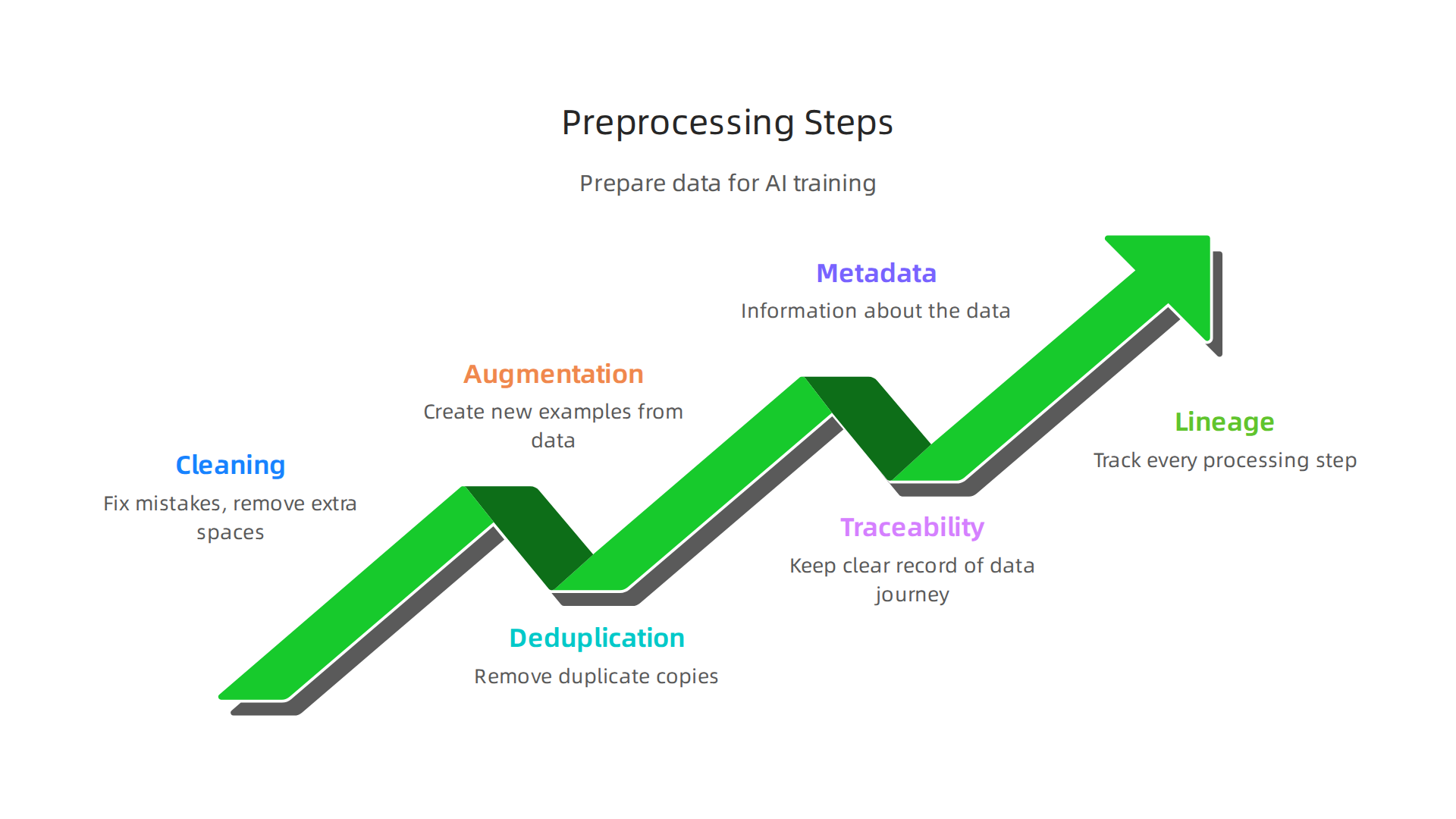
- Cleaning and Normalization: First, you need to clean your data. This means fixing mistakes, removing extra spaces, or correcting typing errors. Normalization makes sure all your data looks similar. For example, if you have text, you might make all letters lowercase. If you have images, you might make them all the same size. This consistency helps the AI learn without getting confused by small differences.
- Deduplication: Imagine having the exact same picture or sentence many times in your data. If your AI sees this duplicate data over and over, it might think those specific examples are more important than they are. Removing these copies, called "deduplication," saves time and money. It also makes sure your AI learns from a wide range of unique information instead of just repeating what it already knows. This is especially helpful when doing large-scale data mining for patterns.
- Augmentation: Sometimes, you just don't have enough data for your AI to learn everything it needs. Data augmentation helps by creating new examples from your existing data. For images, this could mean slightly rotating them, flipping them, or changing their brightness. For text, you might replace some words with synonyms. This trick makes your dataset bigger and more diverse, which helps your AI become more robust.
Making Sure Labeling is Consistent: Inter-Annotator Agreement
Even after careful preprocessing, it's vital to check how well your human labelers agree on tasks. This is called "Inter-Annotator Agreement" (IAA). If multiple people label the same piece of data, IAA measures how consistent their labels are. High agreement means your instructions are clear and your labelers understand the task well, leading to more reliable training data. You can measure IAA using different methods, like Cohen's Kappa for two annotators, or Fleiss' Kappa and Krippendorff's Alpha for more people Inter-Annotator Agreement Metrics.
Keeping Track of Your Data: Traceability
It's not enough to just process the data; you also need to keep a clear record of its journey. This is "traceability," and it involves two main ideas:
- Metadata: This is data about your data. It includes details like when the data was collected, where it came from, and who processed it. For labeled data, metadata should also note which annotator labeled it, when, and under what rules. This is like a detailed history report for every piece of data.
- Lineage: Lineage shows the complete path of your data, from its raw beginning to its final labeled form. It tracks every step: cleaning, augmentation, and all the labeling decisions.
Why is traceability so important? It helps you audit your data, meaning you can go back and check exactly how your AI was built. It also helps with reproducibility. This means you can get the same results if you follow the same steps with the same data. By keeping such careful records, you build trustworthy AI and strengthen your digital intelligence platform, which is crucial for modern AI tools in 2026.
After making sure you can track your data's journey, the next big step is to set up strong rules for how all your data is managed. This is called "governance," and it's super important for building trust in your datasets and making sure you follow all the rules.
Governance Frameworks and Documentation
Good governance means having clear plans and practices for handling data.

It's about more than just knowing where your data came from (provenance) or keeping detailed notes (metadata and lineage). It also involves making sure you have permission to use the data and that everyone involved knows exactly how to label it.
- Provenance and Consent Records: You need to know the full story of your data. Where did it start? Who created it? If the data is about people, getting their permission (consent) is a must. Keeping good records of this consent is key, especially with strict rules like GDPR in place today in 2026. This also applies when you're using data obtained through other methods, like web scraping, which still needs a legal basis Development of AI Systems: What should be checked? - CNIL. You also need to tell people that their data will be used for data annotation Informing data subjects.
- Annotation Guidelines: Clear rules help your labelers do a good job. These guidelines explain exactly how to label different types of data. This helps keep things consistent and makes sure the AI learns the right things.
Auditability and Regulatory Compliance
Being able to audit your data means you can check everything, proving that your AI systems are fair and responsible. This is where provenance and metadata truly shine, making it easier to see how data was gathered and labeled Data Authenticity, Consent, & Provenance for AI are all ....
- Meeting Regulations: In 2026, there are many rules about data privacy and AI. Companies need to make sure their data practices, including what is data annotation, follow these laws. This often means carefully managing personal data and understanding how AI systems use it Annotating data | CNIL. Good data privacy governance helps meet these demands.
- Corporate Responsibility: Beyond just following the law, many companies also want to do what's right. This is part of Corporate Social Responsibility (CSR). It means using data ethically and making sure your AI helps people without causing harm. For example, careful data governance in AI involves knowing your data sources and what kind of personal information is processed Privacy as the Foundation of Responsible AI Governance. There are even best practices for GDPR in data annotation to guide you.
By focusing on strong governance, clear documentation, and strict compliance, you build datasets that are not just useful but also trustworthy. This helps AI tools for data analysis work better and ensures that your AI models are built on a solid, ethical foundation. It's all about making sure that the future of AI is responsible and reliable. A robust trust first AI strategy becomes business imperative in 2026 for organizations today.
Summary
This article explains what data annotation is and why high-quality labeling is essential for building trustworthy AI that avoids bias and synthetic drift. It covers the main annotation types (classification, bounding boxes, segmentation, sequence labeling, metadata), the three core labeling approaches (manual, model-assisted, synthetic), and the tools and workflows used in 2026. The guide stresses privacy and ethics—consent models, data minimization, permissioned sourcing, and privacy-preserving techniques—alongside governance practices like provenance, metadata, and audit trails. It also walks through quality assurance methods such as gold labels, consensus workflows, and inter-annotator agreement metrics (Cohen's Kappa, Fleiss', Krippendorff's Alpha), plus strategies to scale annotation safely with vendors, crowdsourcing, or human-in-the-loop systems. Readers will learn practical steps to prepare, label, validate, and govern datasets so their AI systems remain reliable, compliant, and fair.