Home


Menu

Close

Is Machine Learning AI Why This Distinction Matters for Data Trust and Ethics
Published:
June 19, 2026
Introduction
Ask ten people working in tech what artificial intelligence actually means. You will get ten different answers. Now ask them "is machine learning AI?" and watch the debate get even messier. This confusion is not just a minor misunderstanding. It is holding back how we build, trust, and regulate the technology shaping our world.

Here is the real problem. Most AI systems today are trained on data scraped from the public internet. That data is noisy, distorted, and often collected without clear permission. As this information flows through digital systems, it creates what experts call a crisis of trust in AI outputs. Without clean, ethical data, even the most advanced machine learning models cannot produce reliable results. In 2026, global standards like the ISO/IEC 42001 framework for AI governance are pushing organizations to rethink how they handle data from the very first step.
This article cuts through the noise. We will define artificial intelligence and machine learning so you never have to guess again. We will explore why the shortage of permission-based data is threatening the accuracy of modern AI systems. And we will look at a path forward one that puts ethical data and human values at the center of development. Whether you are a developer, a business leader, or someone trying to understand the technology around you, this guide gives you the clarity you need.
Defining Artificial Intelligence and Machine Learning
Let's clear up the biggest question first: is machine learning AI? The short answer is yes, but not all AI is machine learning. Think of it like squares and rectangles. Every square is a rectangle, but not every rectangle is a square. Machine learning is a specific way to build artificial intelligence, but it is not the only way.
What Artificial Intelligence Really Means
Artificial intelligence is the broad field of building machines that can do things that normally require human intelligence. This includes reasoning, learning, planning, understanding language, and recognizing patterns. The term "artificial intelligence" was first used back in the 1950s. Back then, researchers tried to create smart systems by hand-coding every rule and decision. That approach is called symbolic AI or rule-based AI. It works well for tasks like playing chess by following strict logic, but it falls apart when faced with messy, real-world situations.
How Machine Learning Changes the Game
Machine learning takes a different approach. Instead of programmers writing every rule by hand, the system learns from examples. You feed it lots of data, and it figures out the patterns on its own. That is why machine learning has become so popular today. It handles complex tasks like recognizing faces in photos, recommending movies, or translating languages far better than old rule-based systems ever could. In fact, almost every AI system you interact with in 2026 uses machine learning under the hood.
Why the Distinction Matters Now
You might wonder, why does it matter if we mix up the terms? Here is the thing. When policymakers write laws about artificial intelligence, they need to know exactly what they are regulating. When investors decide where to put money, they need to understand what a technology can and cannot do. And when ethics teams review AI systems, they need a shared language to talk about risks like bias or data quality. That is exactly why international standards like ISO/IEC 22989 exist. This standard provides a common vocabulary for artificial intelligence so that everyone from engineers to auditors uses the same definitions. Getting the terminology right is not academic. It is the foundation for building trustworthy systems that actually serve people.
The Machine Learning Pipeline: From Data to Decision
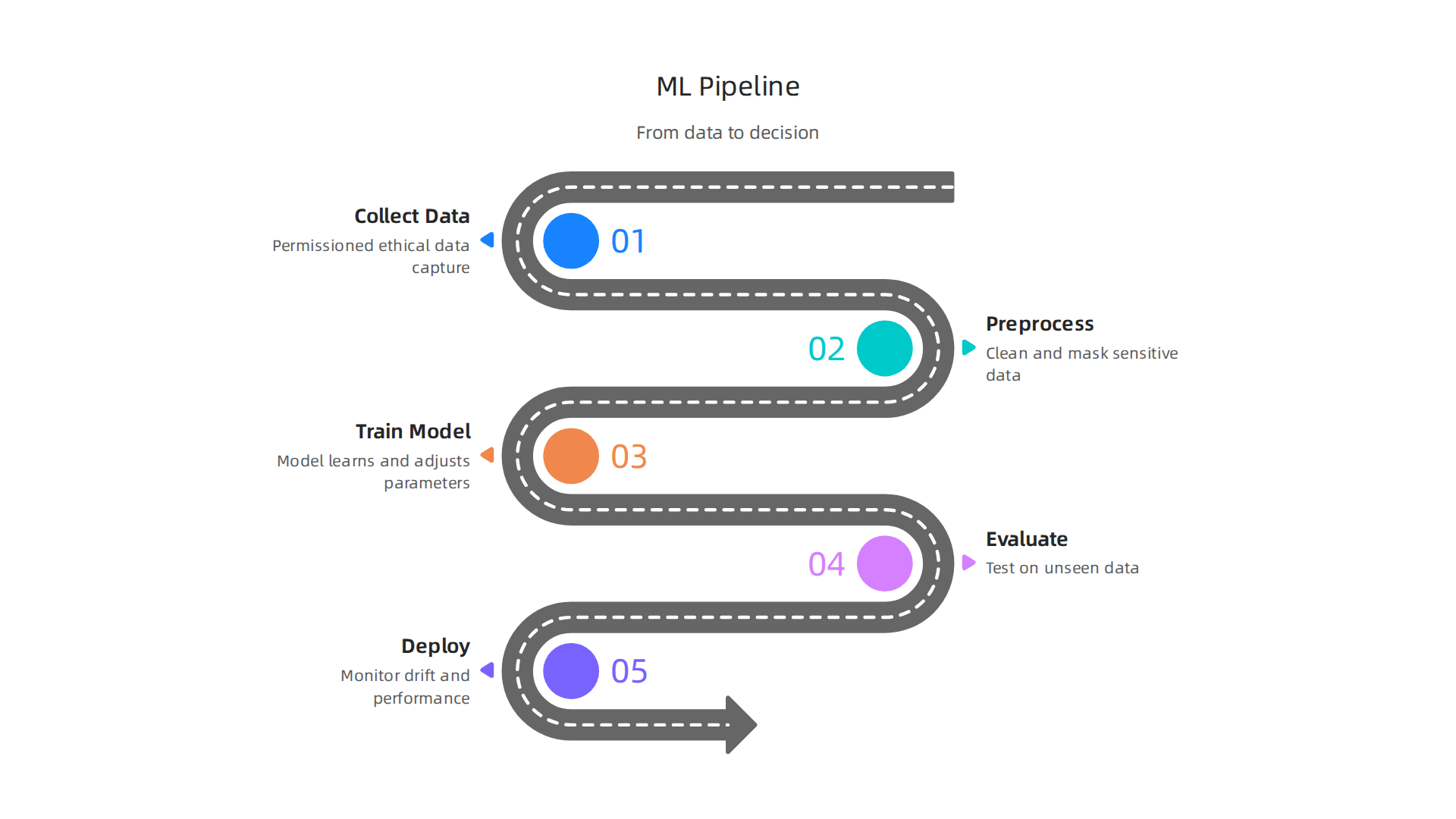
Now that you understand what machine learning is and how it differs from traditional AI, let us walk through how an ML system actually goes from raw information to a final decision. Think of this as the assembly line for smart software.
Step 1: Collect the Right Data
Every machine learning project starts with data. Without data, there is nothing to learn from. The type and quality of data you collect decides whether your model will be helpful or harmful. This is where permissioned, ethical data capture matters most. If you scrape data from the internet without consent, you risk biased, low quality inputs. Organizations serious about trustworthiness follow frameworks like ISO standards that demand rigorous data governance. One key standard, ISO/IEC 42001, requires organizations to enforce data quality gates, bias testing, and full data lineage from the very first step.
Step 2: Preprocess and Clean
Raw data is messy. It has missing values, duplicate entries, and inconsistent formats. Preprocessing cleans this up so the model can learn correctly. Teams also need to handle sensitive information during this stage, masking personal details to protect privacy. Standards like ISO/IEC 22989 define clear vocabulary for training data, validation data, and test data. Using these definitions helps everyone stay on the same page.
Step 3: Train the Model
Training is when the machine learning algorithm studies the cleaned data and finds patterns. The model learns by adjusting its internal math to reduce errors. This step can take hours or days depending on the dataset size and complexity. Modern MLOps tools help teams track experiments, version models, and avoid chaos during training.
Step 4: Evaluate and Validate
Before you put a model into the real world, you must test it. Evaluation uses a separate set of data the model has never seen. If the model performs well here, it is ready. But you must watch for three common pitfalls.
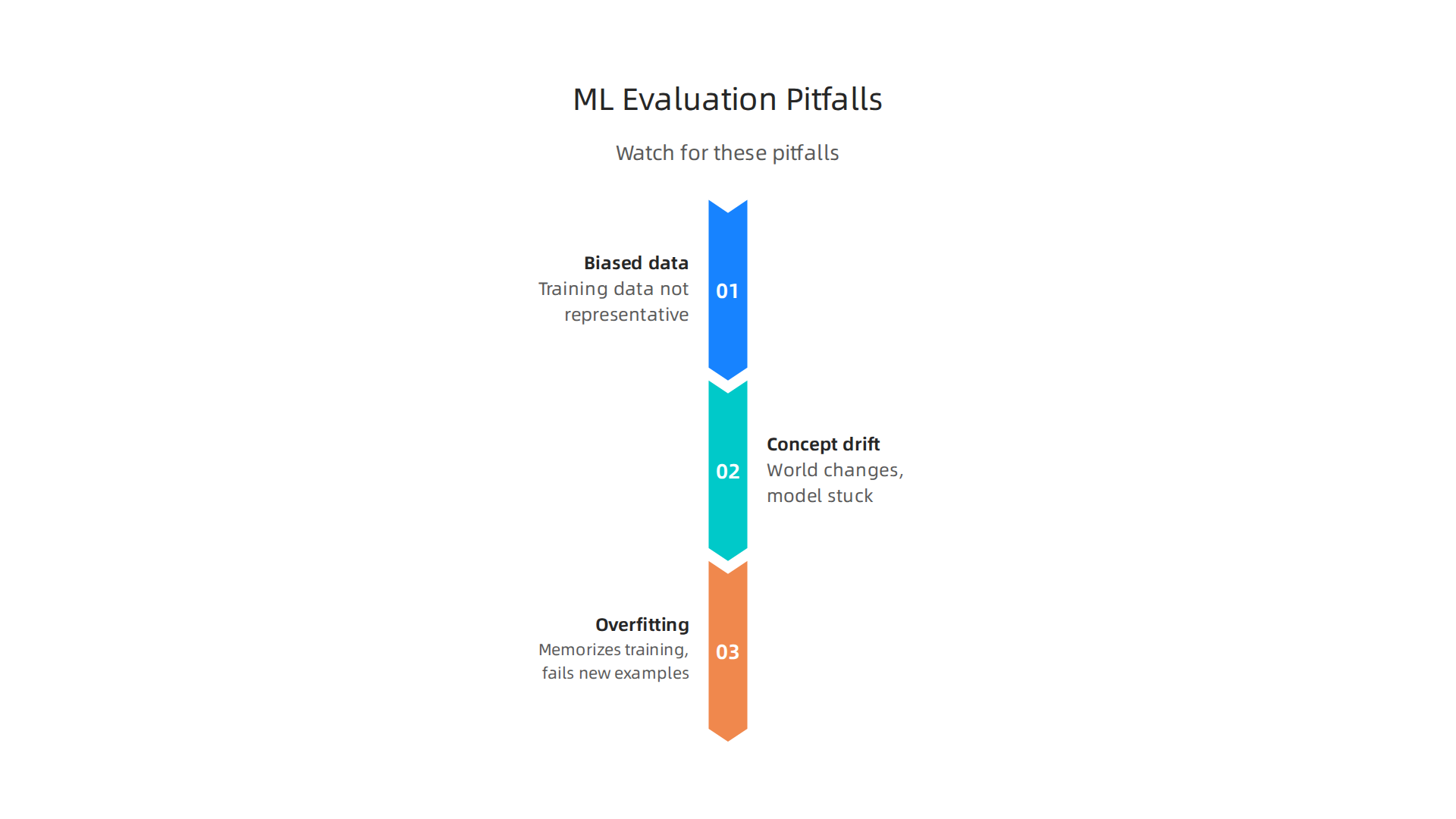
Biased data shows up when your training data does not represent the full picture. For example, a hiring model trained mostly on male applicants might unfairly reject women.
Concept drift happens when the world changes and your model stays stuck in the past. The patterns it learned no longer match reality. This is a common reason models fail in production over time.
Overfitting occurs when the model memorizes the training data instead of learning general rules. It scores high on tests but fails when faced with new examples.
Step 5: Deploy and Monitor
Deployment puts the model to work, but the job is not done. You need to keep watching for drift, performance drops, and data quality issues. Retraining, using fresh or synthetic data, helps the model stay accurate. Monitoring tools can alert you when something goes wrong so you can fix it fast.
The whole pipeline depends on one thing: trustworthy data collected with permission. Without that foundation, even the best algorithm will fail. That is why the smartest teams spend most of their time on the first two steps, getting the data right.
The Data Crisis: Why Permissioned, Ethical Data Matters
But even when teams do spend time on data quality, they run into a huge problem. Most data available online is scraped without permission. Big companies grab everything they can, from social media posts to forum comments, without asking anyone. This creates a mess.
Here is what happens when you train models on that kind of data.
First, you get privacy violations. People did not agree to have their personal information used this way. Laws like GDPR and CCPA now make that illegal in many places. The fines are huge. Organizations risk serious regulatory trouble.
Second, you get biased models. Scraped data is not a fair sample of the world. It overrepresents certain voices and leaves out others. A model trained on Reddit comments, for example, might learn patterns that do not apply to the general population. That is why people search for "data annotation reddit" to find better ways to label data, but even good labels cannot fix a bad original dataset.
Third, you get synthetic drift. When you train models on low quality public data, the model learns distorted patterns. Then when the real world changes, the model drifts even further from reality. This is a downstream effect of using permissionless data at the start. One effective way to fight synthetic drift is through tackling data drift with synthetic data, where you generate fresh, high quality examples to retrain your model.
The scale of scraping is staggering. Billions of posts, images, and videos get fed into training pipelines every day. Most of it was never meant for that purpose. No consent. No compensation. No context.
But there is a better path. Ethical data sourcing means getting permission first. It means paying people for their contributions, or at least being transparent about how their data will be used.

It means building datasets that represent real diversity, not just whatever is easiest to scrape.
Organizations that do this gain a real advantage. Their models are more trustworthy. They face less regulatory risk. And they build long term relationships with their data sources. When you have permissioned data, you can also track the origin of every example, which helps with transparency and debugging.
In a world where AI is everywhere, trust is the new currency. And trust starts with how you collect data. The teams that prioritize ethical sourcing today will be the ones building the most reliable AI systems tomorrow.
Synthetic Drift and the Erosion of Truth
But even with permissioned, ethical data in hand, there is another hidden threat. It is called synthetic drift. And it might be the most dangerous problem in AI today.
Here is what happens. AI models generate content. That could be text, images, videos, even code. Then other AI models get trained on that AI generated content. And the cycle repeats. Each time, small distortions get baked in. Errors grow. Biases compound. Over several cycles, the original truth gets completely lost.
Think of it like a photocopy of a photocopy. The first copy looks fine. The tenth copy is fuzzy. The hundredth copy is unrecognizable. Synthetic drift works the same way, but inside the digital systems we rely on every day.
Real world examples are everywhere now. Misinformation spreads faster than ever because AI generated content looks real but contains subtle inaccuracies.

Value misalignment happens when a model trained on synthetic data starts behaving in ways its creators never intended. Trust erodes because no one can tell what is authentic anymore. This is a core challenge in defining artificial intelligence for the modern era, because the technology itself keeps creating new versions of reality that are slightly wrong.
The scale makes it worse. Billions of AI generated posts, articles, and videos flood the internet every day. Each one carries a tiny distortion. Put together, they reshape how we see the world. And the more we train new models on this polluted data, the further we drift from ground truth.
This is why ethical data sourcing alone is not enough. You also need systems that detect and correct synthetic drift before it spreads. According to recent research on model drift in LLMs, continuous monitoring and human validation are essential to keep AI outputs aligned with reality. Without that, the erosion of truth becomes inevitable.
So when someone asks "is machine learning AI truly reliable," the honest answer depends on whether the model is fighting synthetic drift or feeding it.
Building Trustworthy AI: Frameworks and Best Practices
Synthetic drift sounds scary. And it is. But here is the good news. We already have ways to fight it. Governments, tech leaders, and researchers have built frameworks designed to keep AI honest. In 2026, these frameworks are more important than ever.
The EU AI Act is the biggest one. It is the world's first complete set of rules for artificial intelligence.

The act sorts AI systems by risk level. Low risk systems have light rules. High risk systems face strict requirements. Under the High-level summary of the AI Act, high risk AI must have a risk management system that runs the whole life of the model. Data governance is required too. Training data must be clean, fair, and complete. Human oversight is not optional. And every system needs clear documentation so authorities can check for compliance.
Transparency is a huge part of the EU AI Act. Under the EU AI Act's transparency rules in Article 50, users must know when they are talking to an AI. If content is AI generated, that must be clear too. This helps stop the spread of fake content that looks real. Companies in the EU face a deadline in August 2026 to get this right.
The NIST AI Risk Management Framework is another key tool. It gives organizations a way to measure and manage AI risks. It focuses on trustworthiness. That includes things like accuracy, explainability, and resilience to attacks. IEEE Ethically Aligned Design takes a different angle. It puts human values at the center. The goal is to design AI that respects human rights and well being.
Across all these frameworks, some core principles stand out.
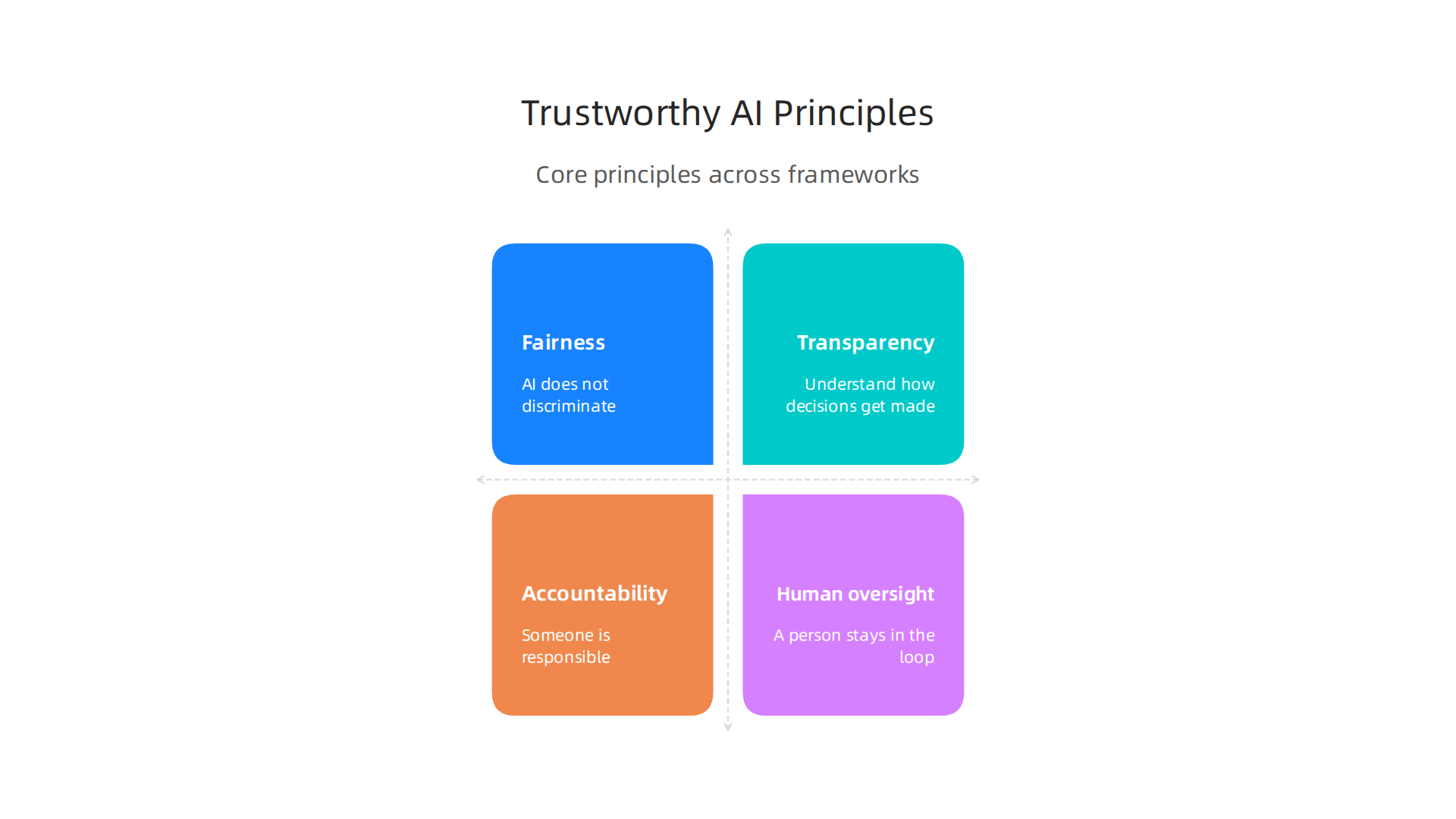
Fairness means the AI does not discriminate. Transparency means people can understand how decisions get made. Accountability means someone is responsible when things go wrong. And human oversight means a person stays in the loop.
So what can you actually do right now? Start with data audits. Check where your training data comes from. Make sure it is clean and permission based. Run bias tests regularly. Build explainability into your models so you can trace how each output was reached. And set up verification steps that catch drift before it spreads. According to a 2026 guide on AI regulations and governance, enterprises are expected to maintain a control catalog and a compliance matrix that map each safeguard to specific regulatory clauses.
These steps are not just for big tech companies. Any organization asking is machine learning AI reliable enough to trust needs a plan. The frameworks exist. The tools exist. The question is whether we use them.
The Role of Behavioral Science in AI Design
The frameworks give us rules. But rules alone are not enough. To build AI that truly serves us, we need to understand how people actually think and make choices. That is where behavioral science comes in.

Behavioral science studies real human behavior. It looks at why we do what we do, often without realizing it. This field shows us that people are not purely logical. We get tired. We get distracted. We follow habits. AI that ignores these human quirks will feel cold or even harmful. But AI built with behavioral science in mind can guide us toward better choices.
One powerful idea is nudging. A nudge is a small change in how a choice is presented. Think of an app that defaults to the healthier option or a social media feed that shows posts that lift you up instead of ones that make you angry. AI can design these nudges at scale. The key is to nudge for ethical outcomes, not just more clicks. That is the core of the work being done by the Bridging AI and Behavior Change community. They bring together computer scientists and behavioral experts to create AI that helps people without tricking them.

Another example is reducing filter bubbles. Algorithms today often show us only what we already agree with. Behavioral science helps AI design systems that gently expose us to different viewpoints. This keeps us informed and reduces social division.
But maybe the biggest shift is in how we measure success. Right now many AI systems optimize for engagement time, likes, or shares. Those metrics are easy to track but they do not measure whether people are actually thriving. Behavioral science suggests we should use human centric metrics instead, like well being, trust, and belonging. The AI and behavioral science in healthcare space already shows how personalized messaging based on behavioral science can improve health outcomes. The same thinking can apply everywhere.
At a deeper level, this field asks a fundamental question: are our AI systems aligned with what humans actually value? The AI alignment definition from behavioral science says yes, we can and should design AI that acts in line with human goals.

That means training models not just on data but on an understanding of how real people behave and what they truly care about.
When you ask is machine learning AI trustworthy, you cannot skip this step. The frameworks give you the rules. Behavioral science gives you the humanity.
Future Outlook: Towards Human-Centric AI in 2026 and Beyond
Looking ahead to the rest of 2026 and beyond, this human-first thinking is becoming not just a nice idea, but a requirement. Governments around the world are stepping in with new rules. The biggest example is the European Union's AI Act, which hits major deadlines in 2026 and 2027. By August 2026, companies must follow strict rules for high-risk AI systems. They need to set up risk management systems, keep detailed technical documentation, and make sure humans can oversee AI decisions. If you are asking "is machine learning AI trustworthy," these laws give you a clear answer: only if you can prove it with real records and testing.
Transparency is a huge part of this. The AI Act requires that when you interact with an AI system or see AI-generated content, you must be told. That means labels on deepfakes, watermarks on synthetic images, and clear notices on chatbots. We break down the exact rules in this practical guide to Article 50 of the EU AI Act. Companies that ignore these transparency rules face serious fines. For anyone wondering how to define artificial intelligence in a regulatory context, it is now the law that says you must be open about what is AI and what is not.
Another major trend is data sovereignty. Countries want to keep their citizens' data under local control. This pushes organizations toward permissioned data markets. Instead of scraping the open web, companies are building ethical data sources where people give clear consent. This is where synthetic data governance comes in. You cannot just generate fake data and hope it works. You need to validate that synthetic data is fair, accurate, and free from hidden biases. A helpful overview of AI regulations and governance in 2026 shows how compliance frameworks like the AI Act and NIST RMF are making data governance a must.
For organizations, the time to act is now. Waiting until a regulator knocks on your door is too late. Start building ethics and trust into your AI systems from day one, not as an afterthought. That means choosing your training data carefully, documenting every decision, and putting human oversight at the center of your machine learning pipeline. The future of AI depends on it.
Summary
This article explains the difference between artificial intelligence and machine learning, then walks through a full machine learning pipeline from data collection to deployment. It highlights why permissioned, ethical data is essential, describes the measurable harms of using scraped public data, and introduces synthetic drift — the gradual erosion of truth when AI is trained on AI-generated outputs. The guide reviews practical mitigation steps (data governance, bias testing, continuous monitoring) and maps those to current standards and regulations such as ISO/IEC frameworks, the EU AI Act, and the NIST risk management guidance. It also makes the case for blending behavioral science with technical safeguards so systems align with human values and real-world behavior. Finally, the article offers actionable recommendations for organizations to document, monitor, and re‑train models to keep AI reliable and compliant in 2026 and beyond.
Related Blogs
No Similar Blogs found
