Home


Menu

Close

How to Choose AI Digital Marketing Courses That Prioritize Ethics and Trust
Published:
July 7, 2026
Introduction: The AI Bottleneck and the Imperative for Trustworthy Education
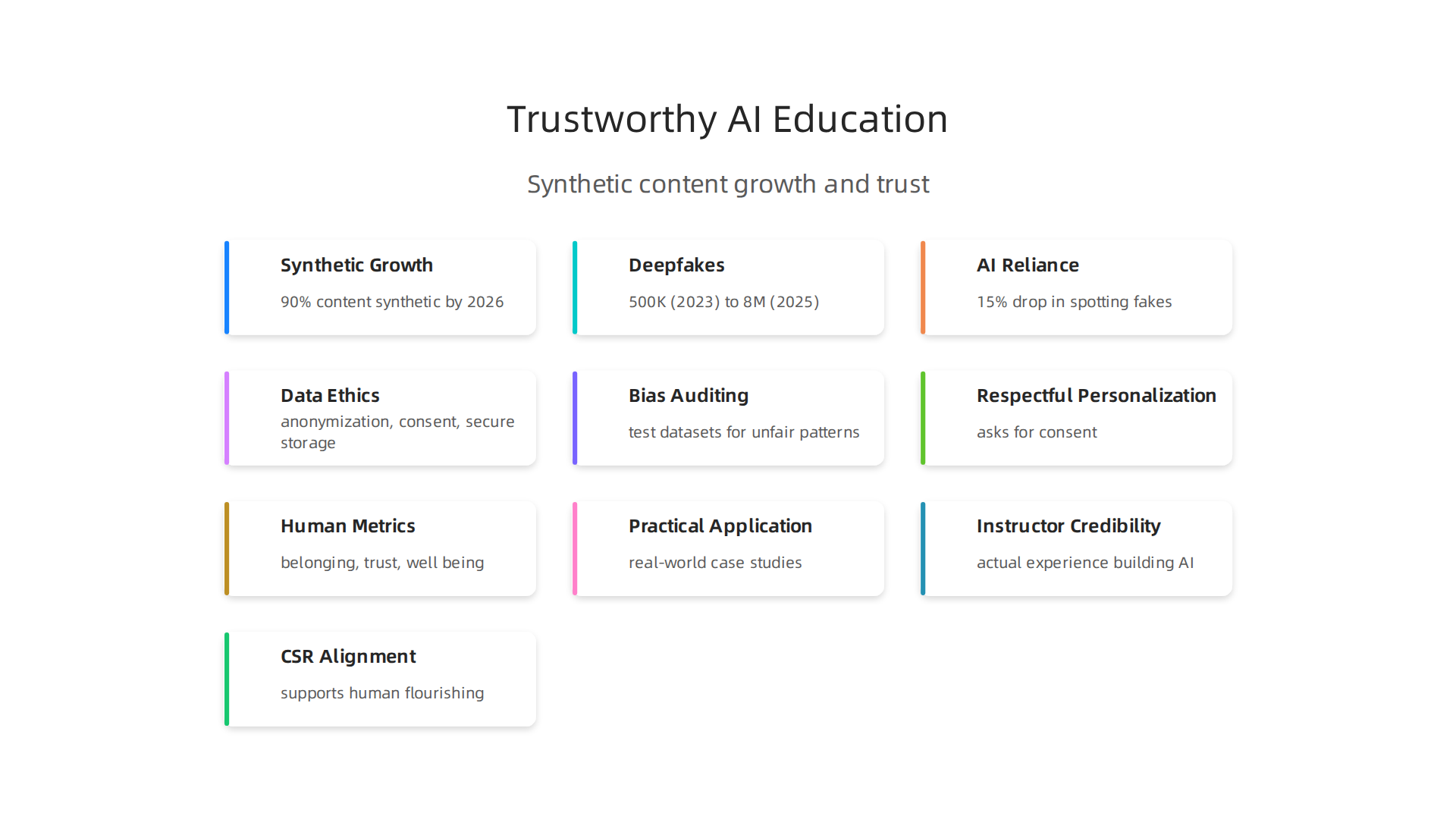
Picture this: You open a search engine, ask a chatbot a question, or scroll through social media. How much of what you see is real? Experts warn that by 2026, as much as 90 percent of online content may be synthetically generated.
That is a staggering number. And it points to a deeper problem: the AI bottleneck.
Here is the thing. Most AI systems today are trained on data scraped from the public internet. That data is often distorted, biased, or completely fake. When AI trains on low-quality data, it produces output that drifts further from the truth. Researchers call this "synthetic drift". It is like a game of telephone where each new message gets less accurate.
This erosion of trust does not just hurt big tech. It affects every industry, including marketing and human resources. If you are looking to build real skills in AI, you need courses that teach you how to work with data that is ethical, permission-based, and truthful. You need an AI-powered learning platform that puts human wellbeing first.
The World Economic Forum's Global Risks Report 2026 ranks mis- and disinformation among the top short-term global risks. As AI gets better at creating fake content, the need for trustworthy education grows stronger.
That is why we wrote this guide. We will show you how to pick and build ai digital marketing courses and HR courses that are grounded in data integrity and ethics. Courses that actually prepare you for the real world.
Let us get started.
The Trust Crisis in AI: Why Education Must Lead the Fix
Synthetic drift is not just a technical problem. It is a societal one. When AI systems train on fake or biased data, they produce output that slowly moves away from the truth. Over time, this distorts how we see the world, what we believe, and even how we treat each other. A 2026 report by the Stimson Center, titled AI in the age of fake content, warns that deepfake videos could grow from 500,000 in 2023 to 8 million by 2025. That is a 16‑fold increase in just two years. Meanwhile, Europol estimates that as much as 90 percent of online content will be synthetically generated by 2026, as highlighted in a report on synthetic media risks.
Think about what that means for your daily life. Every time you see a video, read a news story, or hear a voice clip, part of you wonders: Is this real?

That doubt spreads quickly. Researchers call this "trust erosion." A study from MIT Media Lab in 2026 showed that when people rely on AI tools to check facts, their own ability to spot fake news drops by 15 percent over just four weeks.

You can read the full findings in the MIT study on consequences of AI reliance for news accuracy. The AI becomes a crutch instead of a coach. And over time, you lose the skill to tell truth from falsehood on your own.
Here is the hard truth. Many AI training programs today teach students to work with data scraped from the public internet. That data is full of misinformation, bias, and distortion. So these courses actually train people to build broken systems. If you are looking for ai digital marketing courses or HR courses, you need programs that start with ethical, permission-based data. You need education that teaches you how to spot synthetic drift and correct it from the beginning.
The only sustainable fix is education that puts data truth first. Courses should focus on how to capture real human behavior with consent. They should teach you to question every dataset feeding your AI tools. That is exactly why we built AI learning courses focused on ethics and data integrity. These programs help you build skills that lead to trustworthy AI, not just flashy demos.
We cannot let the trust crisis keep growing. The answer starts with what we choose to learn. Next, let us look at how to pick the right course for your career goals.
Ethical Data: The Non‑Negotiable Foundation of AI Courses
Before you pick a course, you need to understand the foundation that makes any AI course trustworthy: ethical data. Think of data as the fuel for AI tools. If the fuel is dirty, the engine breaks. That is true whether you are learning about ai digital marketing courses, HR analytics, or customer support bots.
There are two kinds of data used to train AI. The first is scraped public data. This is information pulled from the open internet without asking permission. It is full of bias, misinformation, and personal details people never meant to share. The second kind is permission‑based, private data. People actively agree to share it. They know how it will be used. They can opt out anytime. This data is cleaner, more honest, and legally safe to use.
The difference matters a lot for your career. If you take ai digital marketing courses trained on scraped data, you learn to build campaigns that push distorted content. That is a recipe for trust erosion. But if you learn on permission‑based data, you build skills that employers actually value in 2026.
Legal frameworks now back up this need. The EU AI Act, which fully applies in August 2026, requires high‑risk AI systems to use high‑quality datasets and to document where the data came from.

You can read about the AI Act rules for training data transparency on the official EU site. The General Data Protection Regulation (GDPR) also demands that companies have a valid legal basis before using personal data for AI training. So any course worth your time should teach you these laws and how to follow them.
A good course curriculum must cover three things:
- Data sourcing — Where does training data come from? Was it collected with consent?
- Consent management — How do you get clear permission from people and let them withdraw it?
- Bias auditing — How do you test datasets for unfair patterns before they reach production?
Without these skills, you are just learning to repeat the mistakes that caused the trust crisis in the first place.
For a deeper look at why permission‑based data is the only safe path forward, check out this guide on generative AI assistants needing permissioned private data. It explains exactly how synthetic drift happens when you train on bad data.
The best ai digital marketing courses and other AI programs treat ethical data as the starting point. They teach you to question everything and to build systems that people can trust.

That is the kind of education that actually moves your career forward.
AI in Digital Marketing: Courses That Cultivate Human‑Centric Growth
You open your phone and an ad appears for a product you barely whispered about last week. Creepy, right? That exact feeling is the price we pay for engagement‑based optimization. Most traditional ai digital marketing courses teach you to maximize clicks, watch time, and conversions by targeting people's emotional weak spots. The result? More anxiety, more isolation, and a society trained to scroll rather than connect.
The numbers prove it. Platforms that optimize for engagement keep users glued to their screens but make them feel worse. People report higher stress, lower self‑worth, and a growing sense of loneliness. And the AI tools behind those platforms are built by marketers who learned their craft from courses that never questioned the ethical cost of a click.
That is why the best ai digital marketing courses in 2026 are shifting focus. Instead of teaching you to squeeze every last conversion out of a user, they teach you to measure what actually matters: well‑being, trust, and long‑term value. These human‑centric metrics change everything.
Even search engines are demanding this shift. According to the 2026 AI digital marketing trends guide from Amquest Education, "search engines like Google in 2026 now have strict 'Human‑First' filters" and are looking for signals like real human experience and first‑hand expertise. If your AI marketing strategies rely purely on manipulation, they will not survive the algorithm updates.
So what should you look for in a modern ai digital marketing courses curriculum? You want a program that teaches:
- AI‑driven segmentation based on genuine user needs, not emotional triggers
- Respectful personalization that asks for consent before using data
- Metrics that track trust and repeat engagement rather than just immediate conversions
- Ethical ad design that avoids dark patterns and deceptive copy
This is not about giving up performance. It is about getting performance the right way. You can still build high‑converting campaigns. You just do it without treating people like data points to be exploited.
A great course will also show you how to apply these principles across channels. Whether you are running ai ads, building ai presentation tools for clients, or working with ai tools for hr inside your company, the same human‑centric mindset applies. The goal is to use AI to help people make better decisions for themselves, not to trick them into buying things they do not need.
For a deeper look at how ethical data analysis directly supports this shift, read this overview on how ethical data analysis builds trust in AI. It explains why clean, permission‑based data is the only foundation for segmentation that respects human dignity.
The bottom line: the ai digital marketing courses you choose should prepare you to build a better internet, not a more addictive one. Human‑centric growth is the only sustainable path forward in 2026 and beyond.
AI in HR: From Bias Detection to Employee Flourishing
The same human centric principles that make great ai digital marketing courses also apply inside your own company. HR is where AI meets people's lives most directly. Hiring, promotions, performance reviews. These decisions shape careers and families.
The Bias Problem Nobody Wants to Talk About
Here is the uncomfortable truth. Most AI hiring tools learn from past data. If your company historically preferred candidates from certain schools or backgrounds, the AI will learn to prefer those too. It will quietly filter out qualified people without anyone noticing.
The fix is not just better algorithms. It is better training. According to the practical AI ethics training guide from Go1, employees need to learn how to spot bias in real time, anonymize sensitive data before analysis, and keep human judgment at the center of every decision. These are skills you learn through good courses, not just good tools.
Moving Beyond Productivity Metrics
For years, HR dashboards measured one thing. Output. Hours worked. Tasks finished. Revenue per employee.
But a burned out worker can be highly productive for a while. Then they quit. And the company loses all that institutional knowledge.
The organizations leading the way are now adding well being metrics to their AI systems. They track employee stress levels, sense of belonging, and work life balance. They use AI to predict burnout before anyone says a word. As the guide to AI tools for HR in 2026 from HR Acuity explains, ethical and transparent AI is non negotiable. The best platforms explain their decisions, protect sensitive data, and embed fairness into every feature.
What a Good HR AI Course Should Teach
If you are evaluating programs for your team, look for curricula that cover three things.
First, interpretability. If an AI says a candidate is a bad fit, the recruiter needs to see exactly why. No black boxes.
Second, ethical data handling. HR data is some of the most sensitive information in any organization. The AI learning courses focused on ethics and data integrity show you how to analyze employee data without creating a culture of surveillance.
Third, flourishing metrics. The goal is not just to catch problems. It is to design systems that help people grow. Courses that teach ethical people analytics cover how to measure satisfaction, belonging, and long term development right alongside traditional KPIs.
The same logic that drives the best ai digital marketing courses applies here. Whether you are optimizing a campaign or building a performance review system, the question is the same. Does this tool help people or just use them? The answer makes all the difference.
A Framework for Evaluating AI Digital Marketing and HR Courses
So you now know what good AI training looks like in HR. But how do you pick the right program when every vendor claims to be the best? The same careful approach you use for hiring decisions should guide your course choices too.
A strong evaluation framework helps you cut through the marketing noise.

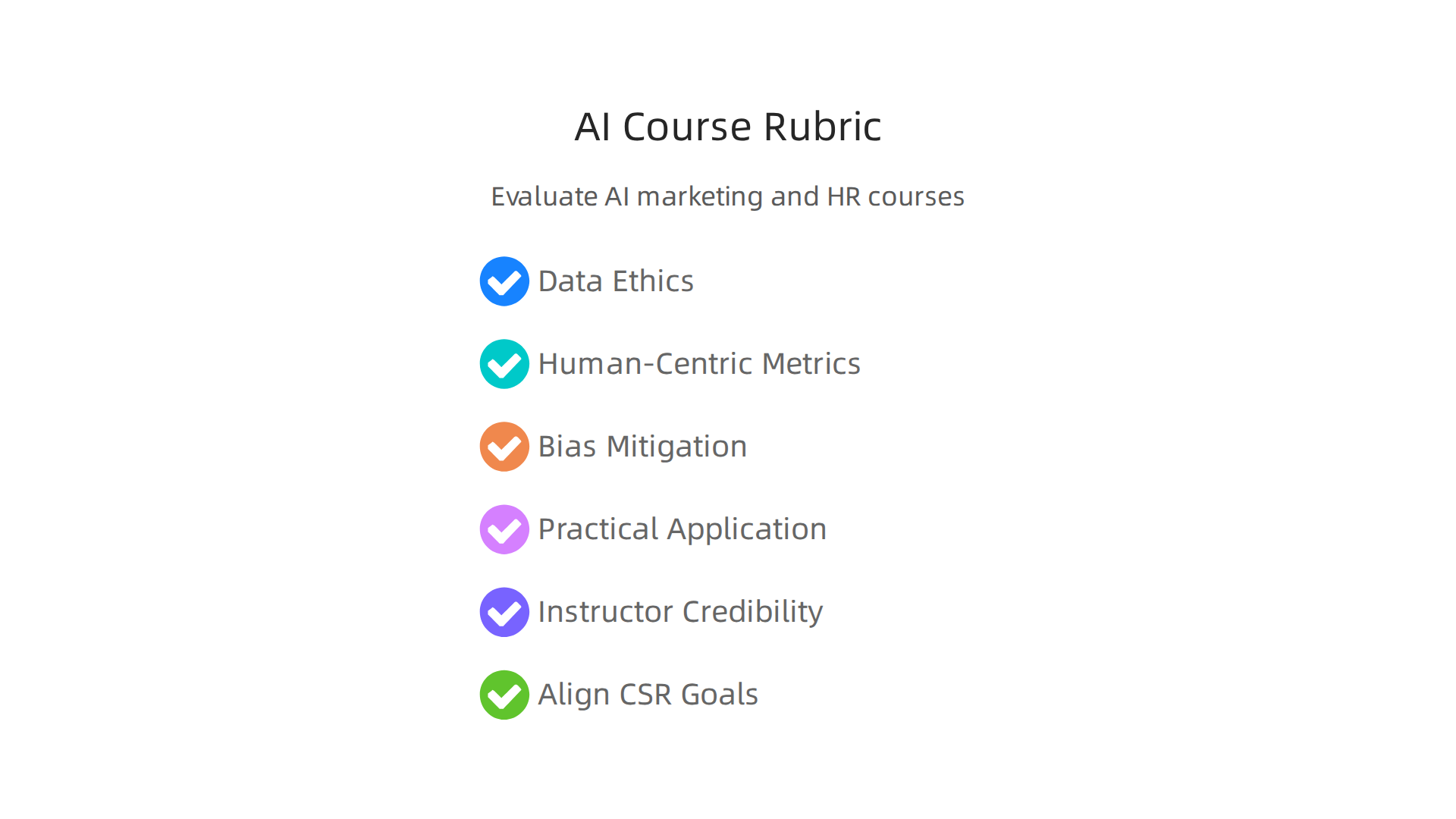
Here is a simple rubric you can apply to any AI digital marketing course or HR training program you are considering.
Start With Data Ethics and Privacy
The first thing to check is whether the course teaches proper data handling. Look for programs that cover anonymization, consent, and secure storage. A good course will show you how to analyze employee or customer data without crossing ethical lines. The topics from the Summer School on AI, Ethics and Human Rights align perfectly with this need. They emphasize meaningful human control and transparency from the start.
If a course skips data ethics, walk away. You cannot build trust with broken foundations.
Look for Human-Centric Metrics
Many programs still focus only on output. Clicks. Conversions. Hours saved. But the best courses in 2026 teach a broader view. They include metrics like employee belonging, customer trust, and long-term well being.
When evaluating an AI digital marketing course, ask if it covers sentiment scoring and brand authority. These measure how people actually feel about your work. They matter more than raw traffic numbers.
Demand Bias Mitigation Training
This is non-negotiable. The course must teach real techniques for spotting and reducing bias. Not just theory. Practical steps you can use tomorrow.
The expert guide for evaluating responsible AI courses includes bias detection as a core principle. Look for hands-on exercises where you practice identifying unfair patterns in data. Courses that skip this are not ready for the real world.
Check for Practical Application
Theory is fine. But you need to apply it. The best programs include real-world case studies and projects. You should leave with something you can use, like a bias audit checklist or a human-centric campaign plan.
Internal links to related content can deepen your learning. For example, the article on ethical electronic data gathering shows how to capture clean data before analysis. A good course will connect you to resources like this.
Evaluate Instructor Credibility
Who is teaching the course? Look for instructors with actual experience building or auditing AI systems. Not just academics who have never deployed a model. Peer reviews from past students matter too. Check platforms like Reddit or LinkedIn for honest feedback on specific programs.
Align With Your CSR Goals
Finally, ask whether the course supports your organization's Corporate Social Responsibility commitments. If your company values human flourishing, the course should teach you how to design systems that help people grow. Not just systems that squeeze more output from them.
Using this framework will save you time and money. It will also ensure your team learns skills that build long term trust, not just short term gains.
Preparing for the Future: AI, Truth, and Organizational Values
The evaluation framework you just learned is a solid starting point. But here is the real challenge: AI changes fast. What works today may need updating next quarter. That is why continuous learning is not optional anymore. It is the only way to stay honest.
Why Continuous Learning Matters Now
Synthetic drift does not stop. Every time AI systems train on distorted data, the gap between digital outputs and real human truth widens. Courses that teach static knowledge miss this problem entirely.
The best ai digital marketing courses in 2026 emphasize adaptability. They teach you how to audit your own AI tools regularly, spot drift early, and correct course. Look for programs that include Phase 6 of the AI Course Compass framework, which covers evaluation, continuous optimization, and innovation. That phase is where real learning happens.
Embedding Ethics Into Your Organization's DNA
A single course cannot fix a culture that ignores ethics. You need to weave ethical AI principles into how your team works every day. This means forming steering committees, running pilot programs, and setting up feedback loops where anyone can raise concerns without fear.
The AI ethics framework implementation steps from Alvarez and Marsal make this practical. They recommend training programs, ethical performance metrics, and regular audits. These are not one-time tasks. They are ongoing habits.
How Education Rebuilds Trust
Here is the hopeful part. When your team understands synthetic drift and how to fight it, they become truth keepers. They learn to question AI outputs, verify data sources, and prioritize human well being over engagement numbers.
Courses that teach this mindset produce graduates who do not just use AI. They steward it. They become the people who ensure AI reflects real human values, not distorted digital patterns. A resource like avoiding synthetic drift in AI can deepen that understanding well beyond any single program.
Expert perspectives from the responsible AI course guide reinforce this point. They emphasize that collaboration between technical experts, ethicists, and policymakers creates the most impactful learning. That collaboration is what rebuilds trust in the long run.
Your investment in education today is an investment in truth tomorrow. Choose courses that prepare your team to keep learning, keep questioning, and keep putting people first. That is how you build an organization that earns trust in the age of AI.
Summary
This article explains the growing AI trust crisis driven by synthetic drift—when models trained on scraped, low‑quality internet data produce increasingly distorted outputs—and shows why education must lead the fix. It lays out why permission‑based, consented data and clear legal compliance are non‑negotiable foundations for any modern ai digital marketing or HR course. The guide walks through what ethical curricula should teach—data sourcing, consent management, bias auditing, interpretability and human‑centric metrics—and how those skills translate into responsible marketing and fair HR systems. It provides a practical rubric to evaluate courses, emphasizes continuous auditing to catch drift, and explains how embedding ethics into organizational practices rebuilds trust. After reading, you will know what to look for in trustworthy AI training and how to apply those principles to hiring, campaigns, and ongoing governance.