Home


Menu

Close

How the CIA Triad Cyber Security Model Protects AI Systems in 2026
Published:
July 10, 2026
Introduction: Why the CIA Triad Matters More Than Ever for AI
Imagine you are using an AI assistant to schedule your day. It knows your calendar, your contacts, even your location.

Now imagine a hacker tricking that assistant into handing over everything. Scary, right? That is why the CIA triad cyber security model matters now more than ever.
The CIA triad stands for three core ideas: confidentiality, integrity, and availability. Together they form the foundation of information security. The triad has been around for decades, but in 2026, with AI systems running everything from customer service to medical diagnosis, these principles are getting a much needed refresh. For a clear definition, check out this CIA Triad explained by Bridewell.
AI systems open up new attack surfaces. Bad actors can poison training data, steal model weights, or flood chatbots with malicious prompts. Social engineering attacks, where a person is tricked into breaking security rules, also target the humans who manage AI. Understanding the social engineering security definition can help teams stop these attacks before they start.
A security first mindset is no longer optional. AI cybersecurity plans must include testing for adversarial attacks and something called synthetic drift, where AI outputs slowly move away from the truth over time. New government guidance, like the NIST AI RMF 2025-2026 updates, helps organizations apply the CIA triad to AI in a structured way.
To keep AI trustworthy, companies need to protect data at every step. Explore how data protection services can help solve the AI trust crisis.
In the sections ahead, we will break down each pillar of the CIA triad. You will learn practical steps to lock down confidentiality, safeguard integrity, and keep AI systems available when they are needed most.
The CIA Triad: A Foundation for AI Security
Let's break down each pillar of the cia triad cyber security model and see how they apply to AI systems in 2026.
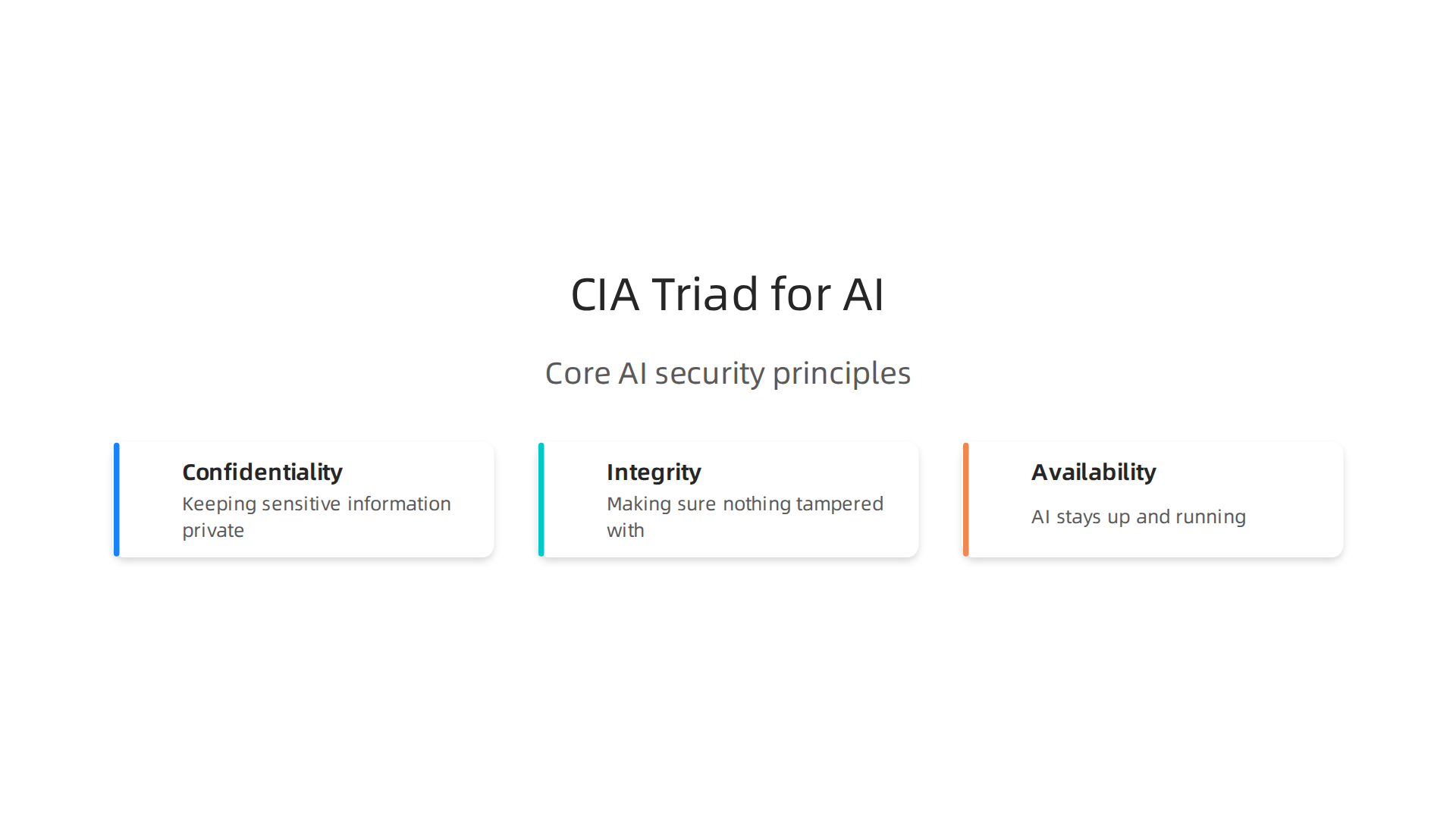
Confidentiality means keeping sensitive information private. In the AI world, this covers three things: the training data used to teach the model, the model parameters (the internal settings that make the AI work), and the outputs it generates. If a hacker steals your training data or model weights, they can copy your AI or extract private user info. As the NIST Cybersecurity Framework for AI profile shows, new government guidance now explicitly addresses these risks.
Integrity is about making sure nothing has been tampered with.

Model weights must stay exactly as they were after training. Data pipelines feeding the AI must be clean and unaltered. Even the predictions the AI makes need to be verified. A poisoned dataset can slowly corrupt an AI's behavior, a problem called synthetic drift. Learn more about how permissioned private data prevents synthetic drift.
Availability means the AI stays up and running when people need it. AI APIs and inference endpoints must handle heavy traffic and resist denial of service attacks. If your customer service chatbot goes down during a sale, you lose trust and money. Applying a security first mindset to each pillar helps teams build AI that is safe, honest, and always ready.
Confidentiality in AI: Protecting Training Data and Model Parameters
Let's start with a real worry. When you train an AI on sensitive data, what stops that data from leaking out later? This is the core question of confidentiality.
Confidentiality in the cia triad cyber security model means keeping information private. In AI, this covers three main things. First, your training data. That data often includes personal details like names, addresses, or health records. Attackers can use extraction attacks to pull this private information right out of a model's responses. Second, the model parameters themselves are valuable intellectual property. You need strict access controls so no one steals or copies your AI's internal settings. Third, the outputs the AI generates can accidentally reveal secrets if not carefully filtered.
A strong security first approach here uses two powerful tools. Differential privacy adds mathematical noise to training data, making it nearly impossible to trace a specific person's information back through the model. Encryption keeps data scrambled both at rest and while traveling between systems. These methods together form a solid defense.
For a deeper look at how ethical data practices support privacy, explore our comparison of ethical AI tools for data privacy. The goal is simple: build AI that respects confidentiality without sacrificing performance. As the CIA security triad explained by URM Consulting reminds us, these principles are the bedrock of any secure system.
Integrity in AI: Ensuring Data and Outputs Are Unaltered
Now let's look at the second pillar of the cia triad cyber security model. Integrity. This means making sure data and AI outputs stay accurate and unaltered. The risk here is real. Attackers can launch poisoning attacks by slipping bad data into the training set during model training or even during live inference. When that happens, the AI learns the wrong patterns and starts giving wrong answers. In fields like healthcare or finance, a corrupted output can lead to serious harm. A misdiagnosis or a bad trading decision could cost real money or even lives.
How do we protect integrity? Two key techniques help. Cryptographic hashing creates a unique fingerprint for data files. If someone changes the data even slightly, the hash changes and you know something is wrong. Provenance tracking keeps a clear record of where every piece of data came from and how it was processed. This makes it much harder for attackers to inject bad information without being caught. As the CIA Triad explained by Bridewell points out, integrity is essential for trust in any system. To get better at applying these principles, consider AI learning courses focused on ethics and data integrity. These courses teach teams how to build systems that resist tampering and keep data trustworthy from start to finish.
That's the goal. Integrity means the AI you rely on today will still give you the truth tomorrow. Combined with confidentiality from the last section, you're building a strong security first foundation.
Availability in AI: Keeping AI Services Operational
Now let's talk about the third and final pillar of the cia triad cyber security model. Availability. Even with strong confidentiality and integrity, your AI system is useless if no one can access it when needed. Attackers know this. They often target AI endpoints with DDoS attacks that flood the system with fake requests. A simpler threat is resource exhaustion, where heavy compute loads drain processing power and memory until the service freezes.
The fix comes in layers. Redundancy is the first line of defense. You run multiple copies of your AI model across different servers. If one goes down, another takes over in seconds. Auto-scaling is the next step. Your cloud infrastructure should automatically add more compute power when traffic spikes. This keeps response times fast even during an attack. As the CIA security triad explained by URM Consulting notes, availability ensures authorized users have reliable access when they need it.
Monitoring for unusual patterns is just as important. Sudden traffic jumps or weird request shapes can signal the start of an attack. Good monitoring lets your team react before downtime happens. Strong cybersecurity awareness training helps everyone spot availability issues early and respond the right way.
Availability is what makes the entire security first approach real. Without it, the other pillars don't matter. With redundancy, auto-scaling, and smart monitoring in place, your AI stays online and ready for your users. That's how you complete the full picture of the cia triad cyber security model.
The AI Security Landscape: Key Threats and Vulnerabilities
Now that you understand the three pillars of the cia triad cyber security model, it's time to look at the specific attacks that threaten AI systems today. These threats target each pillar in unique ways. The most common ones are adversarial attacks, data poisoning, and denial of service.
Adversarial attacks are a top concern. An attacker feeds small, hidden changes into a model's input. To a human, the input looks normal. But the AI misclassifies it completely. For example, a self-driving car could misread a stop sign with a few stickers added. This is a serious risk for any AI handling critical decisions. As adversarial machine learning explains, these attacks are designed to cause errors by exploiting how models process data.
Data poisoning is another big one. Instead of attacking during use, the attacker corrupts the training data itself. They slip bad examples into the dataset. The model learns the wrong patterns. Later, it behaves badly because it was taught bad habits. This attack directly breaks the integrity pillar of the cia triad cyber security framework.
Denial of service on AI APIs can also cripple your systems. We already covered that in the availability section, but it's worth repeating: AI services need protection from traffic floods.
Building trust in your AI means understanding these threats first. That is where a real security first mindset begins. You plan for attacks before they happen. And that starts with knowing what attackers want to break.
Adversarial Attacks on Models
Let's look closer at how adversarial attacks actually work. The core trick is simple: tiny tweaks to input data that a human would never notice. But the model sees something completely different.
Think about a stop sign. You add a few small stickers in just the right spots. A person still reads "STOP." But an AI vision model might read it as a speed limit sign. This is what experts call an adversarial example. As the guide on adversarial AI attacks explains, these attacks feed deceptive data to trick models into wrong answers.
These attacks hit the integrity pillar of the cia triad cyber security model hard. The model's output is wrong, so you cannot trust it. In some cases, availability also suffers if the attack crashes the system.
So how do you defend against this? There are three proven approaches:
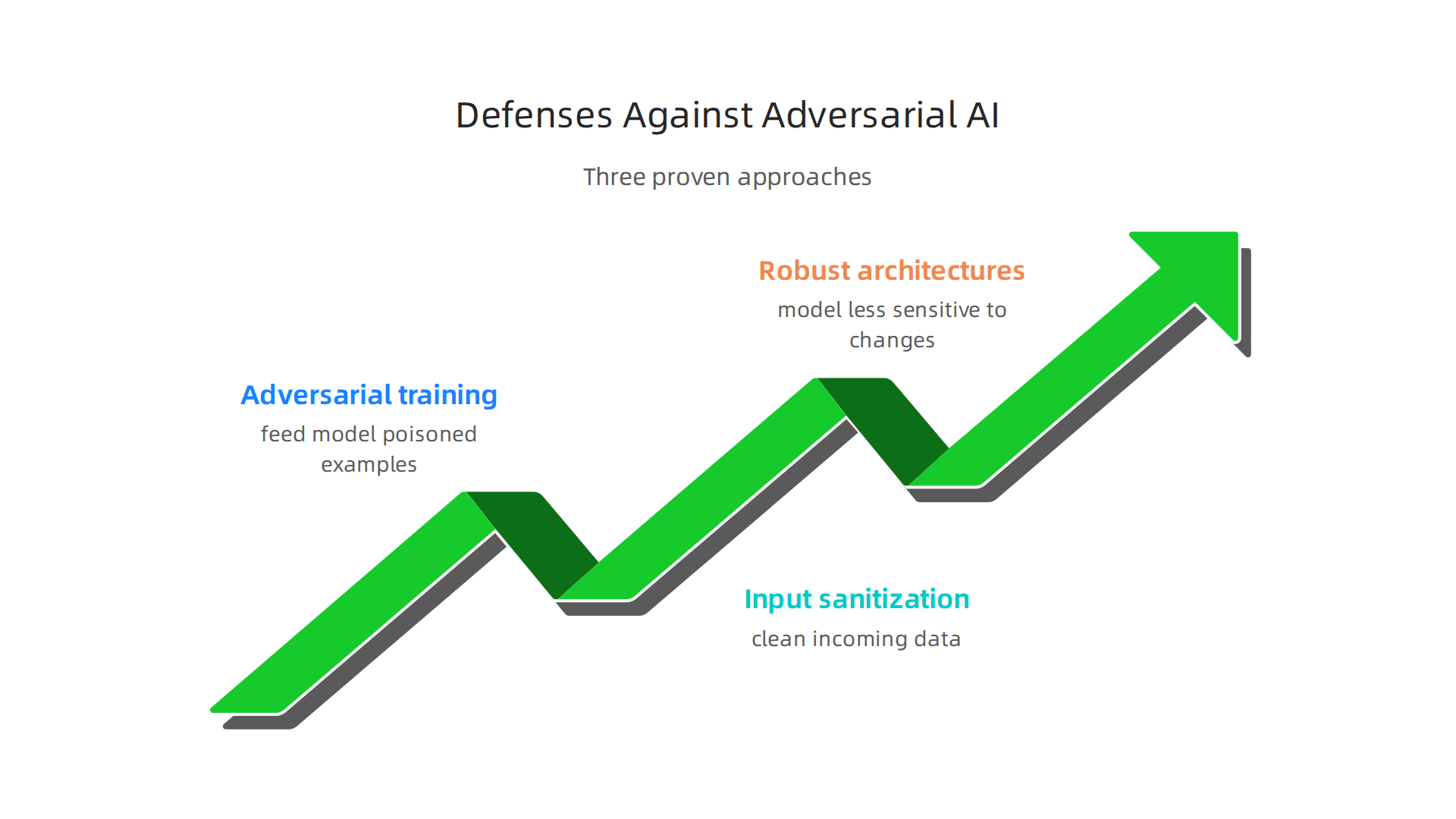
- Adversarial training. You feed your model poisoned examples during training so it learns to spot them.
- Input sanitization. You clean incoming data before the model processes it.
- Robust architectures. You design the model itself to be less sensitive to small changes.
Building these defenses takes planning. Start by understanding the tools available to your team. Investing in cybersecurity awareness training turns your people into your first line of defense.
Data Poisoning and Integrity Compromises
While adversarial examples attack a model after training, another dangerous method hits much earlier. Data poisoning happens when someone slips bad data into the training set. The model learns from that corrupted information and behaves wrongly from the start.
This is a direct hit on the cia triad cyber security pillar of integrity. Your model's outputs look normal, but they are secretly broken. As the data poisoning attacks explained entry notes, these are among the most common threats in adversarial machine learning.
A specific version is the backdoor trigger. The attacker plants a hidden pattern during training. The model works fine on normal data. But when it sees the trigger (a special shape, a certain word), it misclassifies on purpose. For example, a facial recognition system might identify anyone wearing a specific hat as the system administrator, giving them unauthorized access.
Prevention is all about knowing where your data comes from. You need strict data provenance, careful validation, and robust aggregation methods. Teams serious about cleaning up their training pipelines benefit from investing in building trust through ethical data analysis. Clean data is the foundation of trustworthy AI.
Availability Attacks: Denial of Service on AI Endpoints
While data poisoning secretly corrupts the training phase, availability attacks strike while the model is live. These are denial of service (DoS) attacks aimed directly at AI endpoints. Attackers flood an API with cheap, repetitive requests until it cannot serve legitimate users. Since many AI models run on limited compute resources, even a small burst of traffic can cause crashes or extreme latency.
This directly violates the availability pillar of the cia triad cyber security framework. For real-time systems like fraud detection or autonomous driving, that downtime isn't just an inconvenience—it can be dangerous. The tactics and techniques of adversarial machine learning categorize these as oracle or decision-time attacks that exploit model access points.
Mitigation requires a security first mindset. Start with rate limiting to cap how many requests one source can make. Strong authentication ensures only verified users reach the model. Federated failover spreads the load across multiple endpoints so no single target can bring the system down. Organizations should also invest in data protection services that monitor endpoint traffic and flag unusual patterns. Keeping AI available means treating it like any other critical infrastructure—plan for attacks before they happen.
How the CIA Triad Addresses the 'AI Bottleneck'
The previous section showed what happens when availability fails. But the deeper problem for most teams is the "AI bottleneck." This happens when there simply is not enough ethical, permissioned private data to train reliable models. Without that trusted data, AI systems struggle to learn accurately.
This is where the cia triad cyber security framework shines. It gives us a clear roadmap for overcoming the data bottleneck and building trustworthy systems. Let's look at how confidentiality and integrity directly fix this data shortage.
Confidentiality makes it safe to share sensitive data. When organizations know their data is protected through encryption and access controls, they are far more willing to donate or license it for training. This unlocks a huge reservoir of high-quality, private data that was previously locked away.
Integrity controls combat synthetic drift by constantly verifying data provenance. If the source is distorted, the output will be too. This is a key focus in the latest AI cybersecurity trends to watch in 2026, where verification and trust are top priorities. The CIA triad ensures every piece of data can be traced back to its root, keeping the model grounded in reality.
By leaning into these core principles, organizations can unblock the AI bottleneck and build systems people can actually rely on.
Permissioned Data and Confidentiality
The first piece of that puzzle is confidentiality. When we talk about permissioned data, we are really talking about giving data owners control. They need to know their sensitive information is safe before they share it. This is where encryption and access controls come in.
Encryption scrambles the data so no one can read it without the key. Access control decides who gets that key. Together, they allow organizations to share data for AI training without exposing the raw content. Think of it like a secure lockbox. The AI can look inside and learn, but it cannot copy or leak what it finds. This directly supports the cia triad cyber security principle by making private data available safely.
There is also a clever technique called federated learning. Here, the AI model travels to the data instead of the other way around. The data never leaves its home server. Only the model's updates are shared. This cuts privacy risks drastically. For a deeper look at how permissioned data fights distorted AI, check out this piece on why generative AI assistants need permissioned private data.
New tools like data trusts and trusted execution environments (TEEs) take this further. A data trust is like a legal agreement that controls how data gets used. A TEE is a hardware safe inside a computer chip. Both make sure data stays confidential even during processing. This is confidentiality in action, and it is the foundation for unlocking the high-quality data that ethical AI needs.
Verifying Data Integrity to Combat Synthetic Drift
Confidentiality alone is not enough. The second pillar of the cia triad cyber security is integrity, and it is just as vital for building trustworthy AI. Integrity means the data has not been altered or polluted by unauthorized sources. That is exactly what synthetic drift threatens. When AI-generated content sneaks into training datasets, it distorts the truth and leads to unreliable outputs.
So how do we verify data has not been tampered with? Cryptographic proofs offer one solution. These are digital signatures that prove where data came from and whether it has changed. Watermarking adds another layer by embedding hidden markers in original content. Any AI-generated content that lacks the proper watermark can be flagged and removed before it poisons the training pool.
Integrity checks at the moment of data ingestion also filter out suspicious material. Automated systems scan for signs of tampering or synthetic origin. This is a classic cia triad cyber security practice applied to AI pipelines. To understand how integrity fits into the bigger security picture, check out this explanation of the CIA Triad integrity and availability.
When you combine strong integrity checks with the confidentiality methods we just covered, you build a system that is both private and truthful. That is the foundation of a security first approach to AI development. For a deeper look at how careful data collection prevents drift, see this article on ethical data gathering and retrieval.
Regulatory and Ethical Imperatives: CIA Triad Compliance
This is not just good practice. In 2026, it is becoming the law.

The cia triad cyber security is now written into the world's most important AI regulations.
The European Union AI Act is the first major law of its kind. It requires organizations to build risk management frameworks that line up with confidentiality, integrity, and availability controls. High-risk AI systems must go through strict checks before they reach the market. These rules are already in effect as of 2026. You can read more about the EU AI Act requirements for high-risk systems on the official EU site.
Across the Atlantic, the NIST AI Risk Management Framework takes a similar approach. It names confidentiality, integrity, and availability as core functions that every AI system should support. While the EU AI Act is mandatory, the NIST framework offers a voluntary roadmap. But both point to the same truth: you cannot have trustworthy AI without the cia triad cyber security controls.
Ethical AI frameworks add another layer. They push for data provenance and transparency. That means being able to prove where every piece of training data came from and that it has not been altered. That is the integrity part of the triad in action. For a practical look at how ethical tools help meet these goals, see this comparison of ethical AI tools for data privacy and trust.
The bottom line is simple. Following a security first approach is no longer optional. Regulations demand it. Ethics demand it. And your users expect it.
Practical Steps to Implement CIA Triad for AI Systems
So how do you actually put these rules into practice? Here are three concrete steps that bring the cia triad cyber security to life inside your AI systems.

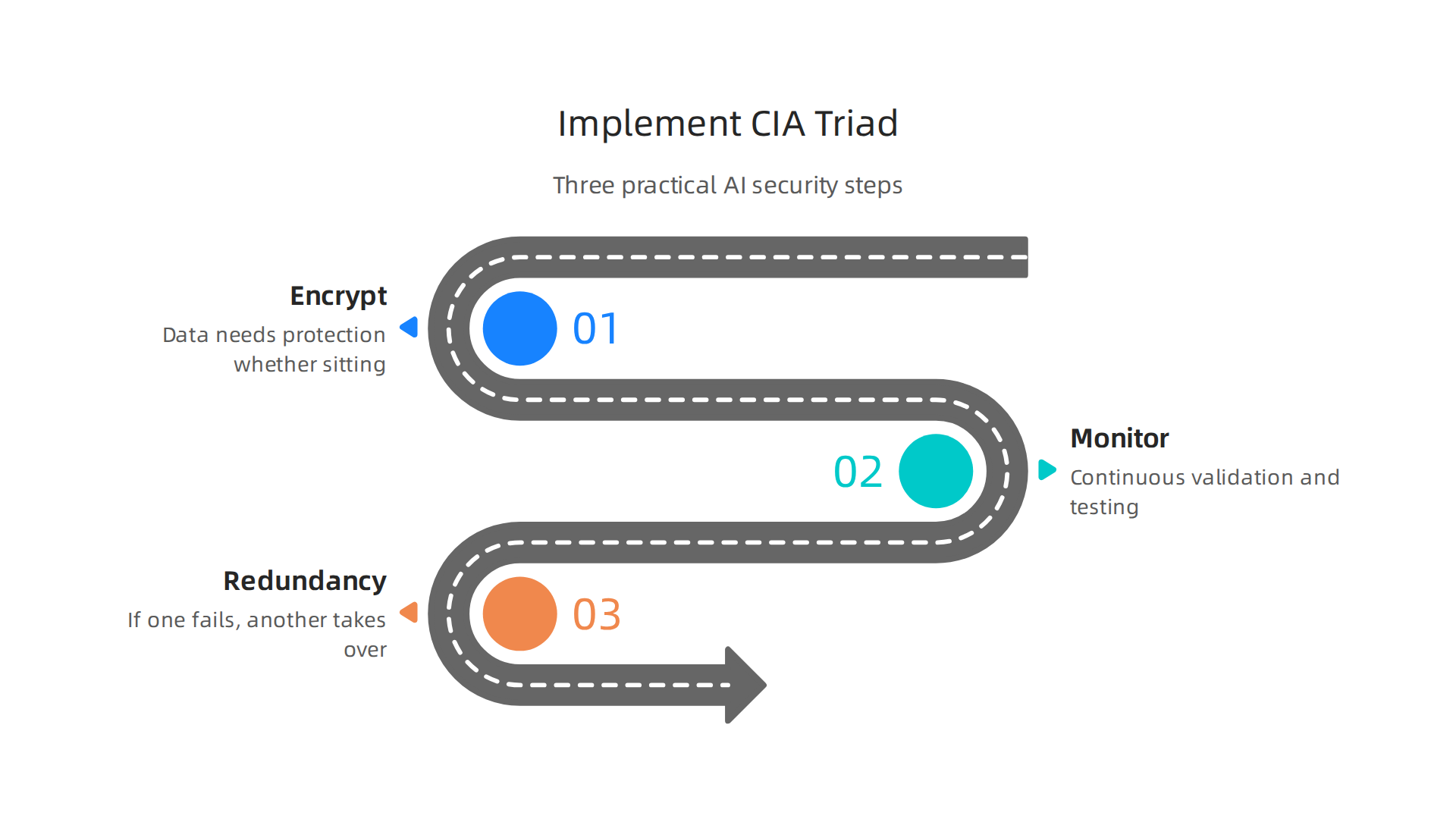
Step 1: Encrypt everything. Data needs protection whether it is sitting in a database, moving between servers, or being processed by a model. Strong encryption keeps unauthorized eyes out. This is the confidentiality piece. The latest guidance from global cybersecurity agencies backs this up. You can see the full details in the AI data security guidelines from international agencies.
Step 2: Monitor model integrity constantly. AI models drift over time. New data can introduce bias or errors. You need continuous validation and testing to catch problems before they spread. This protects the integrity of your system. Regular audits and anomaly detection are key tools here.
Step 3: Build for availability with redundancy. If your AI system goes down, the business stops. Design your infrastructure so that if one component fails, another takes over without missing a beat. Scalable cloud setups and failover plans are your friends here.
These steps also require a strong human element. The best technology fails if people do not use it correctly. That is why training your team matters just as much as the technical controls. A well educated workforce reduces risk from the inside out. You can explore this idea more in a guide on cybersecurity awareness training.
Start small. Pick one of these three steps and build from there.
Data Governance and Encryption
Let's zoom in on the foundation of that first step: data governance and encryption. Before you can encrypt anything, you need to know what you are protecting. That starts with classifying your data by sensitivity.
Not all data is the same. Customer names, financial records, and health information need stronger protection than public blog posts. Sort your data into categories like public, internal, confidential, and restricted. Then apply the right encryption for each category at every stage of the pipeline.
What does that look day to day? Encrypt data at rest (when it sits on a server), in transit (when it moves between systems), and during processing (while the AI model works on it). For the most sensitive information, consider advanced tools like homomorphic encryption or secure enclaves. These let the AI process data without ever seeing the raw values. The latest guidance from CISA lays out exactly how to do this properly in the new best practices guide for securing AI data.
You also need strict access controls. Only the people and systems that truly need the data should have permission to touch it. Audit logs are your friend here. They track every time someone accesses or changes data. Regular reviews of these logs catch misuse early.
Getting data governance right creates trust. It shows users and regulators that the cia triad cyber security principles are not just words on a whiteboard. They are built into how your AI systems actually work. For a deeper look at how ethical data handling builds that trust, check out data protection services that solve the data crisis.
Start with one data category, classify it, and lock it down. Then move to the next.
Continuous Monitoring and Incident Response
Here is where the cia triad cyber security principles really earn their keep. You have encrypted your data and set up governance. But AI models are not static. They drift. New data patterns emerge. Attackers find creative ways to sneak malicious inputs past your defenses. That is why continuous monitoring is not optional anymore.
You need to watch for three things every day: model drift (does the model still make accurate predictions?), input anomalies (are weird requests trying to trick it?), and overall system health (is infrastructure running smoothly?). These directly protect integrity and availability. The 2026 guide on AI Security in 2026: Enterprise Governance, Risks, and Best Practices spells out why real time monitoring is the backbone of a solid ai cybersecurity strategy.
Your incident response plan must evolve too. A data breach is one thing. Model poisoning is another. If an attacker quietly corrupts your training data over weeks, your AI starts making bad decisions without anyone noticing. Your plan needs specific playbooks for these AI centered threats. Automated detection tools can flag unusual model behavior instantly. And automated rollback lets you snap back to a known good version of the model before damage spreads.
This is where security first thinking shines. Build automated detection and rollback into your pipeline from the start. That cuts the time to recover from hours to minutes. For real world tips on building that kind of resilient culture, check out cybersecurity awareness training that turns human error into your strongest defense.
Start small. Pick one AI model in production. Set up monitoring for it today. Test your incident response playbook next week. Small steps add up fast.
The Future of AI Security: Beyond the CIA Triad
The cia triad cyber security model has served us well. But AI brings challenges that confidentiality, integrity, and availability alone cannot solve. Attackers are getting smarter. Models drift. New threats like model poisoning and adversarial inputs appear overnight. That is why security professionals are looking beyond the triad.
Two big ideas are gaining traction in 2026. The first is zero-trust for AI. You do not trust any user, device, or model by default. Every request gets verified. Every data flow gets checked. This approach stops attackers from moving sideways inside your AI system. It also limits damage if a model is compromised.
Human-in-the-loop security is the second big shift. Machines can spot patterns fast, but they still miss context. A human reviewer catches nuance that automated tools overlook. This mix of speed and judgment is especially important for handling sensitive decisions or detecting tricky social engineering attacks. Understanding how people fall for manipulation is at the core of the social engineering security definition that security teams now use to train staff.
Behavioral science is also shaping more resilient systems. Instead of just blocking bad inputs, teams design workflows that guide users toward safe actions. Small nudges, clear warnings, and repeatable checkpoints reduce errors. This human-centric approach makes security feel less like a barrier and more like a helpful guide.
Looking ahead, the threat landscape will keep shifting. The 2026 guide on top cybersecurity trends highlights how AI and zero trust are becoming essential for staying ahead of attackers. Static defenses will not cut it anymore. Security first means building adaptability into your systems from day one.
For a deeper look at how ethical data practices support human-centered AI, check out this piece on ethical data analysis builds trust in AI. It connects the dots between clean data, behavioral insights, and trust.
Summary
This article explains why the classic CIA triad—confidentiality, integrity, and availability—is essential for securing modern AI systems and restoring user trust. It walks through how each pillar applies to AI, from protecting training data and model weights with encryption and differential privacy, to ensuring integrity through provenance, hashing, and continuous validation, and keeping services online with redundancy and auto-scaling. The piece also reviews the main threats AI faces—adversarial attacks, data poisoning, and denial-of-service—and gives concrete defenses and operational steps teams can adopt. You'll learn how permissioned data, federated learning, and data governance unblock the AI data bottleneck, why monitoring and incident playbooks matter, and how regulations like the EU AI Act and NIST guidance map to the triad. The goal is practical: after reading, you should be able to prioritize controls, start one tangible improvement (encrypt, monitor, or add redundancy), and align your AI security program with legal and ethical expectations.