Home


Menu

Close

Cybersecurity Awareness Turns Human Error into Your Strongest Cloud Defense in 2026
Published:
June 20, 2026
Introduction
Picture this: your team spends months building a secure cloud infrastructure. You invest in firewalls, encryption, and access controls. Then one employee clicks a suspicious link, and suddenly your data is exposed. That single moment of human error wipes out all your technical safeguards.
This scenario happens more often than you might think. In 2026, human mistakes remain the leading cause of cloud security failures.

Research shows that 95% of cloud security failures come from human error, not software flaws. With cloud adoption growing faster than ever, every person in your organization becomes a potential line of defense or a weak point.
Why cybersecurity awareness matters more than ever
Cybersecurity awareness is no longer just a nice-to-have training session you run once a year. It has become a strategic requirement for protecting data in the cloud. Here is why:
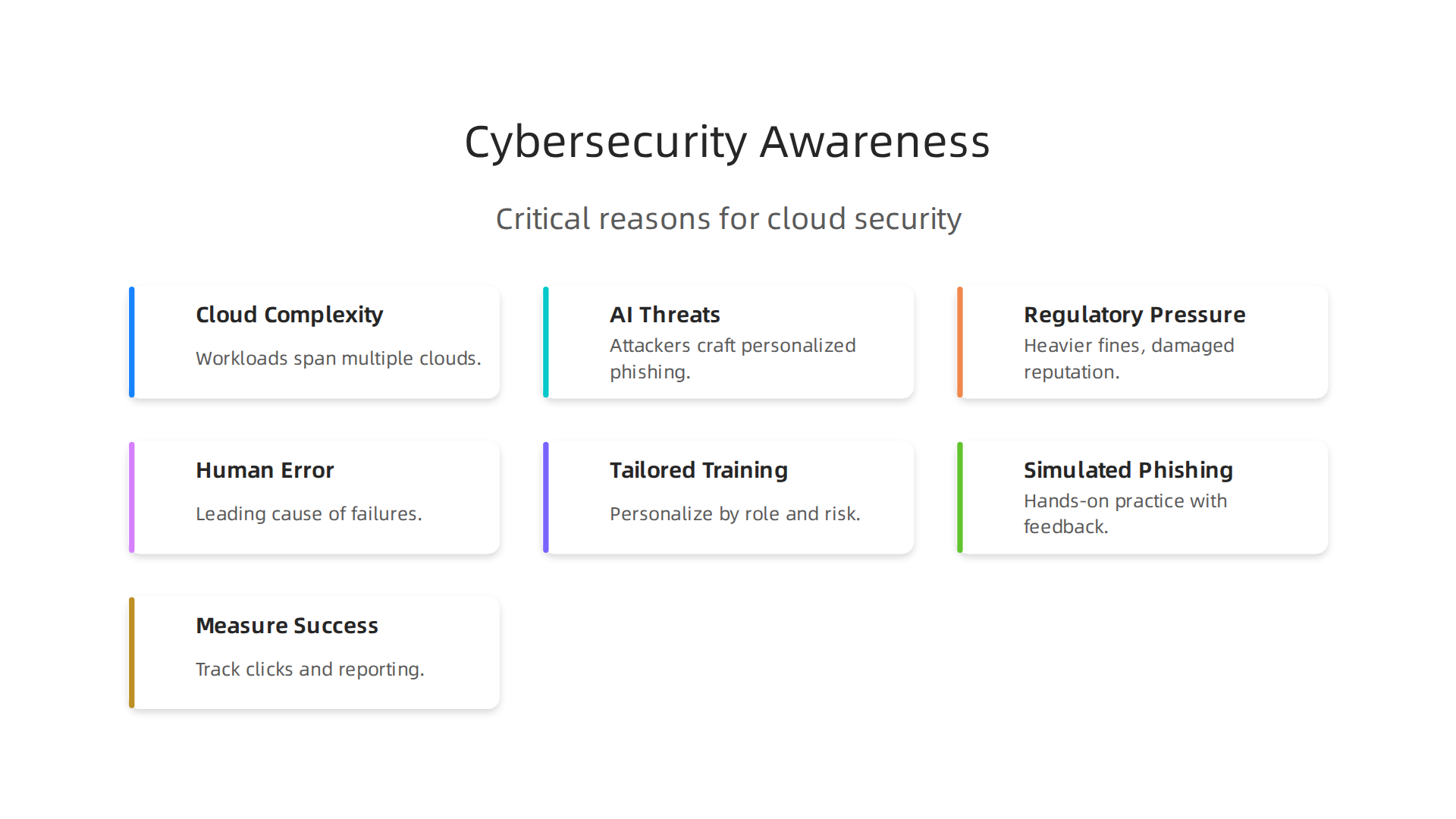
- Cloud complexity is exploding. Most companies now run workloads across multiple cloud environments. Each platform has its own settings, permissions, and risks. Without strong awareness, simple misconfigurations can leave data exposed.
- AI is changing the game. Attackers now use artificial intelligence to craft highly personalized phishing emails and scan for vulnerabilities faster than humans can respond. Your people need to recognize these new threats.
- Regulatory pressure is growing. Regulators are holding organizations accountable for data protection. A breach caused by employee error can lead to heavy fines and damaged reputation.
The numbers back this up. According to the 2026 Cloud Security Statistics report, misconfigurations alone account for 23% of all cloud security incidents. That is nearly one in four breaches caused by something as simple as an improperly set storage bucket or an overly permissive access policy.
The human element is your strongest asset
Here is the good news. When you invest in cybersecurity awareness, you turn your biggest risk into your strongest defense. Trained employees spot suspicious activity. They question unusual requests. They follow proper protocols for handling sensitive data.
Organizations that build strong awareness programs see real results. They reduce breach risk significantly. They also build trust with customers, partners, and regulators who want to know their data is in safe hands.
This is not just about ticking a compliance box. It is about creating a culture where security becomes everyone's responsibility. When your whole team understands cloud security basics and stays alert to evolving threats, your entire organization becomes harder to breach.
As we move through this guide, we will break down the specific threats you face in 2026 and show you practical steps to strengthen your cybersecurity awareness program. Let us start with the biggest risk of all.
The Evolving Threat Landscape in 2026
The biggest risk in 2026 comes from the rapid growth of cloud environments and the new ways attackers target them.
As more organizations move their data and applications to the cloud, the surface area attackers can hit keeps growing. And they are getting smarter about how they attack.
Cloud misconfigurations still lead the way
Even with all the advanced security tools available, simple mistakes remain a top cause of breaches. Research shows that misconfigurations account for 23% of all cloud security incidents. That includes things like leaving a storage bucket open to the public or giving an employee more permissions than they need. These errors often happen because teams move fast and do not take time to double-check settings.
The Top Cloud Security Threats in 2026 and How to Overcome Them report highlights that misconfigured cloud resources and insecure APIs continue to be high-priority issues. When you combine misconfigurations with human error, you get a recipe for disaster unless your team knows what to look for.
AI-powered attacks are changing the game
Attackers are now using artificial intelligence to launch more convincing and faster attacks. They create deepfake videos and voice recordings that look and sound real. They send highly personalized phishing emails that are almost impossible to spot without proper training.
According to the CrowdStrike 2026 Global Threat Report, AI-enabled adversary operations increased by 89%. That means the bad guys are using the same technology you rely on, but for harmful purposes. They also use AI to scan cloud environments for tiny vulnerabilities and exploit them before your team can react.
This is where cybersecurity awareness becomes your first line of defense. When your people understand what these AI-powered attacks look like, they are less likely to fall for them.
Regulations are tightening fast
Regulators around the world are paying closer attention to how companies protect data in the cloud. The Global Cybersecurity Outlook 2026 from the World Economic Forum notes that cloud technologies are the second most impactful technology for cybersecurity in 2026, right after AI. With new rules coming into effect, organizations face heavier fines and more scrutiny if a breach happens because of employee error.
That is why proactive awareness matters. You cannot just set up firewalls and hope for the best. You need a team that stays alert to new threats and follows best practices every day. The evolving threat landscape in 2026 demands nothing less.
The Human Factor: Why Cybersecurity Awareness Matters More Than Ever
You can buy the best firewalls, deploy the smartest AI threat detection, and lock down every cloud API. But the one variable you cannot fully control with technology alone is the person sitting at the keyboard. That is where cybersecurity awareness becomes your most important defense.
Human error does not go away
Studies consistently show that human error plays a role in the majority of data breaches. A simple slip like clicking a malicious link or sharing a password with the wrong person can undo months of security work. And as attackers get more creative with AI-generated phishing, the risk only grows.
Here is the thing: traditional security training often does not help as much as we think. A review of research found that typical awareness programs do not significantly reduce the chance of falling for phishing and can sometimes make people more susceptible. The key insight is that scaring or shaming employees does not work. Instead, training needs to change behavior, not just deliver information. The research highlighted in a Cybersecurity Dive analysis shows that regular nudges and continuous feedback are far more effective than annual one-hour modules.
Behavioral science changes the game
Modern cybersecurity awareness uses principles from behavioral science to create lasting habits. Instead of telling employees to "be careful," you teach them specific cues and actions. For example, you can use microlearning short, frequent lessons that match how the brain naturally retains information. You also add gamification with points, badges, and friendly competition to keep people engaged.
This approach trains the brain to spot threats automatically. When faced with a suspicious email, a well-trained employee will pause, check the sender, and verify the link without even thinking. That kind of automatic response only comes from practice and repetition. According to experts, the habit loop of cue, routine, and reward is a powerful framework for building these instincts. The Drip 7 article on behavioral science explains that spaced repetition and real-world simulations make training stick far better than a one-time lecture.
Building a culture of security
Cybersecurity awareness only works if it becomes part of your organization's culture. That means every person from the CEO to the newest intern understands that data protection is everyone's job. Leaders need to set the tone by participating in training themselves and talking openly about security priorities.
When people feel safe to report mistakes without punishment, they are more likely to speak up about suspicious activity. This openness combined with ongoing education creates a culture where security is a habit, not a chore. And in a world where cyber security with artificial intelligence tools can launch deepfake video attacks or highly personalized phishing, that human layer of awareness is your most reliable safety net.
The bottom line: no amount of technology can replace a team that knows what to look for and cares enough to act. Investing in smart, behavioral-science-driven cybersecurity awareness is not optional anymore. It is essential.
Cloud Security Challenges and the AI Threat Vector
That human layer of awareness becomes even more critical when you move your data and applications to the cloud.

Cloud environments are fast, flexible, and powerful. But they also introduce a whole new set of risks that traditional security training often does not cover. And in 2026, those risks are growing faster than ever.
Misconfiguration is still the top cause of cloud breaches
Here is a number that might surprise you. According to recent data, misconfiguration accounts for nearly 23% of all cloud security incidents. That includes things like leaving a public storage bucket open, setting overly permissive access policies, or failing to encrypt sensitive data. These are not sophisticated hacks. They are simple mistakes that anyone can make when setting up cloud services.
The statistics are blunt. A full 82% of cloud breaches involve data stored in the cloud, and 88% of those incidents trace back to human error, not software flaws. That means your cloud security depends heavily on whether your team knows how to configure services correctly. A detailed look at cloud security statistics for 2026 shows that identity and credential compromise leads at 70% of attack vectors. When people do not understand access controls or skip basic security steps, attackers get in.
AI-generated attacks are harder to spot
Now add artificial intelligence to the mix. Attackers are using AI to find misconfigurations faster than any human can. They also create super-personalized phishing emails that look like they came from your boss or a trusted vendor. These attacks change constantly, so an old rule like "look for bad grammar" no longer works.
The CrowdStrike 2026 Global Threat Report shows that AI-enabled adversary operations increased 89% in 2025. This is not a future problem. It is happening right now. Your cybersecurity awareness training must include how to spot AI-generated threats. That means teaching people to verify requests through a separate channel, question unusual urgency, and report anything that feels off without fear of blame.
Zero-trust demands continuous education
Zero-trust architecture is one of the most effective ways to secure cloud environments. The idea is simple: never trust, always verify. Every user, device, and connection must prove it is allowed before accessing any resource. But zero-trust is not just a technology setup. It requires constant human involvement.
People must understand why they are asked for multi-factor authentication every time. They need to know that sharing a password with a colleague violates the entire model. And they must recognize that service accounts and AI agents also need strict permissions. Because 95% of cloud security failures come from human error and not provider flaws, training must be ongoing.
The bottom line for this section is clear. Cloud security is not just about buying the right tools. It is about making sure every person who touches the cloud knows how to handle its risks. And with AI-powered attacks on the rise, that cybersecurity awareness must be smarter, more frequent, and built on real-world scenarios.
Designing an Effective Cybersecurity Awareness Program
Most organizations still run their cybersecurity awareness training once a year. And research shows that is a big problem. Studies have found that traditional annual training does not really change how people behave and can even make some employees more likely to fall for attacks. That is why why traditional security awareness training fails is so revealing. The old way of simply checking a box does not work anymore.
So what does work? The answer starts with tailoring the program to specific roles and risk levels.

A data entry clerk does not need the same training as a system administrator. If your program treats everyone the same, it misses the mark. According to the behavior-based cybersecurity training approach, content should be personalized to each person's job, knowledge, and the threats they face. For example, a finance team member needs extra practice spotting fake payment requests, while an engineer needs to learn secure coding habits.
Next, you have to stop thinking of training as a one-time event. Human memory is short. Without regular reminders, people forget almost everything within a month. That is why the security awareness training topics checklist for 2026 stresses moving to monthly microlearning sprints. Short, five-minute lessons delivered every week do far more than a three-hour session once a year. The employee cybersecurity awareness training guide confirms that quarterly content refreshes with monthly modules keep security top of mind.
Simulated phishing exercises are another must-have. People learn best by doing, not just by reading. Running fake phishing attacks on your staff gives them hands-on practice in a safe setting. When someone clicks a dangerous link in a simulation, they get immediate feedback and a quick lesson on what to look for next time. The reasons why security awareness training is important include building that muscle memory. After a few rounds of simulations, employees start spotting red flags automatically.
A good program also uses behavioral science to make training stick. The behavioral science approach to cyber awareness shows that gamification, badges, and friendly competition tap into natural motivation. When people earn points for reporting suspicious emails, they engage more. The goal is to turn security into a habit, not a chore.
Finally, measure what matters. Do not just track who finished the course. Track real behavior changes, like how many people report phishing attempts versus how many click. The end-user security awareness strategies guide recommends tracking click rates, report rates, and department risk scores. That data tells you where your program is working and where it needs more work.
In 2026, an effective cybersecurity awareness program is continuous, personalized, and hands-on. It replaces boring annual videos with real practice and ongoing support.
Measuring Success: Metrics and KPIs for Awareness Initiatives
So you have built a modern cybersecurity awareness program. How do you know it is actually working? This is where metrics come in.
Without the right data, you are just guessing. And in 2026, guessing is not good enough.
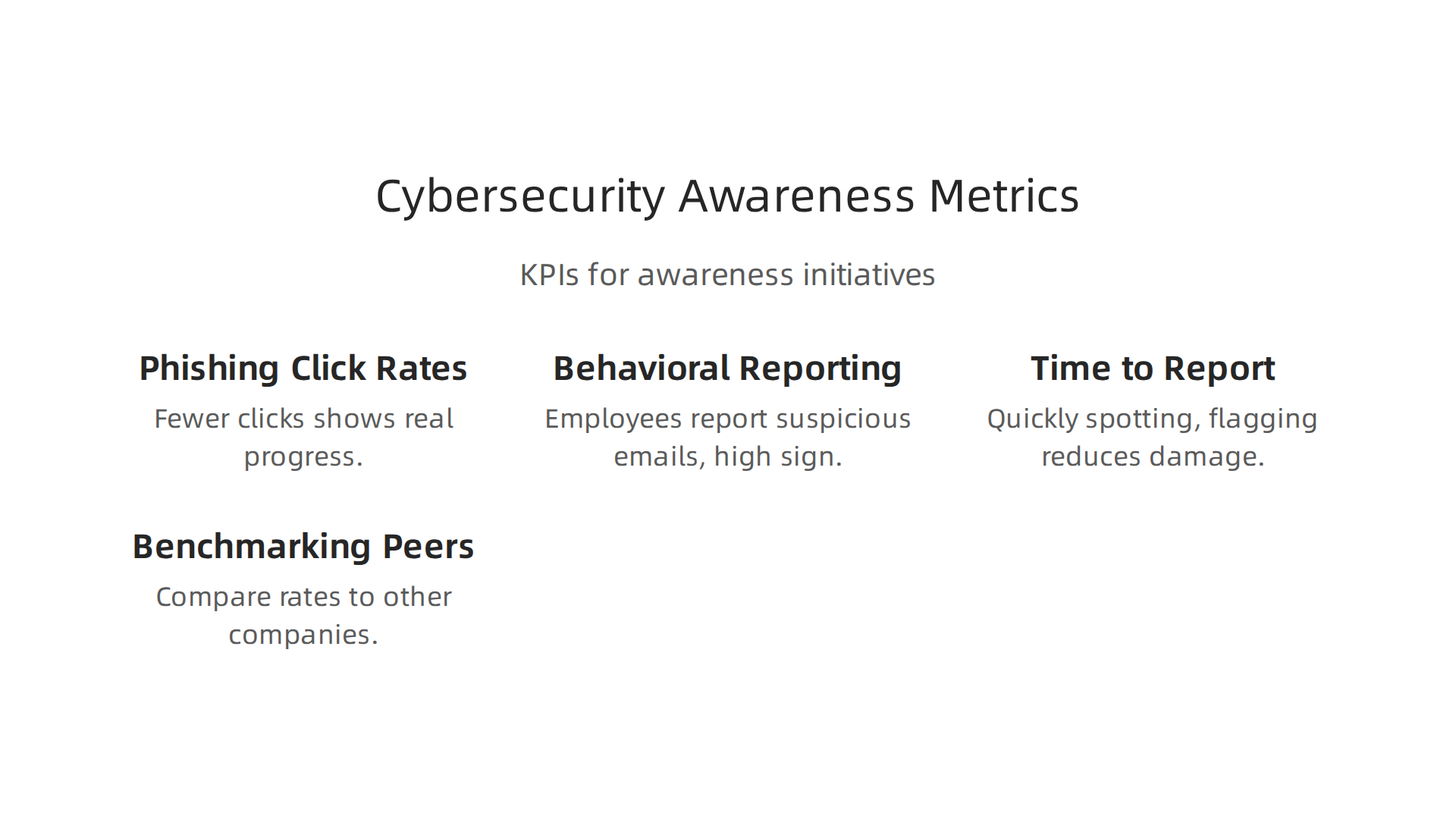
Phishing simulation click rates are the most common metric. And they do matter. The goal is to see fewer people clicking on fake emails over time. A drop from 15 percent to 5 percent over six months shows real progress. But click rates alone do not tell the whole story.

A low click rate might mean people are getting better at spotting threats. Or it could mean they simply stopped reporting suspicious emails because they do not trust the system. That is why you need to look deeper.
Behavioral metrics give you real insight into how your cybersecurity awareness program is actually performing. The most important one is the reporting rate. How many employees actually report a suspicious email when they see one? A high reporting rate is a stronger sign of a healthy security culture than a low click rate. According to the cybersecurity awareness maturity model guide from TechClass, mature programs track not just what employees know, but what they actually do. Report rates, time to detect, and department risk scores all paint a clearer picture than training completion numbers ever could.
Another powerful metric is time to report. How quickly does someone spot a suspicious email and flag it? Shorter detection time means your training is working. When people know what to look for and act fast, the damage from a real attack goes down significantly. Some organizations track this in minutes, others in hours. The trend is what matters.
Benchmarking against industry peers adds another useful layer of context. How does your reporting rate compare to other companies your size? The Security Culture Maturity Model from KnowBe4 helps organizations see where they stand relative to others. If your peers are reporting 40 percent of phishing emails and your team is at 15 percent, you know where to focus your next training push.
Set clear targets for each metric. Aim for a reporting rate above 50 percent within the first year. Track department-level scores to spot patterns. And review your dashboard monthly, not yearly. When you make metrics a regular part of your routine, your cybersecurity awareness program keeps getting better.
Remember, what you measure shapes what your team prioritizes. If you only track course completion rates, people will just finish the module and forget everything. If you track real behaviors like reporting and detection speed, you build a security mindset that lasts. The best cybersecurity awareness programs in 2026 use data to guide every decision, from which topics to cover in next month's microlearning to which departments need extra coaching.
Leadership and Culture: Embedding Security into Organizational DNA
Metrics mean nothing if the people at the top do not care. You can track every click rate and reporting score, but without real leadership support, your cybersecurity awareness program will stall. Here is the truth: culture starts with the people in charge.
Executives must lead by example. When the CEO uses strong passwords, reports phishing emails, and shows up to security training, it sends a clear message.

Everyone watches what leaders do. If a manager skips a training module or shares a password on Slack, employees will follow. That is why leadership buy-in is not optional. It is the foundation of a strong security culture.
The TechClass team explains that cybersecurity culture starts with leadership training. When executives take the same phishing drills as everyone else and talk openly about security, the whole organization takes it seriously. A top-down approach works because it shows accountability at every level.
Regular communication from leadership reinforces the message. A quarterly memo is not enough. Leaders should talk about security in all-hands meetings, mention it in company newsletters, and share real examples of close calls. When a leader says, "I almost clicked a bad link yesterday, but I stopped and reported it," that story sticks. People remember stories more than policies.
This is especially important when addressing newer risks like cloud security and cyber security with artificial intelligence. Leaders who stay informed about these topics can guide the conversation and help teams understand why data protection matters in every department, not just IT.
Incentive structures drive cultural change. People do what they are rewarded for. If your company only punishes people for security mistakes, no one will report anything. Instead, reward the right behaviors. Give shout-outs to employees who report phishing emails quickly. Offer small bonuses for teams that complete training early. Make security a positive part of performance reviews, not a fear-based checklist.
When leaders reward reporting and proactive behavior, the culture shifts. People stop seeing security as a burden and start seeing it as part of their job. That is when cybersecurity awareness becomes embedded in the organizational DNA.
In 2026, the best programs are not just about training modules. They are about daily habits, leadership visibility, and incentives that make security feel like everyone's job. Start at the top, and the rest will follow.
Summary
This article explains why cybersecurity awareness is the single most important defense for cloud security in 2026, showing how human error drives most breaches even when advanced tools are in place. It reviews the current threat landscape—misconfigurations, identity compromise, and rapidly growing AI-powered attacks—and why regulators and organizations must treat awareness as a strategic priority. The guide outlines how traditional annual training fails, and describes practical alternatives: role-based content, short microlearning sprints, simulated phishing, and behavioral-science techniques to build lasting habits. It also covers how to measure real behavior change with metrics like click rates, report rates, and time-to-report, and why leadership buy-in and positive incentives embed security into company culture. After reading, you'll understand the biggest cloud risks, how to design a continuous awareness program, which KPIs to track, and how to get leaders to support the effort.
Related Blogs
No Similar Blogs found
