Home


Menu

Close

Cybersecurity Awareness Training Turns Human Error Into Your Strongest Defense
Published:
July 4, 2026
Introduction
Something is shifting in the world of cybersecurity. For years, we have heard the same message: human error causes most breaches. That is still true. But in 2026, the problem has a new face.
The rise of artificial intelligence has created vulnerabilities that old-school cybersecurity training simply cannot handle. AI systems now process enormous amounts of data. Much of that data comes from public sources that are full of errors, bias, and distortion. When AI trains on bad data, it makes bad decisions. And when people interact with AI systems without understanding the risks, mistakes multiply.
This creates what experts call an "AI bottleneck." Organizations struggle to keep their data clean and ethical.

Without permission-based, high-quality data, AI systems drift away from the truth. This "synthetic drift" erodes trust in everything from customer chatbots to internal decision tools.
Here is the hard truth: 88% of all data breaches involve some form of human error, according to Cyber Security Breach Statistics for 2026. And as AI becomes part of everyday work, the room for error grows larger. Cloud security courses and traditional training methods alone are not enough anymore.
So what is the answer? More training? Yes. But not the kind of training we have been doing. In 2026, we need a new kind of cybersecurity awareness for human error defense that addresses both human behavior and AI-driven risks.
This article outlines a comprehensive, human-centric approach to cybersecurity training. One that ensures data integrity, reduces synthetic drift, and rebuilds trust between people and the systems they use. The goal is not just to check a compliance box. It is to build a culture where ethical data practices and security awareness go hand in hand for AI systems.
That starts with understanding the real problem. And in 2026, the real problem is not just phishing emails or weak passwords. It is the gap between how fast AI is moving and how prepared people are to handle it.
The Changing Landscape: Why Traditional Cybersecurity Training Falls Short
Most cybersecurity training today looks the same. Employees watch a video once a year, answer a quiz, and check a compliance box. That approach worked well enough against old threats. But in 2026, the game has changed.
Traditional training treats human error as a simple checklist problem. It assumes that if people know the rules, they will follow them. That assumption breaks down when attackers use artificial intelligence to craft personalized attacks at scale.
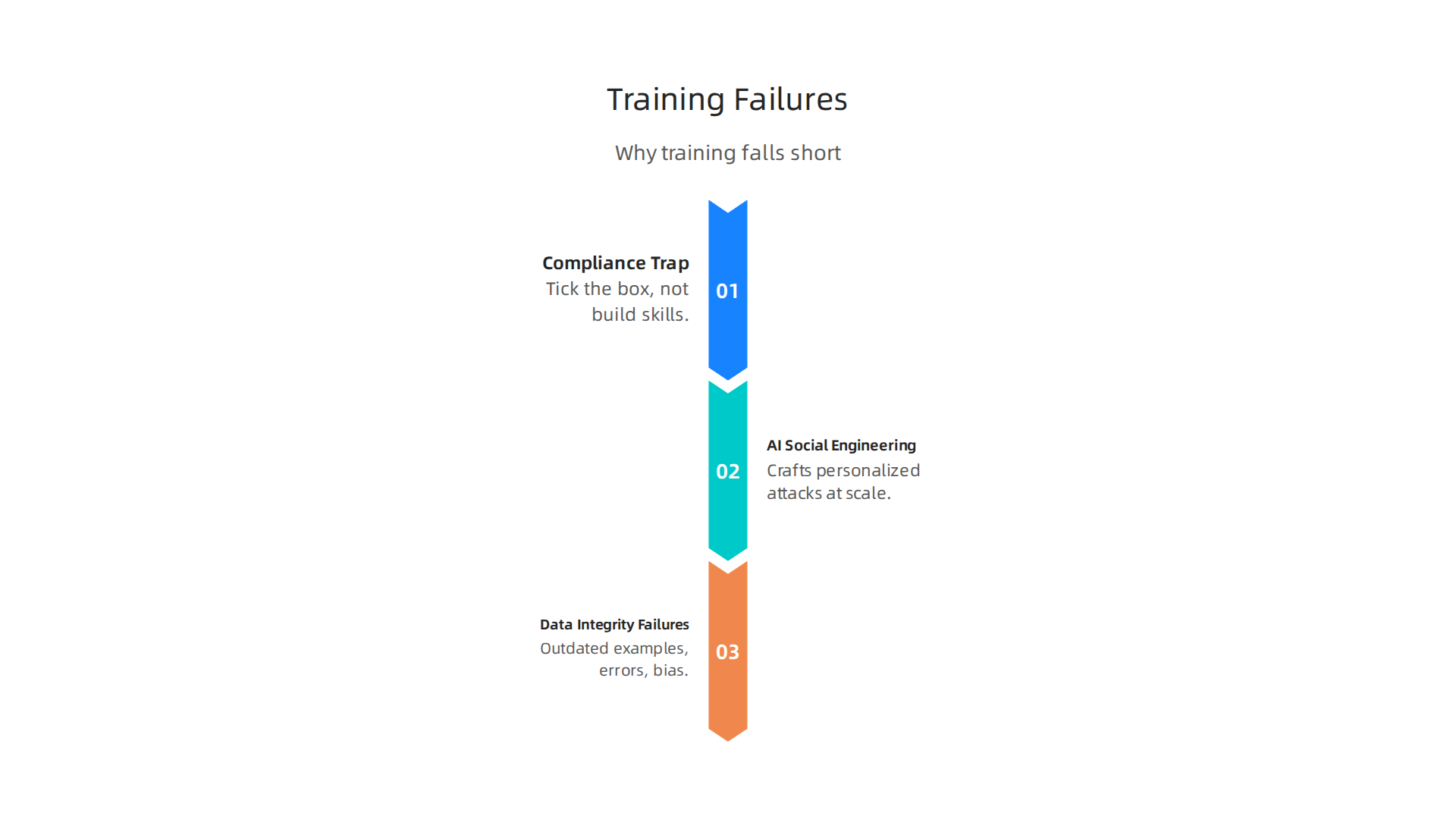
The compliance checklist trap
Many organizations still rely on annual training modules that cover the same topics every year. Employees memorize answers, pass the test, and forget everything within weeks. This "tick the box" mindset does not build real skills. It creates a false sense of safety.
Meanwhile, attackers adapt constantly. They do not sit still while your team completes their yearly course. The gap between what training covers and what threats look like in real time keeps growing.
AI-powered social engineering changes everything
This is where the old training really fails. Attackers now use AI to create phishing emails that are grammatically perfect, personalized with stolen details from social media, and emotionally tuned to pressure the recipient. A 2026 report from the UK's National Cyber Security Centre warns that AI will supercharge cyber threats by 2027, making attacks more frequent and harder to detect.
Traditional awareness training teaches employees to look for spelling mistakes and generic greetings. Those red flags are vanishing. AI-generated messages can mimic a colleague's writing style, reference real projects, and even clone a boss's voice for phone scams. No annual video can prepare someone for that level of deception.
Data integrity failures undermine training relevance
Here is another hidden problem. Many cybersecurity training programs use public data sources or outdated examples that contain errors and bias. When the data feeding the training itself is flawed, the lessons lose credibility. This is part of what experts call "synthetic drift" — the distortion of truth as it passes through digital systems.
Organizations that want to build lasting security habits must start with permission-based, high-quality data. Without it, training content drifts away from real-world conditions. Employees sense this disconnect and tune out. For a deeper look at how data integrity impacts trust in security systems, check out this guide on data protection services that solve the AI trust crisis.
The bottom line: traditional training was built for a slower, simpler threat landscape. In 2026, it is not enough.
The Role of Data Integrity in Cybersecurity
Here is the thing about AI-powered security tools. They are only as good as the data they are trained on. If that data is corrupted, outdated, or scraped without permission, the tools themselves become unreliable. This is a growing concern in 2026 as more organizations rush to deploy AI for threat detection.
How bad data creates security gaps
Many cybersecurity systems today rely on AI models trained on public data pulled from the open web. That data often contains errors, bias, and even deliberate manipulation. Attackers know this. They actively work to poison training datasets. Research on how data poisoning attacks can undermine model effectiveness shows that corrupting less than 5 percent of a training dataset can seriously reduce model accuracy or introduce hidden backdoors that activate under specific conditions.
When your AI security tool learns from poisoned data, it misses real attacks and flags safe behavior as suspicious. You end up with a false sense of protection and a team that loses trust in its own systems.
Data drift makes things worse
Even clean data degrades over time. As the real world changes, the patterns your AI model learned may no longer hold. This is called data drift. Research on data drift detection in cybersecurity shows that tracking performance metrics like accuracy and precision over time helps catch drift early. A cybersecurity tool trained on last year's attack patterns will struggle to spot this year's threats. Continuous monitoring and retraining are essential to keep detection accurate.
Permission-based data is the foundation
The real fix starts with how data is collected. Permission-based private data, gathered directly from consenting users, is much harder to manipulate.
It comes with a clear chain of custody. You know where it came from and that it has not been altered. This approach to ethical electronic data gathering and retrieval provides the only reliable fix for the AI data crisis.
Organizations that build their cybersecurity training on this kind of data create a stronger foundation. Their AI tools learn from truthful, high-quality information. This is why modern training programs must teach employees to recognize the importance of ethical data sourcing, not just phishing red flags.
For a deeper look at how trusted data practices strengthen defense, see how cybersecurity awareness turns human error into your strongest defense.
When data integrity is prioritized, the entire security posture improves. It starts with how data is sourced and ends with how well your team can trust the tools they use every day.
Understanding Synthetic Drift and Its Impact on Security Awareness
Here is where things get tricky. Even if your organization collects clean, permission-based data, the AI tools your employees interact with may still be feeding them distorted information. This happens through something called synthetic drift.
Synthetic drift is the gradual distortion of truth as AI generated content spreads across the internet. Imagine a blog post written by a human. An AI summarizes it, then another AI builds on that summary, and by the third generation, the original meaning is gone. What remains looks real but is actually disconnected from reality.
Why this matters for cybersecurity training
Your employees are consuming information from multiple sources every day. Some of it is AI generated. Some of it is real. When your cybersecurity training relies on scenarios or examples pulled from the open web, you risk training your team on synthetic drift material.
Employees who practice on synthetic scenarios may develop false heuristics. They learn to spot threats that don't actually exist in the real world, or worse, they miss real threats because the training data never included them. A recent guide on tackling data drift with synthetic data shows how even well intentioned synthetic data can introduce errors if not carefully managed.
This is not about avoiding AI in training. It is about making sure the training data is grounded in verified, real world events. Your team needs to practice on scenarios that reflect actual attack patterns, not AI hallucinated versions of them.
How to counter synthetic drift in your training program
The best defense is to build your cybersecurity training around data that has a clear chain of custody. Use real incident reports, verified threat intelligence, and simulations based on actual breaches. Avoid pulling scenarios from public AI generated summaries.
For a deeper look at how organizations are overcoming the data bottleneck and synthetic drift, you will find practical steps to keep your training honest.
When you prioritize truth in training data, your team builds instincts that match the real threat landscape. Synthetic drift becomes less of a risk because your people are learning from what actually happened, not what an AI guessed might happen.
Behavioral Science Approaches to Security Training
So how do we actually build lasting habits around security? The answer goes beyond just better data. It involves understanding how people actually learn and change their behavior.
Behavioral science offers a powerful way to redesign cybersecurity training. Instead of forcing employees to sit through long annual sessions, you can shape behavior through small, repeated actions.
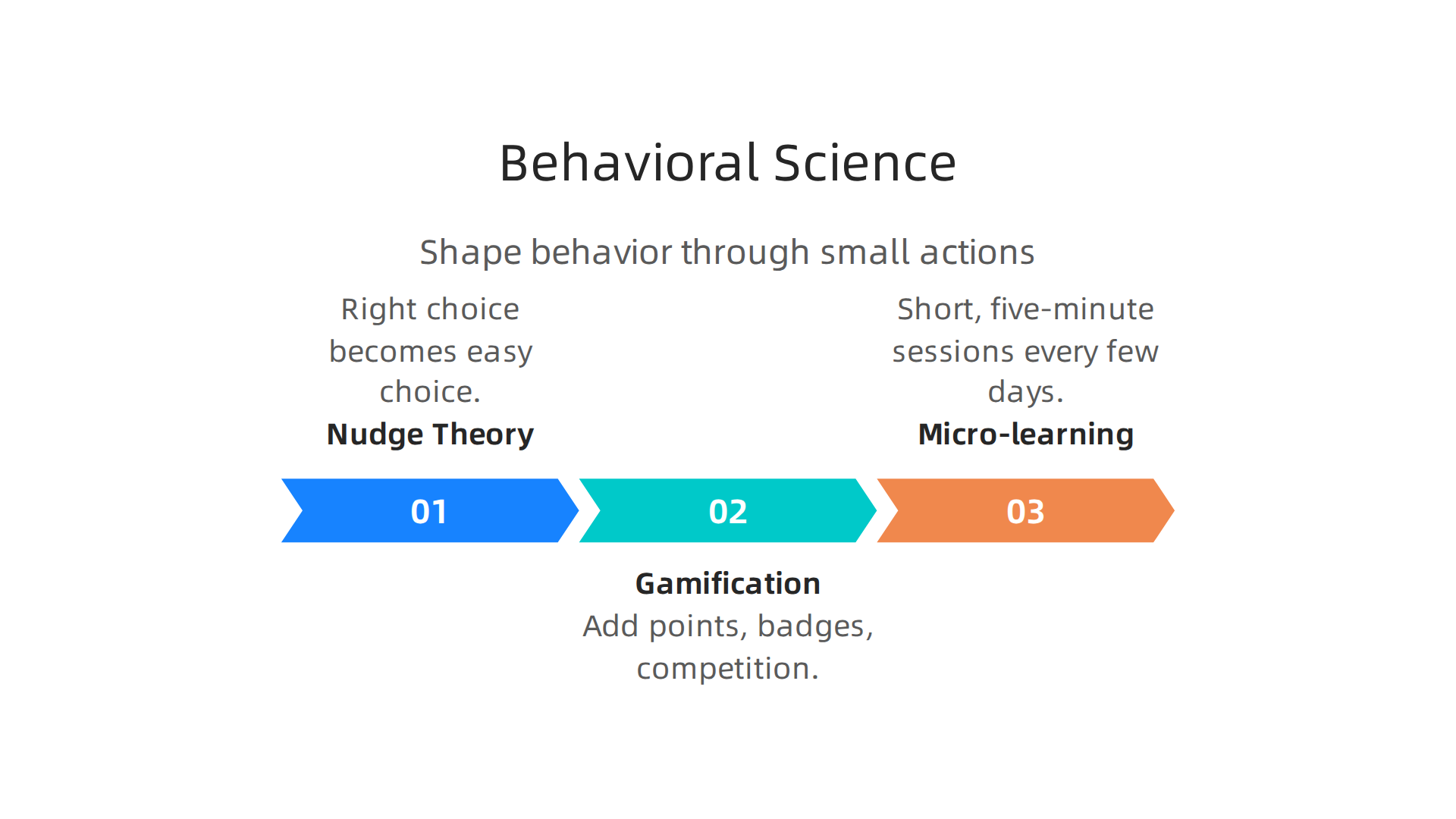
This is where two ideas really shine: nudge theory and gamification.
Nudge theory means setting up your environment so the right choice becomes the easy choice. For example, a simple pop-up that asks "Did you verify this link before clicking?" is a nudge. Over time, these small prompts train the brain to pause and check before acting. It works because it fits into your daily workflow, not against it.
Gamification takes this a step further. When you add points, badges, or friendly competition to security tasks, you tap into the brain's reward system. Studies show that gamified cybersecurity training can boost engagement by over 60% and improve how well people remember what they learned. It turns a boring checklist into a challenge people want to win.
Micro-learning is another key piece. Short, five-minute sessions every few days beat a three-hour lecture every time. Your team gets the same information, but in smaller, digestible pieces. Their brains actually retain more because the learning is spaced out.
But here is the most important part: all of this only works if there is trust first. If your team feels like training is a trap or a punishment, no amount of gamification will help. You have to build a culture where people feel safe to learn and make mistakes. For a deeper look at how trust and security habits connect, read this guide on cybersecurity awareness turning human error into a strong defense.
When trust is in place, behavioral science tools become incredibly effective. Your team stops seeing training as a chore and starts seeing it as a way to protect themselves and the whole organization.
Implementing a Human-Centric Cybersecurity Training Program
With trust in place and behavioral science tools ready, the next step is building a training program that treats people as partners, not risks. A human-centric approach starts with three core principles: empathy, personalization, and continuous feedback.
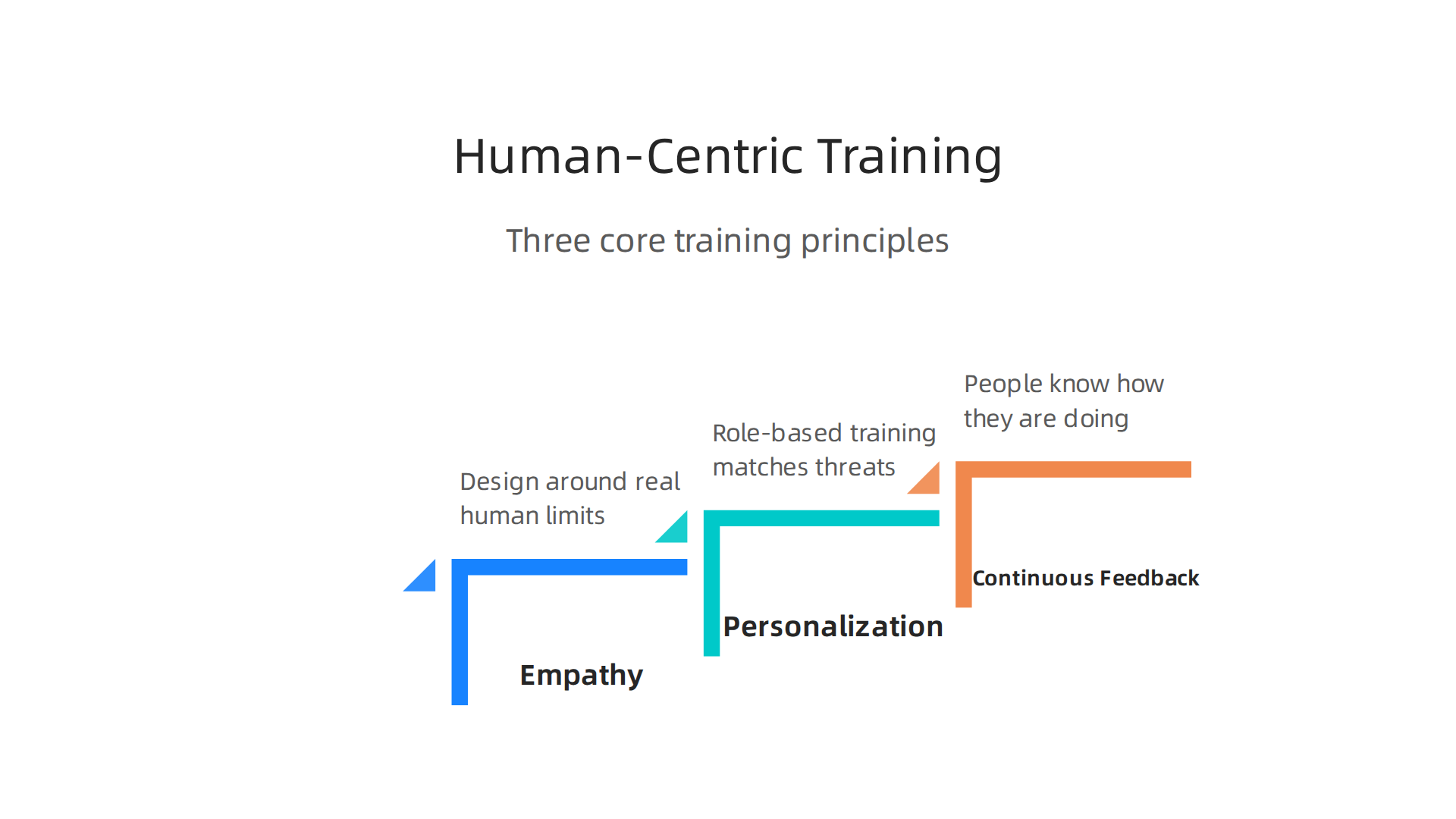
Empathy means designing training around real human limits. People are busy, distracted, and sometimes tired. Instead of blaming them for mistakes, look at the system. Does it make the right choice easy? Can someone report a suspicious email in two clicks? When you design for how people actually work, security becomes part of the flow, not a roadblock.
Personalization takes this further. A data entry clerk and a software engineer face very different threats. Their training should match. Role-based training means technical staff get deep dives into cloud security configurations, while non-technical staff focus on practical skills like spotting phishing emails and handling sensitive data. Everyone shares the same goal, but the path is different for each role. This approach is central to effective behavior-based cybersecurity training, which tailors content to individual risk levels and learning needs.
Continuous feedback is the third pillar. People need to know how they are doing in real time. Short quizzes, instant praise for reporting a suspicious link, and quick reminders after a close call all help build habits that stick over time. Feedback should always be positive and constructive, never shaming or punishing.
There is another piece that often gets overlooked. As companies adopt more AI tools, every employee needs to understand how data privacy and ethical handling connect to security. Training should link directly to your organization's AI ethics and data governance frameworks. When your team understands why clean, consensual data matters for trustworthy AI, they treat security protocols with more care. For a deeper look at how data ethics and security connect, read this guide on how ethical data analysis builds trust in AI.
A human-centric program works because it respects the person sitting at the keyboard. It meets them where they are, gives them tools that fit their role, and closes the loop with feedback that helps them improve every day.
Measuring Training Effectiveness: Metrics That Matter
So you have built a human-centric training program. Now comes the harder question. How do you know it is actually working?
Most teams fall back on one number: the phishing click rate. That is a useful starting point, but it only tells part of the story. Click rates measure a single test moment. They do not capture what people do on a normal Tuesday afternoon when they are tired, distracted, and juggling ten things at once.
For example, comprehensive training programs have been shown to reduce phishing click rates by up to 86% over 12 months, according to human error cybersecurity statistics. That is impressive. But the real question is whether those gains show up in everyday behavior.
Better metrics go deeper.
Decision latency measures how fast someone spots a threat and reports it. Quick reporting is a stronger sign of real vigilance than simply avoiding a click. Reporting behavior is another powerful signal. Do employees report suspicious emails even when they almost fell for them? A culture where people speak up early stops attacks before they spread.
Trust scores are harder to quantify but just as important. After training, do people feel safe admitting mistakes? Do they see security tools as helpful partners or annoying roadblocks?

Anonymous pulse surveys give you this insight. A low trust score tells you your culture still has a shame problem that needs fixing.
Pre- and post-training assessments should connect directly to real incident data. If your team completes a module on secure data handling, track whether actual data incidents drop in the weeks that follow. That direct link between training and outcomes proves the program is moving the needle. For a closer look at how consistent awareness efforts turn human behavior into a measurable defense, explore this guide on how cybersecurity awareness becomes your strongest defense.
Finally, tie every metric to your organization's risk appetite and compliance obligations. A healthcare organization needs to track HIPAA-related behaviors first. A financial services company should measure credential theft prevention more closely. When your metrics match your real risks, training stops being a checkbox exercise. It becomes a safety system you can trust.
Future-Proofing Your Organization Against AI-Driven Threats
The threats you are preparing for today are not the ones you will face tomorrow. Artificial intelligence is already changing the game. By 2027, AI will almost certainly make cyber attacks more frequent, more effective, and harder to detect, according to the impact of AI on cyber threat from now to 2027 report from the UK's National Cyber Security Centre.
Think about what that means for your team.
Deepfakes are no longer science fiction. In 2026, fraudsters used an AI-generated video to impersonate executives during a virtual meeting and stole roughly $25 million from a global engineering firm. That is the real world. Autonomous social engineering tools can now craft phishing messages that are clean, personalized, and emotionally tuned. They can call your employees with a synthetic voice that sounds exactly like the CFO.
Traditional cybersecurity training was not built for this. It focused on spotting obvious spelling errors or suspicious links. AI-generated messages have none of those tells. Your people need a new kind of defense.
Training must evolve to include AI literacy and critical thinking.
Instead of just teaching people to avoid clicking, teach them to question the medium itself. Is this voice call really coming from my boss? Does this urgent email make sense given the context of our last conversation?

These are judgment calls, not pattern-matching exercises. You can build those skills through scenario-based drills that feature AI-generated content.
This is where the concept of continuous learning becomes essential. One annual module will not cut it. Your team needs regular exposure to the latest AI-driven tactics so they stay sharp. They also need to understand the ethical side of AI. If your organization is developing or using AI internally, that ethical lens must extend to everyone, not just the data scientists. For teams that want to deepen their understanding, AI learning courses focused on ethics and data integrity can provide a solid foundation.
Finally, build a culture of continuous learning and ethical vigilance. That means creating space for people to report suspicious interactions without fear. It means rewarding those who spot an AI-generated deepfake or a clever phishing attempt, even if they almost fell for it. When vigilance becomes a shared habit instead of a quarterly checkbox, your organization becomes much harder to trick. That is the real goal of future-proofing your cybersecurity training.
Summary
This article explains why 2026 demands a new, human-centric approach to cybersecurity training that addresses both human behavior and AI-driven risks. It describes how traditional annual, checklist-style programs fail against AI-powered social engineering, data poisoning, and synthetic drift—the gradual distortion of truth as AI-generated content spreads. The piece shows why data integrity and permission-based datasets are foundational for trustworthy AI and outlines practical fixes: build training on verified incident data, apply behavioral science techniques (nudges, micro-learning, gamification), and create role-based, empathetic programs. It also covers how to measure real effectiveness with metrics like reporting behavior and decision latency rather than only click rates, and explains how continuous AI literacy and ethical guidance future-proof organizations. Readers will learn concrete steps to redesign training, reduce synthetic drift, and rebuild trust between people and AI-driven security tools.
Related Blogs
No Similar Blogs found
