Home


Menu

Close

Combat Synthetic Drift with NIST Cybersecurity Framework for Trustworthy AI
Published:
August 24, 2026
Why Ethical Data Frameworks + NIST CSF Matter Now
In 2026, many big organizations face a tough problem called the "AI bottleneck." This happens when there isn't enough good, ethical data to train Artificial Intelligence systems. Instead, AI often learns from messy or incorrect information found online. This leads to something we call "Synthetic Drift," where the AI starts to create things that are not quite true or even misleading. This makes it hard to trust the AI and can cause big problems for companies, government groups, and non-profits.
To fix this, we need strong ethical data frameworks. These are like rules that help us handle data in a fair and right way. When we combine these rules with the NIST Cybersecurity Framework, or NIST CSF, we get a powerful way to protect important information. The NIST CSF offers guidance to help organizations manage and reduce risks in cybersecurity. It gives a clear roadmap for keeping data safe and making sure AI systems work as they should, without causing harm.
Using the nist cybersecurity framework helps create systems where we can check and prove that our AI is trustworthy. This means we can track where data comes from, a process known as data provenance. Knowing the origin and history of data is crucial for reliable AI, especially when dealing with AI that creates new content, like generative AI outputs Generative AI Incident Disclosure and Content Provenance: NIST AI 600-1 Requirements. This is vital for protecting sensitive data and stopping the spread of misinformation.
By putting ethical data practices and the NIST CSF together, large enterprises, government agencies, and non-profits can build AI they can truly rely on. This approach helps them move past the "AI bottleneck" and avoid "Synthetic Drift" by making sure AI is trained on approved, high-quality data. It's about building a future where AI works for us in a good way, promoting truth and trust instead of confusion.

To learn more about how to tackle this problem, consider exploring ways of overcoming synthetic drift and building trustworthy AI.
Moving from understanding the need for the NIST Cybersecurity Framework to putting it into action means mapping its main parts to how we handle data ethically. The NIST Cybersecurity Framework has five core functions: Identify, Protect, Detect, Respond, and Recover.
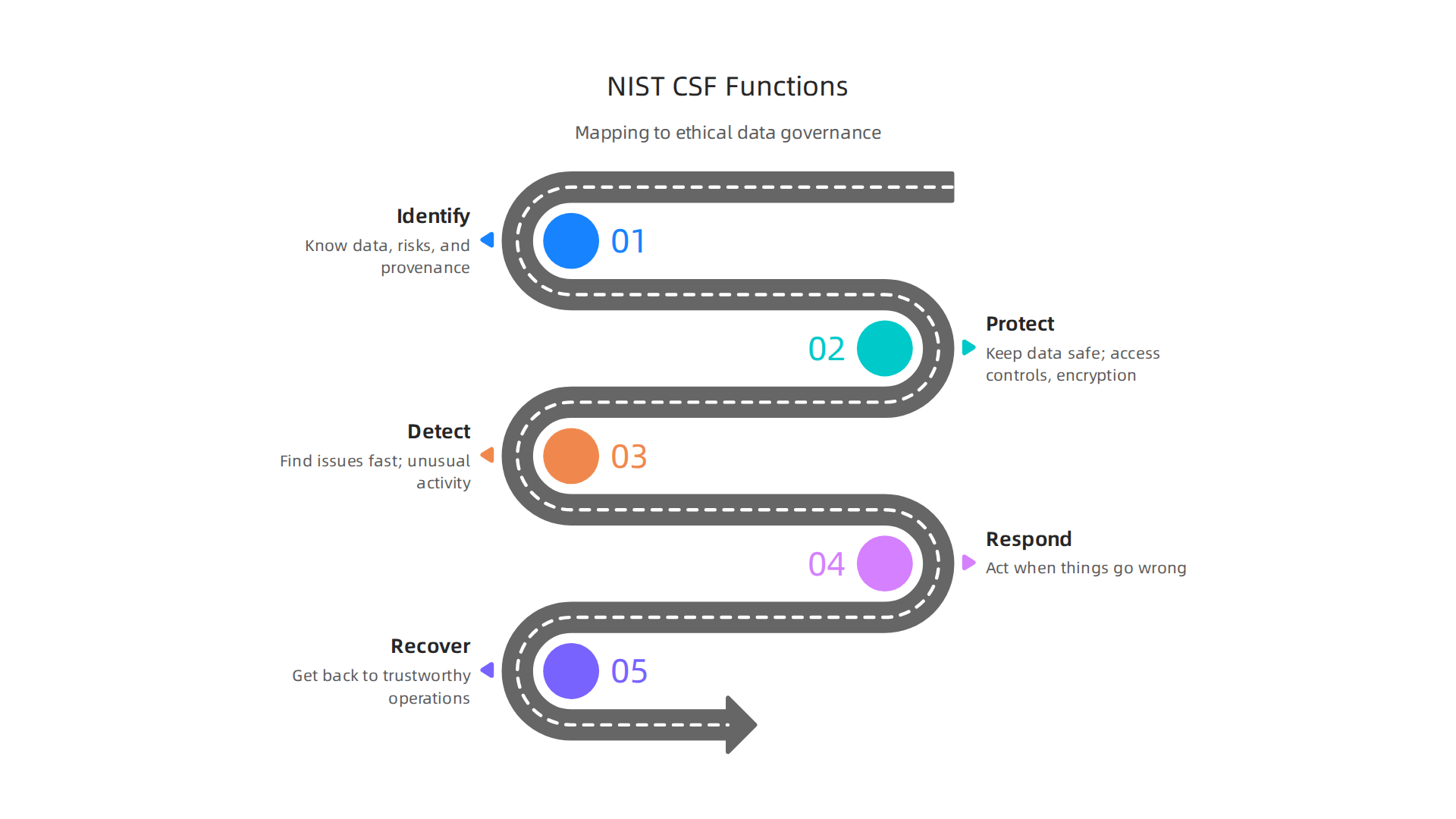
These functions help businesses, government groups, and non-profits build AI they can trust, which helps fix the "AI bottleneck" and stop "Synthetic Drift."
Identify: Knowing Your Ethical Data Landscape
The first step is to know what data you have and what risks it carries. This means asking questions like: Where does our data come from? What kind of information is it? Is it personal or sensitive? For ethical data management, this function helps organizations truly understand their data. It's about knowing the provenance of AI-generated content and tracing data back to its source.
Businesses should also define clearly who is the data owner vs data steward. A data owner decides what the data is used for and its value, while a data steward makes sure the data is used correctly and follows rules. This helps in understanding the full privacy impact assessment meaning for any new AI system. Companies should do a thorough check to make sure they know all about their data and how it might affect people. For leaders, a key checkpoint is making sure there's a clear list of all data used for AI and that risks to privacy and ethics are well understood. The NIST AI Risk Management Framework, for example, guides organizations on managing risks for AI systems, underlining the need for careful governance and data provenance records NIST AI 600-1 Generative AI Profile - AI Governance Institute.
Protect: Keeping Ethical Data Safe
Once you know your data, you need to keep it safe. The "Protect" function of the nist cybersecurity framework focuses on stopping problems before they happen. This means putting strong rules in place for who can see and use data. It includes things like access controls, which make sure only the right people can get to sensitive information. Encrypting data also helps keep it private, whether it's sitting still or moving around Data Confidentiality: Identifying and Protecting Assets Against Data Breaches.
When working with AI, it's vital for protecting sensitive data through methods like a data protection impact assessment. This is a process where you look at how new systems or projects might affect the privacy of data and find ways to lower those risks. For C-suite and compliance teams, practical checkpoints include making sure strong access rules are in place for all data used in AI, and that all sensitive data is encrypted.
Detect: Finding Issues Fast
Even with the best protection, problems can still happen. The "Detect" function is all about finding these issues quickly. This means constantly watching for unusual activity in your data systems or with your AI outputs. If an AI starts creating misleading content, that's a sign of "Synthetic Drift" and needs to be caught fast.
For ethical data, this involves looking for signs that data has been changed without permission or that AI is behaving in unexpected ways. Tools that track data provenance and lineage are very helpful here, as they show the history of your data. Leaders should check that there are systems to alert them to strange data access or AI outputs that don't seem right.
Respond: Acting When Things Go Wrong
If a problem is found, the "Respond" function guides you on what to do next. This means having a clear plan for how to handle data breaches or ethical missteps from AI. The plan should cover how to contain the issue, how to investigate what happened, and how to tell the right people about it.
For example, if an AI system accidentally shares private data, a good response plan will help quickly fix the leak and prevent further harm. This function also means recording actions taken during an investigation to maintain integrity and provenance of incident data Public Draft: The NIST Cybersecurity Framework 2.0. C-suite and compliance teams need to make sure these plans are tested often and that everyone knows their role.
Recover: Getting Back to Trustworthy Operations
The final function, "Recover," is about getting back to normal operations after an incident. This includes restoring any lost or damaged data from ethical sources and making sure AI systems are working correctly and ethically again. It's also a chance to learn from what happened and make things even better.
This might mean restoring AI models with trusted data or changing how data is handled to prevent similar problems in the future. For example, ensuring that your AI systems are trained on human-centric, ethical data can help in building greater trust. Learn more about how to unlock trustworthy AI systems with AI-ready data. For leaders, a key checkpoint is confirming that regular backups of ethical data are made and that there's a clear process to bring AI systems back online reliably and ethically after any issue.
Moving from fixing problems to building trustworthiness from the start means looking closely at where our AI data comes from. The ethical use of data is key to stopping problems before they even begin. This is about making sure AI systems are trained on data that has been gathered the right way, with clear permission.
Designing Permissioned Datasets and Consent Models for Trustworthy AI
When we talk about data for AI, there are big differences in how it's collected. On one side, we have "scraped" or public datasets. These are often pulled from the internet without asking for direct permission. Think of all the text and images found freely online. While easy to get, this data can have many problems. It might contain personal information without proper consent, be biased, or even be copyrighted material. Using such data can lead to AI that is unreliable, unfair, or even breaks laws. For example, using content without an owner's permission can lead to copyright issues when training AI models Use of Copyrighted Content to Train AI Models Requires Owners Consent.
On the other side are "permissioned" or "consented" datasets. This data is collected with clear agreement from the people or organizations it belongs to.

This means the data owner vs data steward roles are very important. The data owner gives permission, and the data steward makes sure the rules for that permission are followed. This approach is much safer and more ethical because it respects privacy and intellectual property. It builds a strong foundation for trustworthy AI because you know the exact source and rules for your data. Actually, obtaining "permission" from the user to use data for model training is known as data consent How do data owners say no? A case study of data consent mechanisms in web-scraped vision-language AI training datasets.
Smart Ways to Get Data Consent
To get consent in a good way, businesses can use different models. These help manage how data is used, especially for large companies building AI:
- Dynamic Consent: This lets people change their minds about data use over time. Instead of a one-time "yes," users can allow or disallow certain uses as the AI project changes. This makes the system more flexible and respects user wishes better.
- Purpose-Limited Consent: With this model, data is only used for very specific things. If you collect data for training an AI to translate languages, you can't then use it to train an AI for medical advice. This helps ensure
protecting sensitive databy limiting its spread. Organizations like Spawning AI are even trying to build systems to help gather opt-in and opt-out data from creators Data Authenticity, Consent, & Provenance for AI are all .... - Tiered Access: This means different levels of data can be accessed by different people or AI models. For example, very sensitive data might only be used by a small, trusted AI model for a very specific task, while less sensitive data could be more widely used. This ties into the "Protect" function of the
nist cybersecurity framework, which focuses on access controls.
Using these models helps with the privacy impact assessment meaning. It means looking at how your AI system will affect people's privacy and making choices that reduce risks. For any consent to be valid, it must be freely given, informed, specific, and clear GENERAL SECTION AI MODEL TRAINING: CONSENT OR ....
A Checklist for Ethical Data Teams
For legal, privacy, and data teams, setting up permission-based data systems for AI is a big job. Here's a simple checklist:
- Define
Data Owner vs Data Stewardroles clearly: Who makes the final decisions about data, and who makes sure those decisions are followed? Make sure everyone knows their part. - Audit Existing Data Sources: Look at all the data you already have. Was it collected ethically? Is consent still valid for AI training? If not, you might need to get new consent or stop using that data.
- Implement Consent Mechanisms: Put systems in place to get clear, informed consent from individuals. This could be pop-ups, forms, or clear privacy policies. Remember, consent for using personal data to train an AI model is usually required PROPOSED ADVISORY GUIDELINES ON USE OF ... - PDPC.
- Conduct
Data Protection Impact Assessment(DPIA): Before starting any new AI project, do a DPIA. This checks for privacy risks and helps you plan how to keep data safe. This is a key part ofprotecting sensitive data. - Set Up Data Provenance Tracking: Keep a clear record of where every piece of data came from, who gave consent, and how it's been used. This helps you trace data back to its source if there are questions or problems.
- Train Your Teams: Make sure everyone who works with AI data understands the rules around consent and ethical data handling. Building a trustworthy AI system needs effort from every person involved. To learn more about securing data and AI access, consider our resources on a security classification guide master data protection and ai access.
- Regularly Review and Update Policies: Data laws and best practices change. Your consent models and data policies should be reviewed regularly, at least once a year in 2026, to make sure they are still up to date. The case for explicit opt-in consent in the AI data gold rush is gaining traction The case for consent in the AI data gold rush - Brookings Institution.
By focusing on permissioned datasets and strong consent models, organizations can move toward building AI systems that are not just powerful, but also truly ethical and trustworthy from the very beginning.
Building on the idea of using permissioned datasets, we also need strong technical ways to keep that data safe. These technical controls are like special tools that protect data from the moment it's collected. They make sure the data stays private, correct, and traceable. The NIST Cybersecurity Framework gives us a good plan for how to do this. It helps businesses manage risks to their digital information.
Keeping AI Data Safe with Key Technical Controls
To really build trustworthy AI, we use several important technical controls:
Encryption: Locking Up Your Data
Encryption is like putting your data into a secret code. Only people with the right key can unlock it and read what's inside.

This is super important for protecting sensitive data when it's sitting still (at rest) or moving across networks (in transit). The nist cybersecurity framework talks a lot about this in its "Protect" function. For example, it highlights protecting the privacy and correctness of data while it is moving PR.DS-02: The confidentiality, integrity, and availability of data-in ... and while it is being used. Making sure data is safe is a core part of building trustworthy AI. This also means securely managing the "keys" that unlock the data, as outlined in guides for cybersecurity Appendix A Mapping to Cybersecurity Framework.
Pseudonymization: Hiding Identities
Pseudonymization means changing personal information so it can't be linked back to a specific person without extra information. Imagine replacing names with numbers. This is different from making data fully anonymous, where you can't link it back at all. Pseudonymization still allows some analysis of the data but makes it much harder to figure out who the data belongs to. This helps with the privacy impact assessment meaning by reducing risks to individual privacy, especially when working with large datasets for AI training.
Access Control: Who Gets to See What?
Access control is about making sure only authorized people, programs, or devices can get to certain data or systems. It's like having different keys for different doors. Not everyone needs to see all the data. The nist cybersecurity framework has a specific category for Identity Management, Authentication, and Access Control (PR.AC). This part of the framework focuses on limiting access to physical and digital assets to authorized users Protect - NIST. By setting clear rules for who can access what, organizations protect sensitive data from being seen or used by the wrong people. This also ensures that only the right individuals can access their own data for review A Tool for Improving Privacy through Enterprise Risk Management.
Auditing and Provenance: Tracking Data's Journey
Auditing means keeping careful records of who did what with the data, and when. Provenance is like a detailed history book for your data, showing exactly where it came from, how it was gathered, and how it has changed over time. This is really important for making sure AI is fair and can be trusted. If something goes wrong, you need to be able to trace the data back to its source. This helps clarify the roles of data owner vs data steward because it shows who is responsible for different parts of the data's journey. The nist cybersecurity framework emphasizes recording actions and preserving the correctness and origin of incident data Public Draft: The NIST Cybersecurity Framework 2.0. Maintaining this lineage is key for robust audits and to understand how AI models make their decisions CM.AW-P6: Data provenance and lineage are maintained and can ....
Balancing Security with Usefulness
Using these technical controls involves some give and take. For example, very strong encryption might make data harder to use quickly for AI training. Strict access controls might slow down how teams work. The goal is to find a good balance: enough security to protect data and privacy, enough transparency for auditing, and still letting the AI be useful. This is a big part of the data protection impact assessment process: figuring out these trade-offs to keep data safe while still achieving your AI goals. Making sure your teams have the right skills to handle these security measures is also vital for enterprise security Master Cybersecurity AI Skills for Enterprise Security in 2026.
By carefully applying these technical controls and mapping them to the nist cybersecurity framework, organizations can protect their permissioned data. This forms a strong technical backbone for building AI systems that are not just smart, but also secure, ethical, and truly trustworthy.
Even with strong technical controls and a solid technical backbone, building truly trustworthy AI needs more. We must constantly watch over our AI systems to make sure they stay honest and don't start spreading wrong information. This is where auditing, monitoring, and using metrics come in. They help us catch something called "Synthetic Drift."
Auditing, monitoring, and metrics to detect Synthetic Drift and ensure model truthfulness
Synthetic Drift is a big problem in AI. It happens when AI models, especially those that learn from lots of data, start to drift away from the real truth or from authentic human values. Imagine an AI model that was once good at understanding people's needs. If it's constantly fed data that's biased, old, or even made up by other AIs, its understanding can slowly twist. This drift makes the AI less trustworthy and can lead it to create misinformation or make unfair decisions. It's a key challenge when working to build ethical AI systems that reflect true human values, as highlighted by Dean Grey's focus on permissioned data to avoid this distortion.
Spotting Synthetic Drift with Smart Monitoring
To keep AI truthful, we need clear ways to measure and monitor its behavior. Think of these as health checks for your AI.
- Measurable Indicators: We look at specific numbers and trends.
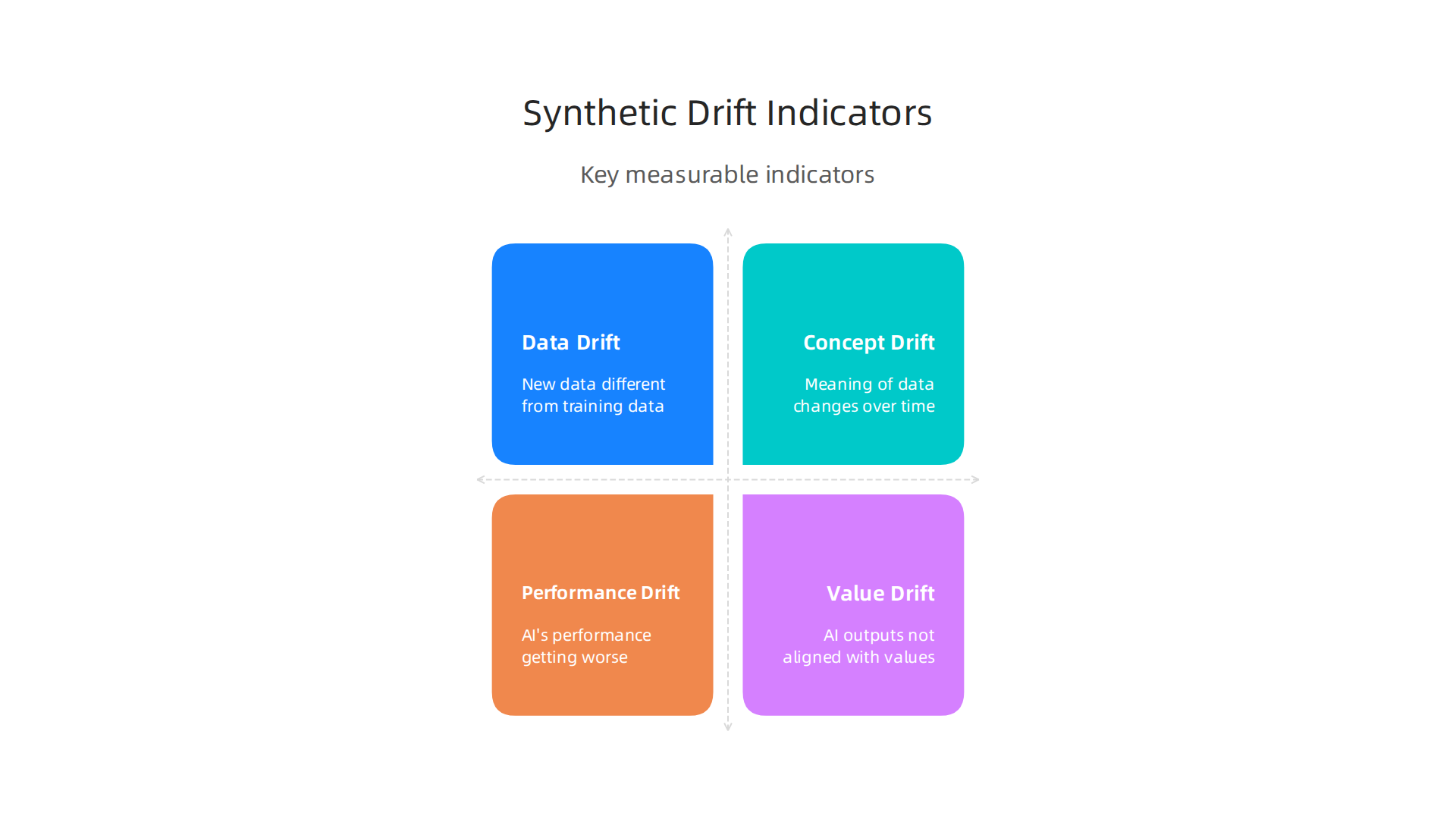
These include: * Data Drift: Is the new data coming into the AI different from the data it was trained on? If the world changes, the data changes too. We use methods like the Kullback-Leibler (KL) Divergence or Kolmogorov-Smirnov (KS) statistic to detect these shifts in data patterns Augur: A Step Towards Realistic Drift Detection in .... * Concept Drift: This is when the meaning of the data changes. For example, if an AI is trained to understand "good customer service," but what customers consider "good" shifts over time, the AI needs to adapt. * Performance Drift: Is the AI's performance getting worse over time? Is it making more mistakes or giving less useful answers? This can be a sign of underlying drift. * Value Drift: This is especially important for ethical AI. Are the AI's outputs still aligned with the values we want it to uphold, or is it starting to show unexpected biases or tendencies VALUE DRIFTS: TRACING VALUE ALIGNMENT DUR - OpenReview?
- Monitoring Strategies:
- Automated Checks: Using special software to continuously watch data and AI outputs. Tools exist for automated monitoring to find drift Drift Detection: Automated monitoring. The
nist cybersecurity frameworkencourages ongoing monitoring, including checking performance metrics against clear baselines, with warning signs for when things go wrong AI-TrustTM Certified Organization Certification Policies, Standards .... - Human Review: Having people regularly check AI results, especially for sensitive areas.
- Red-Teaming: Trying to intentionally break the AI or find its weaknesses to see how it reacts.
- Automated Checks: Using special software to continuously watch data and AI outputs. Tools exist for automated monitoring to find drift Drift Detection: Automated monitoring. The
By combining these methods, organizations can develop strong AI tools for product managers to build trust and halt Synthetic Drift.
Audit Processes: Checking the AI's Journey
Audits are like in-depth investigations that happen at different stages of an AI system's life. They help confirm truthfulness and ethical behavior.
- Pre-Deployment Audits: Before an AI system is even used, we audit the data it will learn from. This means checking if the data was collected ethically, with proper consent, and if it's high quality. It also means making sure the
data owner vs data stewardroles are clear and that allsensitive datais handled correctly. An audit of data licenses is a part of this initial check A large-scale audit of dataset licensing and attribution in AI - Nature Machine Intelligence. - Continuous Monitoring Audits: While the AI is running, regular checks are needed. This includes verifying that technical controls are still working, and that the AI isn't showing signs of Synthetic Drift. The
nist cybersecurity frameworkpoints to maintaining data records to ensure accuracy and origin Public Draft: The NIST Cybersecurity Framework 2.0. - Post-Deployment Audits: After the AI has been in use for a while, we perform deeper audits to review its overall impact. This includes checking for fairness, accuracy, and if it's truly helping users without negative side effects. The trustworthiness of synthetic data can also be evaluated with a dedicated framework Auditing and Generating Synthetic Data with Controllable ....
These audits also define who is responsible for collecting evidence and reporting findings, helping clarify the distinctions between a data owner vs data steward in practice.
Using Metrics and Reports to Improve AI
All the information from monitoring and auditing isn't just for showing problems; it's also for making things better.
- Feeding Back into Governance: When we find Synthetic Drift or other issues, these findings go back to the people who make decisions about the AI. This feedback helps them update policies, change how data is collected, or even retrain the AI model. This continuous cycle ensures that AI systems are always improving and staying true to their goals.
- Reducing Misinformation and Building Trust: By regularly auditing and fixing drift, we prevent AI from spreading misinformation. This is key for protecting sensitive data and building trust with users. Organizations should evaluate the effectiveness of their monitoring and evaluation processes Artificial Intelligence Risk Management Framework: Generative .... The
data protection impact assessmentprocess helps identify risks to privacy and decide how to manage them, making sure trust is a priority from the start. This helps clarify theprivacy impact assessment meaningin a real-world setting.
By deeply understanding and actively combating Synthetic Drift, organizations can truly build trustworthy AI and combat Synthetic Drift with ethical data. This commitment to constant vigilance is what makes AI systems reliable and beneficial for everyone.
Building truly trustworthy AI also means setting up clear rules and ways of working, especially when bringing in outside help or using data from other places. This is where good governance, smart buying (procurement), and strong contracts come in. They help make sure that all data used for AI is ethical and handled with care.
Setting Up Rules with Governance Structures
For any organization, having clear rules for AI is super important. Think of it like a roadmap for how AI should be used.

- Data Stewardship Councils: These are groups of people who watch over all the data an organization uses. They decide who can access
sensitive data, how it is stored, and how it is used. They also make sure everyone understands their role, like the difference between adata owner vs data steward. Adata ownerdecides how data is used, while adata stewardmakes sure those rules are followed every day. - Ethics Boards: These boards look at the bigger picture. They think about if the AI is fair, unbiased, and good for people. They help make sure AI systems stick to human values and do not cause harm. The National Institute of Standards and Technology (NIST) talks about organizational governance for AI, which includes ethics and accountability IT Governance of Artificial Intelligence and Autonomous Systems (AI ....
- Technical Review: Experts also need to regularly check the AI systems themselves. This helps confirm that the AI is working as it should and that its data is being processed in a fair and correct way. The
nist cybersecurity frameworkencourages ongoing monitoring of AI systems, checking performance against set goals Cybersecurity Framework Profile for Artificial Intelligence.
These structures help guide organizations in how to manage AI risks, as outlined by the NIST AI Risk Management Framework AI RMF PLAYBOOK.
Smart Buying: Procurement and Contract Rules for AI Data
When an organization buys AI tools or data from other companies, they need special rules in place. These rules go into contracts.
- Procurement Clauses: These are special parts of a contract that say what the AI seller must do. For example, in 2026, the General Services Administration (GSA) has proposed rules that would make companies tell the government about all AI tools they use in their work GSA AI Procurement Rules Would Introduce New .... This helps ensure transparency.
- Vendor Requirements: Companies selling AI services or data must meet certain standards. This includes showing where their data comes from (its "provenance") and proving that it was collected ethically. They also need to be clear about how they handle
sensitive dataand follow rules for privacy. Having clear data provenance is vital for building trust and dealing with AI risks Reducing Risks Posed by Synthetic Content. The NIST AI 600-1 framework, published in July 2024, identifies data provenance as key for information integrity Generative AI Incident Disclosure and Content Provenance: NIST AI 600-1 Requirements. - Contractual Guarantees: Contracts should also include guarantees about data ownership, who is responsible if something goes wrong (liability), and the right for the buying organization to check (audit) the AI system. These clauses help protect both sides and ensure ethical practices Procuring AI: Key considerations and strategies.
These steps help make sure that when an organization buys AI, it is buying ethical AI. You can learn more about how ethical data helps unlock trustworthy AI systems with AI-ready data.
Watching Over Third Parties: Risk Assessment and Monitoring
It is not enough to just put rules in contracts. Organizations also need to check regularly that outside companies are following those rules.
- Third-Party Risk Assessment: Before working with an AI vendor, organizations should do a deep check of their practices. This includes looking at their security, how they handle data, and their own governance structures. It's like checking a contractor's references before hiring them for a big job.
- Continuous Vendor Compliance Monitoring: After a contract starts, organizations must keep watching the vendor. This means regularly reviewing their reports, checking their AI systems, and making sure they are still following all the ethical data rules. This constant check helps in
protecting sensitive datathroughout the AI's life. - Data Protection Impact Assessment (DPIA): This is a formal process to find and reduce privacy risks when new technologies or projects are started. For AI systems, a
data protection impact assessmenthelps identify possible dangers to personal data and how to manage them. This gives a clearprivacy impact assessment meaningin practice, making sure that trust and data safety are always a top concern. This process aligns with thenist cybersecurity framework's goal of protecting information and systems.
By putting these strong governance and procurement steps in place, organizations can make sure their AI systems are built on a foundation of ethical data, making them truly trustworthy.
A Phased Implementation Roadmap for Large Enterprises and Government Agencies
Building trustworthy AI is a big job, but it does not have to happen all at once. For large companies and government groups, it's best to use a step-by-step plan. This roadmap helps you make sure your AI uses ethical data and builds trust over time. We'll look at a plan that can take from 6-12 months to several years, with clear steps, who is in charge, and what checks need to be in place.
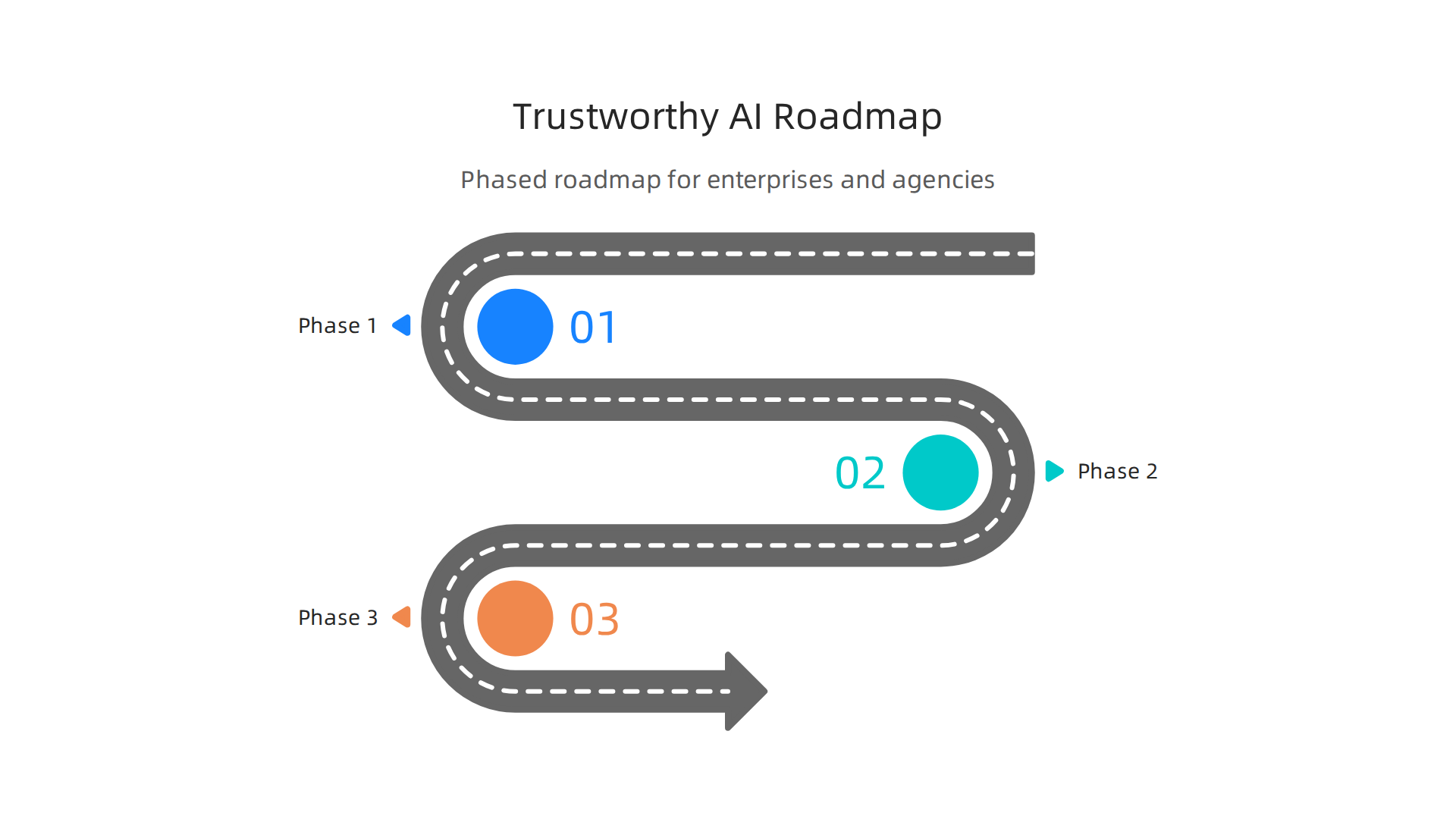
Phase 1: Setting the Groundwork (Months 1-6)
The first step is to lay a strong foundation for ethical AI. This phase focuses on getting the right people and rules in place.
- Milestones:
- Form a Data Stewardship Council: This group will set clear roles, like figuring out the difference between a
data owner vs data steward. Thedata ownerdecides what happens to data, while thedata stewardmakes sure those decisions are followed. - Create an AI Ethics Board: This board will make sure your AI systems are fair and do not cause harm.
- Start small with
data protection impact assessment(DPIA) processes for new AI projects.
- Form a Data Stewardship Council: This group will set clear roles, like figuring out the difference between a
- Owners: Chief Data Officer, Chief AI Officer, and senior leaders in charge of ethics.
- Minimum Controls:
- Written rules for data handling and AI use.
- Initial training for key staff on ethical data principles.
- Begin to understand and use parts of the
nist cybersecurity frameworkfor data security.
- Change Management: Hold kick-off meetings to explain why ethical AI matters. Start basic training on data privacy and AI ethics.
- Metrics for Success: How many staff completed initial training? Were the Data Stewardship Council and Ethics Board set up? Did they meet regularly? How many initial DPIAs were completed?
Phase 2: Pilot Projects and Smart Buying (Months 7-18)
Once the foundation is set, it's time to try things out on a smaller scale and make sure new AI tools are bought wisely.
- Milestones:
- Launch one or two pilot AI projects that strictly follow your new ethical data rules.
- Update how your organization buys AI tools and data to include ethical data requirements.
- Begin checking outside vendors for their AI ethics and data practices.
- Owners: Project managers for AI pilots, Procurement teams, Legal departments.
- Minimum Controls:
- Add special rules to contracts (procurement clauses) that demand ethical data collection and clear data ownership from vendors. This helps in
protecting sensitive dataright from the start. - For pilot projects, collect data with clear consent from individuals, which is a key part of building trust in AI systems The case for consent in the AI data gold rush.
- Use the
nist cybersecurity frameworkto guide security measures for pilot data.
- Add special rules to contracts (procurement clauses) that demand ethical data collection and clear data ownership from vendors. This helps in
- Change Management: Hold workshops for procurement staff on new contract rules. Share lessons learned from the pilot projects.
- Metrics for Success: Number of ethical AI pilot projects launched. How many new vendor contracts include ethical AI clauses? How many vendor assessments were done?
Phase 3: Growing and Improving (Years 2 and Beyond)
This phase is about expanding ethical AI across the whole organization and making sure it keeps working well over a long time.
- Milestones:
- Roll out ethical AI practices to all relevant departments and projects.
- Set up ongoing systems to check AI performance and data quality, watching for things like "Synthetic Drift" where data can become less accurate over time.
- Make ethical data practices a regular part of how the organization works.
- Owners: All department heads, IT security teams, central AI governance team.
- Minimum Controls:
- Make
data protection impact assessmenta standard step for all new AI systems. - Implement continuous monitoring tools to check AI systems for fair performance and data integrity. This includes looking for shifts in data that might make AI less trustworthy A Methodology for Auditable Trustworthiness Levels in AI.
- Fully integrate the
nist cybersecurity frameworkinto all AI operations to keep data safe. - Regularly review
privacy impact assessment meaningand results to make sure personal data is always protected.
- Make
- Change Management: Provide advanced training on specialized AI ethics topics. Create internal "champions" for ethical AI. Share success stories and best practices widely.
- Metrics for Success: Percentage of AI projects with completed DPIAs. Audit pass-rates for AI systems. How much has unmanaged
sensitive datausage been reduced? How well are new ethical data rules being followed? You can learn more about how data protection services can help solve the AI trust crisis by reading our article on data protection services solve the AI trust crisis.
Tools and Templates for Your Journey
To help you get started, look for templates for:
- Pilot Project Charters: These outline the goals, scope, and ethical considerations for your first AI projects.
- Vendor Assessment Checklists: Use these to quickly evaluate if an outside AI provider meets your ethical data standards and follows the
nist cybersecurity framework. A good checklist will cover things like data provenance and privacy rules forprotecting sensitive data. - Ethical Data Frameworks: These are like instruction manuals for how to collect, use, and store data ethically across your organization.
By following this roadmap, large enterprises and government agencies can build AI systems that are not just smart, but also truly trustworthy and fair.
Summary
This article explains why strong ethical data frameworks combined with the NIST Cybersecurity Framework (NIST CSF) are essential to break the 2026
Related Blogs
No Similar Blogs found
