Home


Menu

Close

Build Trustworthy AI with Robust Data Pipelines
Published:
August 28, 2026
Introduction: Why data pipelines determine AI trustworthiness
In 2026, Artificial Intelligence (AI) is everywhere, from helping us find the best coffee to guiding big business choices. But there's a big problem: can we really trust what AI tells us? Many AI systems face a tough challenge, which we call the "AI bottleneck." This happens because it's hard to find and use private data that people have given permission for, and that has been gathered in a fair way. Instead, AI often gets trained on information that's been gathered without permission, or data that's already twisted and changed as it moves through digital systems. We call this problem "Synthetic Drift." When AI learns from this kind of data, it can become less reliable and sometimes even spread wrong information.
The key to solving this problem lies in how we build our data pipelines. A data pipeline is like a careful path that data takes from when it's first collected to when it's used by an AI system. Every step in this path matters greatly. For example, decisions made early on about how data is managed (governance), how it's brought into the system (ingestion), and where it came from (lineage) directly affect how the AI behaves later on. If we don't handle these early steps well, the AI might make unfair decisions or give us answers that we can't truly trust. This is why having clear rules and records about data's journey is so important. In fact, standards like ISO/IEC 42001 help make sure that we manage data's history and origin in a way that is clear and trustworthy for AI systems ISO42001 – Establishing Data Provenance in AI Systems.
To truly make AI systems reliable and helpful for everyone, we must look at the source of the data.

This means moving away from practices like widespread data scraping and focusing on getting permissioned, ethical data. Understanding what is data analytics at a fundamental level helps us ensure data quality from the start. This article will give you a clear plan for building data pipelines that are strong and reliable. We will share the best ways to manage data, bring it into your systems, and keep track of its history. Our goal is to help businesses reduce risks and make sure their AI systems work hand-in-hand with human well-being, avoiding the issues that arise from distorted data. For more on how to use ethical data, read about Why generative AI assistants need permissioned private data to avoid synthetic drift.
1) Establishing enterprise-grade data governance for pipelines
To truly make AI trustworthy, we must first set up clear rules for how data is handled.
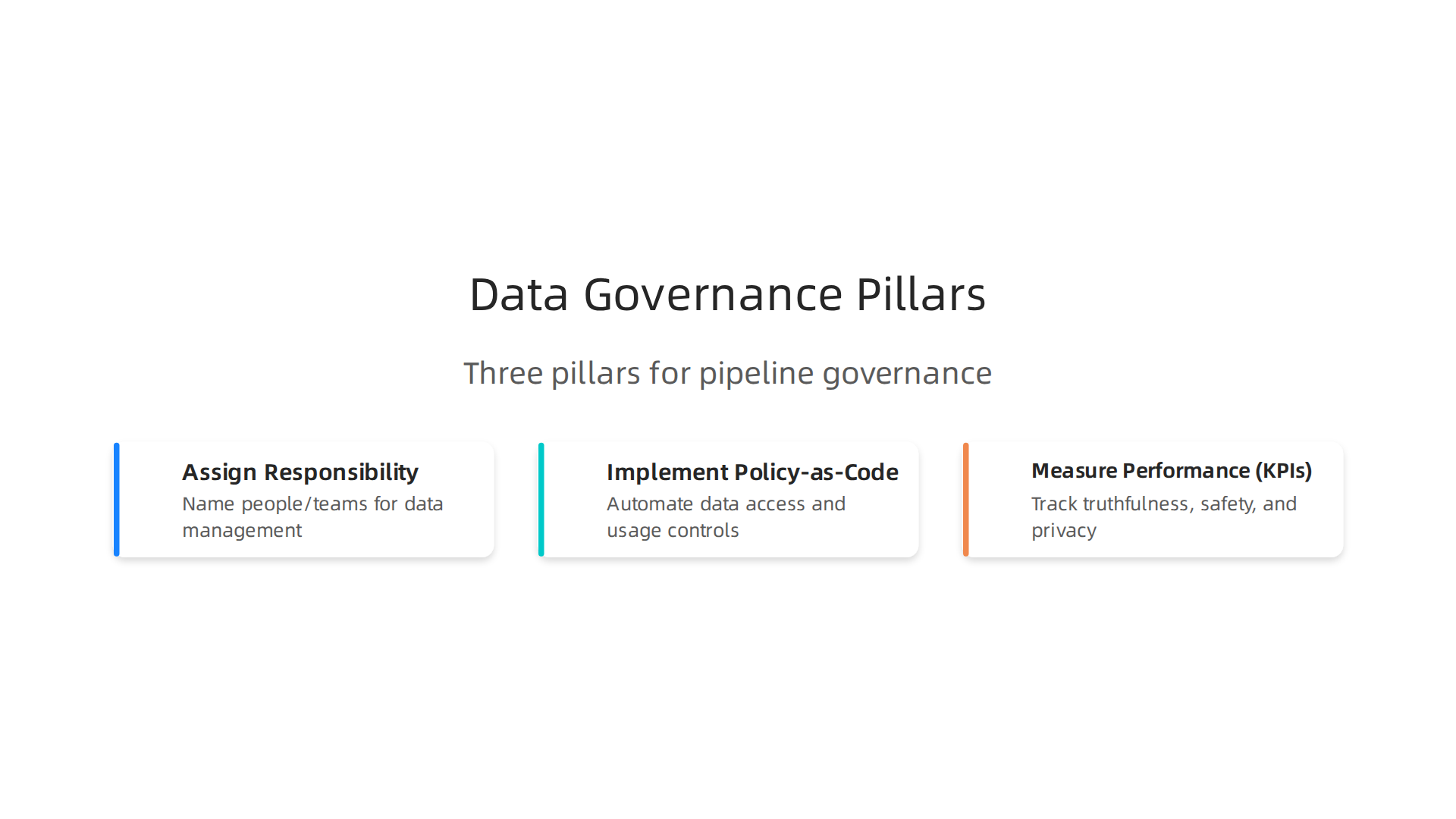
This is called data governance. It's like having a traffic cop for your data pipeline, making sure every piece of information goes where it should and is used correctly. This approach helps businesses avoid risks and supports human well-being by keeping data truthful.
First, your company needs to decide who is in charge of different parts of the data. This means naming specific people or teams and giving them clear jobs for managing permissioned data. They will make sure that consent records are kept safely and that all data contracts are followed. Think of data provenance, which is knowing the full story of your data, from where it started to how it was changed. Standards like ISO 42001 highlight the need for clear proof of data's origin and how it's used at every step of your data pipeline ISO 42001 Annex A.7.5 – Data Provenance.
Next, you'll want to set up "policy-as-code." This means turning your data rules into computer code. This code then automatically checks and controls how data is accessed and used. This stops people from using data in ways it wasn't meant for, and it helps keep a strong record of where data came from. This helps fight against data scraping and ensures that data is used only for its intended purpose. Keeping track of this is part of good data governance, provenance, and lineage in AI systems, which is vital for trust Data Governance, Provenance, and Lineage in AI Systems.
Finally, we need to measure how well these rules are working. This means creating clear goals, or KPIs, that show if your data pipeline is truly helping people. These goals should focus on things like truthfulness, safety, and privacy. If your AI helps people make better choices and keeps their information safe, then your data pipeline is working well. This kind of careful tracking helps us understand what is data analytics in a deeper way, making sure our data practices lead to AI that everyone can trust. To understand more about how ethical data analysis builds trust in AI, read our article on how ethical data analysis builds trust in ai.
2) Ingestion: sourcing permissioned, diverse, and verifiable data
After setting up strong rules for data, the next big step is bringing data into your system in the right way. This is called ingestion. It's like carefully choosing the ingredients before you start cooking. We must make sure the data we put into our data pipeline is permissioned, varied, and can be checked for truthfulness.
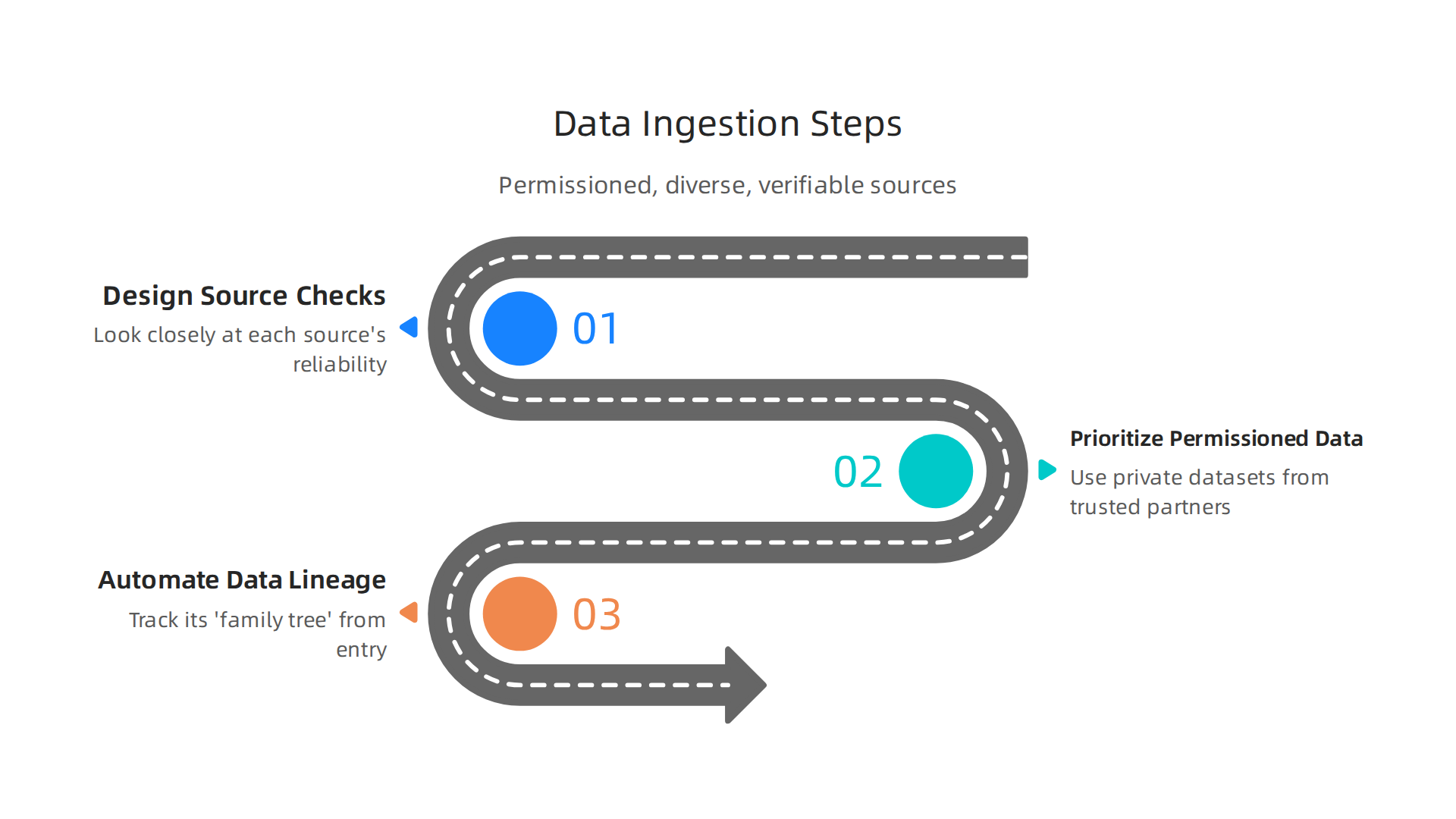
First, we need to design smart ways to check where our data comes from. This means looking closely at each source to make sure it's reliable. We also need to collect important information, called metadata, right when the data comes in. This metadata should include things like who gave permission to use the data, where the data started (its provenance), and how good the data quality is. This helps build trust from the very beginning. Standards like ISO 42001 show how important it is to keep clear records about the origin and journey of data in AI systems ISO42001 – Establishing Data Provenance in AI Systems.
It's always best to use data that we have clear permission for, like private datasets from trusted partners. This helps avoid problems like data scraping, where information is taken without proper consent. When we bring in data from outside, we should only use sources that are carefully chosen and known to be good. Once data is in, we need rules for changing it, making sure its original meaning and accuracy stay the same. This protects against "Synthetic Drift," which is when data gets twisted or loses its truth over time. Using permissioned private data helps generative AI assistants avoid synthetic drift. Many new rules for AI, especially in 2026, require companies to document where their training data came from and if they had the right licenses and consent to use it AI Regulation: How It Works, What It Requires, and ....
Finally, we need to automatically track the "family tree" of our data as soon as it enters the system. This is called data lineage. By doing this, we can easily see where every piece of data came from and how it has changed. If something goes wrong, like the data starts to change in unexpected ways or has bad content, we can quickly find the source of the problem and fix it. Keeping good records about data sources acts as proof that our claims about accuracy are true Regarding the Proposed Policy Statement Concerning the ... - FDD. This careful handling helps us unlock trustworthy AI systems with AI ready data.
Once you have brought data into your system, the next important step is to make sure it is of good quality. This is where data quality controls come in. It is like checking the ingredients carefully before you cook, making sure they are fresh and clean. We need to set up automatic checks for data before it is used to train AI or for what is data analytics.
This makes sure our AI systems are trustworthy.
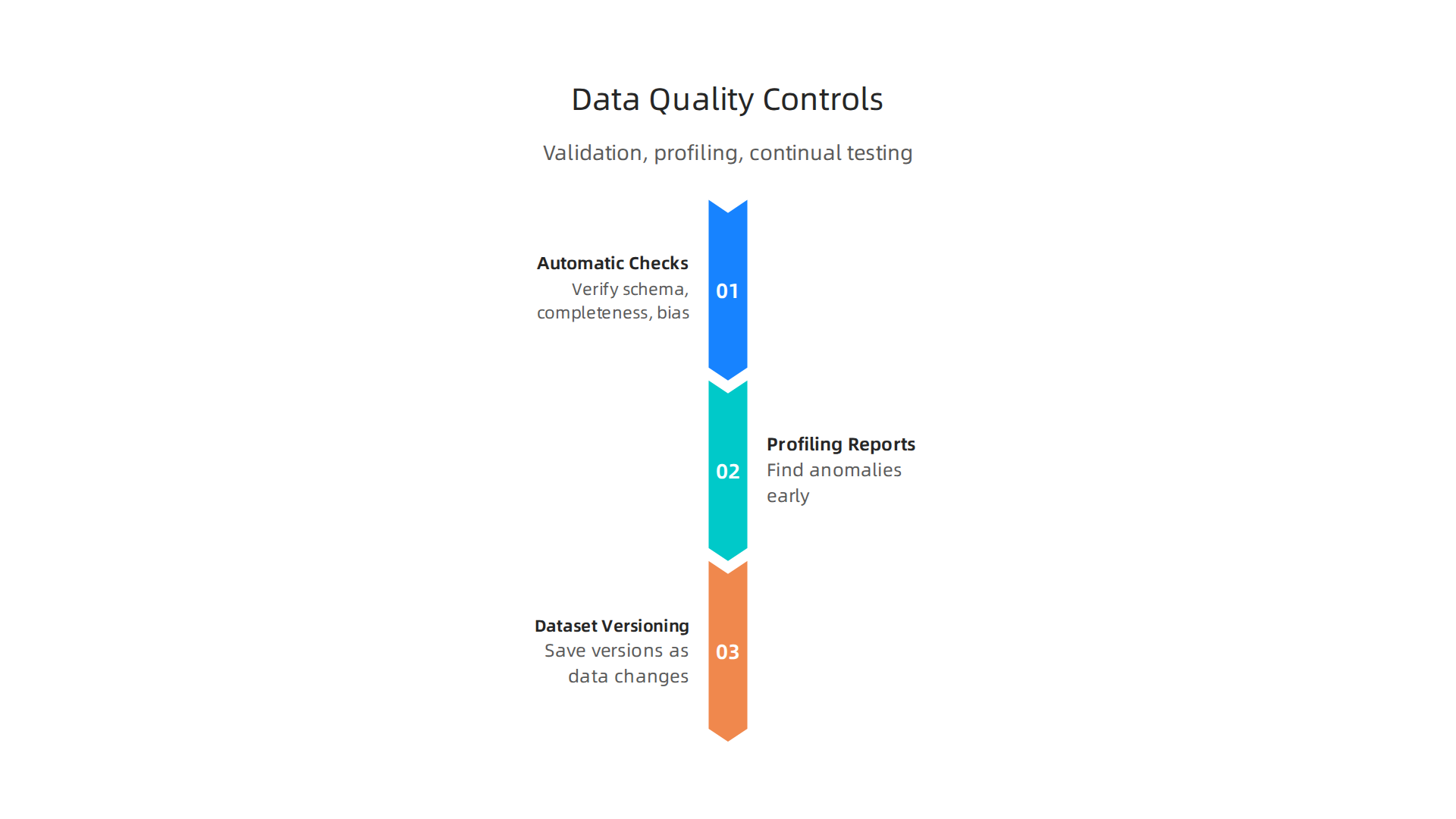
First, we use automatic checks to look at the data before it goes into the main data pipeline. These checks look for many things. They make sure the data is shaped correctly (its schema), that all parts are there (completeness), and that it does not show unfair leanings (bias checks). They also check if the data truly shows what it is supposed to (representativeness). These checks are like gates that data must pass through. If data fails these checks, it is flagged and fixed or not used. Experts even create systems to stop wrong data from getting through, like a "semantic firewall" for synthetic data A semantic firewall for proactive governance of synthetic ....
Next, we create special reports that show us what the data looks like. These are called profiling reports. They help us find strange things or mistakes in the data very early. We also take small samples of the data to check it more closely. This is very important to find any "synthetic artifacts," which are tiny errors that can appear in data that has been changed or created by a computer. Catching these early helps us overcoming synthetic drift building trustworthy AI. Knowing how to measure these changes, or "drift," is key to good quality control Measuring the gap: correlating synthetic-to-real drift with PHI ....
Finally, we need to keep track of every change to our datasets. This is called dataset versioning. It means we save different versions of the data as it changes, so we always know exactly what data was used at any time. We also use special tests, called test suites, to check our AI models. These tests always use a known, clear snapshot of the data. This way, we can always go back and check our work, making sure our AI is fair and accurate. Building an End-to-end data quality-driven framework for machine learning in production environment helps ensure continuous trustworthiness.
Beyond just keeping versions of our data, we need to know the entire story of that data. Where did it come from? What happened to it along the way? This complete story is called data lineage and provenance. It means we can trace every piece of information used to train our AI, all the way back to its original source, transformations, and even the permission given to use it.

Think of it like a detective following clues from the very start of a case to the end. Every step the data takes in the data pipeline is recorded. This end-to-end tracking is very important for understanding our data, as discussed in an end-to-end framework for data lineage analysis.
To make sure no one can secretly change this data history, we give each piece of data a special, unchangeable ID. We also use things like "digital fingerprints" or cryptographic checksums. These are unique codes that prove the data has not been touched or altered from its original form. This helps prevent wrong or bad data from ever being used, even if someone tried to sneak it in. This is very important when we want to make sure we are not using data from data scraping without permission, which can lead to big problems for our AI systems.
Finally, we design special ways to show this detailed data story. These "lineage views" help us follow rules and laws, or what we call compliance. They also help us fix problems quickly if something goes wrong, and be open with everyone about how our AI learns. We show enough detail to be clear, but we are careful not to share any private or sensitive information. Being transparent like this helps everyone trust the AI more. It also makes it easier to understand what is data analytics truly telling us if we know where the data came from. This careful approach is key for good AI Integrated Data Governance and Data Lineage. Building clear trails for data also supports security classification guide master data protection and AI access. Ultimately, this focus on clear and ethical data movement shows how ethical data analysis builds trust in AI.
5) Privacy, consent, and permission models for training data
Building on the idea of clear data trails, we must also make sure our AI uses data in a way that respects everyone's privacy and wishes. This means we need special ways to handle consent and permissions for all the training data. For every piece of information, we attach details about who gave permission to use it and exactly what it can be used for.

We call this "consent metadata" and "purpose limitations." These rules must be strictly followed, even down to each individual record. The good news is that our data pipeline is designed to enforce these rules, acting like a gatekeeper that checks permissions before data can be used to train AI. This helps ensure that we avoid issues like using data from data scraping without proper approval.
Sometimes, to protect privacy even more, we explore clever technical solutions. One such method is "differential privacy." This technique adds a small amount of "noise" to the data. This noise is carefully added so that the AI can still learn general patterns from a big group of data, but it becomes very hard for anyone to figure out details about any single person's data. It is important to know that there's a balance between how private the data is and how well the AI model performs, a concept explored in discussions about Differential Privacy for Federated Learning trade-offs. Another smart way is "federated learning." With this, AI models learn directly on people's devices, like their phones, without the need for the raw, private data to ever leave the device itself. This keeps individual data local and private, as detailed in a guide to Federated Learning and Differential Privacy.
We also use "synthetic-but-validated datasets." These are fake datasets that look and act like real data, but they don't contain any actual private information. The "validated" part is key: it means we check to make sure this fake data still accurately represents the real world, so the AI learns correctly. We must avoid simply swapping out real data with unverified synthetic data, which might teach the AI the wrong things. Balancing privacy with accuracy is a core challenge, highlighted in studies on privacy, accuracy, and model fairness trade-offs in AI systems.
Finally, people must have ways to control their own data. This means creating clear processes for them to "revoke" their consent if they change their mind, or to seek "redress" if they find an error in how their data was used. These processes allow individuals to exercise their data rights and help organizations quickly fix any mistakes in the data's history. This focus on individual control and correction is vital for truly unlocking trustworthy AI systems with AI-ready data and helps build deeper trust in what is data analytics telling us.
6) Monitoring, validation, and MLOps: detecting and responding to drift
Even with careful planning and ethical data use, things can change. AI models need constant watching, or "monitoring," to make sure they keep working correctly and fairly over time. This is especially true when we are working with our data pipeline. We need special tools and methods, often called MLOps, to find problems early and fix them fast.
One big problem is "drift." This happens when the real-world data that an AI model sees starts to look different from the data it learned from. Think of it like a river changing its path. This can be data distribution shifts, where the type of information coming in changes, or label drift, where what we call something shifts. For example, if an AI was trained on pictures of cats, but then suddenly starts seeing only dogs, it would "drift." If we don't catch this, the AI might start making bad choices or showing what we call synthetic drift or value misalignment. Experts in 2026 use many ways to detect these shifts, including looking at how much the data has changed from its original pattern, which can help measure the quality of synthetic data too Measuring the gap: correlating synthetic-to-real drift with PHI ....
To detect drift, we look for special signs:
- Data distribution shifts: This means the way data is spread out changes. For example, if your AI used to see mostly young people, but now sees many older people. Tools can compare the current data flow to a past, trusted set Model Monitoring in MLOps: Tools, Metrics & Best Practices.
- Label drift: This is when the meaning of what the AI is trying to predict changes. Imagine an AI classifying "happy" faces. If what makes a face "happy" changes over time, the AI might get confused.
- Downstream behavior: This checks if the AI's final actions or predictions are still good. Is it giving useful answers? Is it making fair choices?
When we find drift, we need to act quickly. Our systems have ways to raise alerts, much like a smoke alarm. For important changes, we might even need a "human-in-the-loop" to review things, meaning a person checks the problem and decides what to do. Sometimes, we have to "roll back" the AI to an older, working version. Other times, we retrain the AI with the new, changed data to help it learn better. This is all part of having a strong data pipeline and good MLOps practices MLOps in 2026: Monitoring, Drift Detection, and Automated Retraining. Many companies use platforms like AWS SageMaker Model Monitor or Azure Machine Learning to help with this Chapter 6C: Model Monitoring and Observability Tools - AI Playbooks. Keeping a close eye on what is data analytics telling us is very important here.
It is not just about technical checks. We also need to measure how the AI affects people and society. This includes looking at things like:
- Misinformation amplification: Is the AI accidentally spreading false information?
- Fairness signals: Is the AI being fair to all groups of people, or is it showing bias?
- User feedback: What are real users saying about the AI's performance?
Monitoring these human-centric metrics helps us make sure the AI is not just smart, but also kind and helpful. Building trustworthy AI means always checking and improving, ensuring that we are overcoming synthetic drift building trustworthy AI at every step.
Moving from just watching our AI models to making them truly fair and helpful needs more than just technical fixes. It also means big changes in how a company works, including its rules, what it rewards, and its overall way of thinking.

This is called organizational change, and it's key to building AI systems that everyone can trust.
First, we need to make sure that the goals we set for our AI products actually lead to good outcomes for people. Right now, many systems only care about how much people "engage" or click on things. But this can sometimes lead to problems like spreading wrong information. Instead, we should reward things like honesty, helping people live better lives, and creating strong information systems that are not easily broken. This change in what we value helps ensure our AI supports human well-being, not just profits.
Next, it's important to have different teams work together to check on AI projects. This means setting up groups like ethics boards or data stewards. These groups should look at decisions made at every step of the data pipeline to make sure they are fair and follow good rules. For instance, when we gather data, how do we know it's fair? We can check what experts say about how to put AI governance into practice from the start. This kind of teamwork helps make sure that the way we collect and use data, and what is data analytics showing us, matches our ethical goals. It also involves knowing how to manage privacy when using data, as privacy is a big part of building trust Federated Learning with Differential Privacy: An Utility ....
Finally, we need to teach everyone involved how to build AI in a good way. This means giving training and easy-to-follow guides, called "playbooks," to engineers and product teams. These tools help them put ethical data practices into their daily work. For example, they might learn how to avoid issues like data scraping or how to set up a secure data classroom for learning. By having clear steps and ongoing education, companies can make sure that ethical behavior is a normal part of how they create and use AI, helping to build trustworthy AI: combat synthetic drift with ethical data across the entire organization. This way, AI becomes a tool for good that truly serves people.
Summary
This article explains how enterprise data pipelines determine whether AI systems are trustworthy and useful. It walks through the full pipeline lifecycle—starting with governance and policy-as-code, moving through permissioned data ingestion and automatic quality checks, and ending with lineage, consent models, and ongoing MLOps monitoring. The piece highlights practical controls like metadata capture, dataset versioning, cryptographic fingerprints, differential privacy and federated learning, and shows how these reduce risks such as synthetic drift and unauthorized scraping. Readers will learn what concrete steps to take (roles, KPIs, testing, alerts, and remediation), which trade-offs to expect between privacy and model performance, and how organizational change and standards (e.g., ISO 42001) support compliance and long-term trust. After reading, practitioners will be able to design or evaluate pipelines that protect privacy, prove provenance, detect drift, and maintain reliable AI outcomes.