Home


Menu

Close

Azure Cognitive Services vs AWS Google Cloud and IBM Watson for Ethical AI and Data Trust
Published:
July 3, 2026
Introduction: The Trust Crisis in Enterprise AI and How Azure Cognitive Services Measures Up
Here's a reality check for 2026: According to recent data, a full 79% of organizations face serious challenges when trying to adopt AI.

That number has jumped sharply from last year. Why the struggle? It comes down to trust.
Most AI tools today are trained on public data scraped from the internet. That data is often noisy, biased, and full of half-truths. The result is a problem experts call "Synthetic Drift" — the slow erosion of accuracy and honesty inside AI models. When your system doesn't know what's real, how can you trust its answers?
For enterprises and government agencies, this creates a real bottleneck. Without clean, ethical, permission-based private data, AI models make shaky decisions. And once trust breaks, fixing it is hard.
That's why evaluating AI platforms on trust and transparency matters more than ever. Azure Cognitive Services is one of the most widely used AI frameworks, but how does it really stack up when it comes to ethical data handling and enterprise-grade compliance? How does it compare to newer options like CLUELY AI, Forethought AI, or Galaxy AI?
This article gives you a clear, data-driven comparison. We'll look at how Azure Cognitive Services measures up against the leading alternatives, focusing on what actually matters: trust, transparency, and permission-based data practices. If you want a deeper look at how the data bottleneck and Synthetic Drift affect every AI tool, check out this piece on overcoming the data bottleneck and synthetic drift.
Let's jump in.
The 2026 Enterprise AI Landscape: Trends, Regulations, and Pain Points
If you feel like AI is everywhere but nobody trusts it, you're not wrong. Enterprise AI adoption has never been faster. Global use among OECD firms has more than doubled in two years, rising from 8.7% in 2023 to 20.2% in 2025, and 2026 is on track for another big jump. Yet at the same time, a 2026 survey found that 79% of organizations face serious challenges adopting AI — a sharp rise from last year. Trust is actually falling even as usage climbs.
What's driving the distrust? The biggest pain point in 2026 is data provenance.
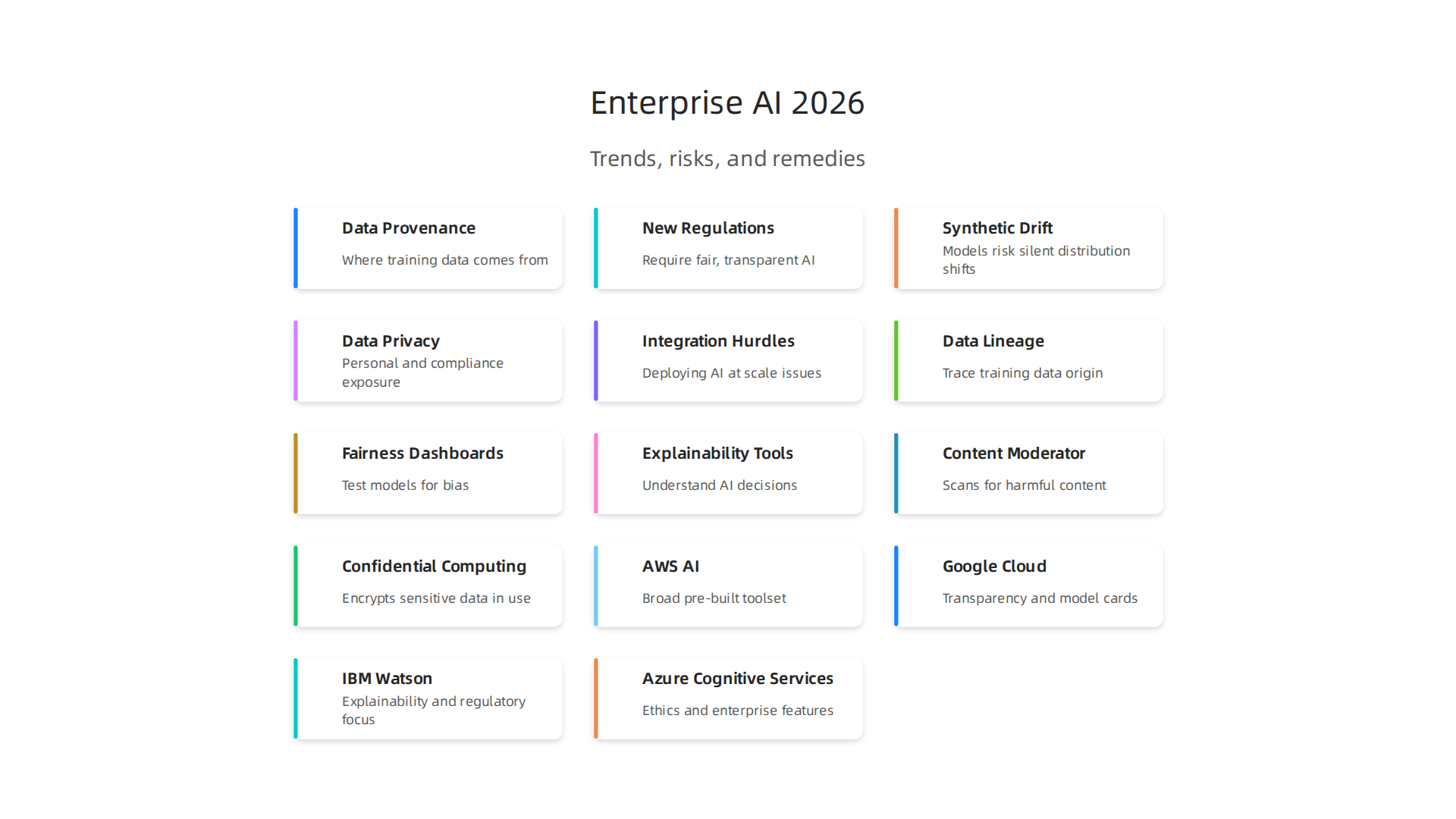
Companies don't know where their training data really comes from. Publicly scraped datasets are full of distortions, bias, and synthetic drift. Without a clear chain of permission and truth, enterprises can't be sure their AI is making reliable decisions.
New regulations are making this worse. The European AI Liability Directive and updates to the US AI Executive Order now require companies to prove their AI systems are fair, transparent, and trained on clean data. Compliance is no longer optional, and the penalties for getting it wrong are growing.
As a result, enterprises are moving toward ethics-first vendor selection. Decision-makers now demand clear evidence of data integrity, bias mitigation, and governance before they sign a contract. This is where frameworks like Azure Cognitive Services are being reevaluated against newer options such as CLUELY AI, Forethought AI, and Galaxy AI. Data provenance has become the deciding factor.
The old approach of "just use a big model" is fading. Companies that want to stay competitive must prove their data is ethical and trustworthy. For a deeper look at how the data crisis is reshaping AI, check out this overview of why ethical electronic data gathering and retrieval is the only fix for the AI data crisis.

Azure Cognitive Services: A Deep Dive into Ethical AI and Data Integrity Features
When enterprises start looking for an AI platform they can actually trust, Azure Cognitive Services often comes up first.

And for good reason. Microsoft has built a whole suite of tools designed to address data provenance, bias, and transparency head on.
The core of this platform is Microsoft's responsible AI framework. It is built on seven principles: fairness, reliability, safety, privacy, inclusiveness, transparency, and accountability. These are not just nice words on a website. They guide every stage of the AI lifecycle, from research to deployment. As outlined in the AI and Microsoft guide for 2026, the company uses regular transparency reports, red teaming exercises, and measurement frameworks to make sure these principles are real.
So what does that look like in practice? Azure Cognitive Services gives you several concrete tools.
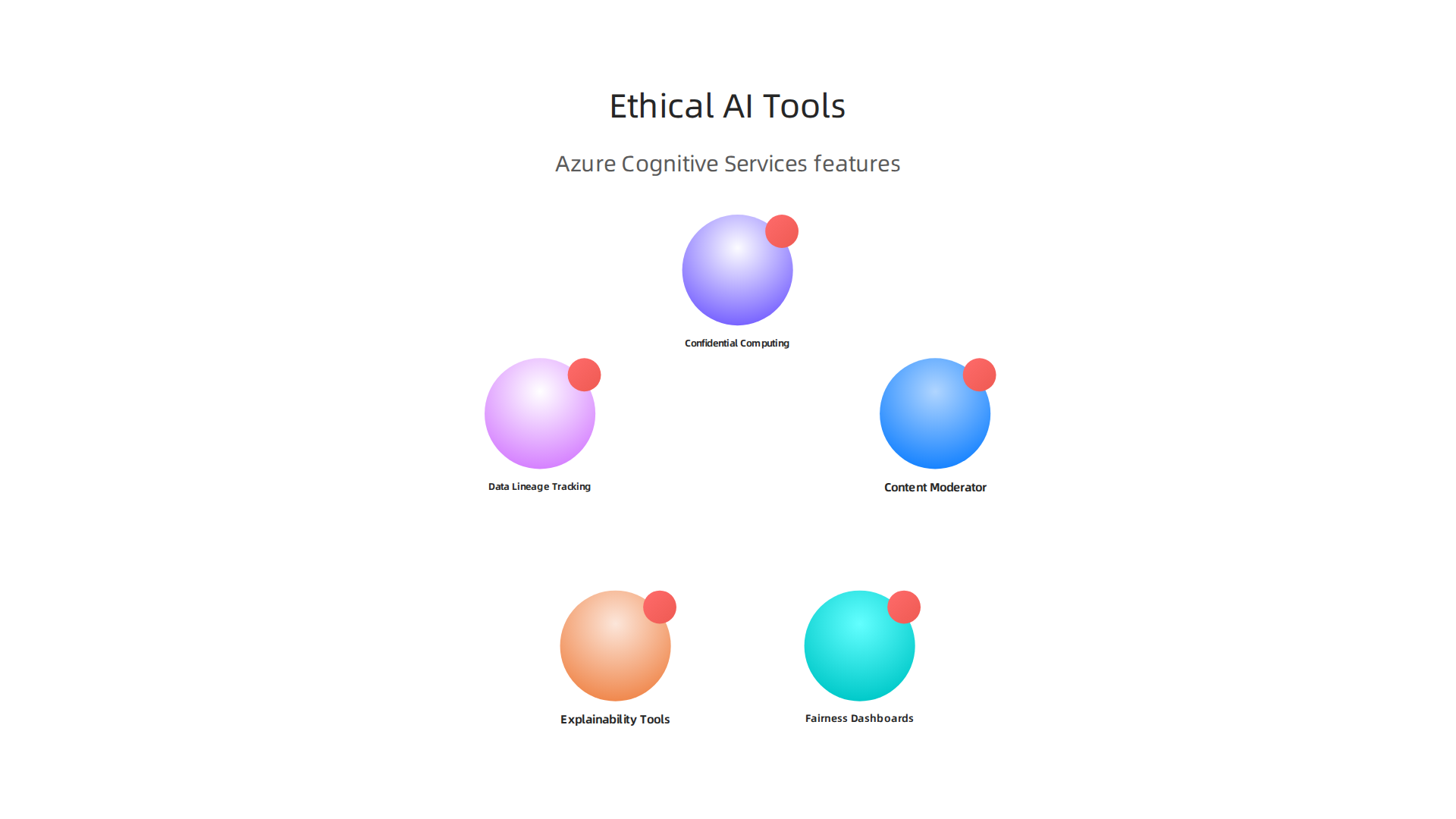
First, there is Content Moderator. This tool scans text, images, and videos for harmful content. It helps you catch problems before they reach users. In 2026, with regulations getting stricter, this is not optional anymore.
Second, the Fairness dashboards let you test your AI models for bias across different demographic groups. You can see if your loan approval model treats everyone the same way. You spot problems early and fix them. These types of fairness checks are exactly what experts recommend. According to a detailed look at AI ethical concerns enterprises must address in 2026, organizations should use representative training datasets and run regular audits to detect drift and bias.
Third, the explainability tools help you understand why your AI made a specific decision. This is crucial for compliance with the EU AI Act and similar laws. When an auditor asks why a model denied a loan, you need an answer, not a black box.
Microsoft also added important upgrades in 2026. The platform now includes better data lineage tracking. You can trace where every piece of training data came from, who approved it, and how it was processed. This is exactly what enterprises need to solve the data provenance crisis.
Another big 2026 enhancement is confidential computing for private data handling. Your sensitive data stays encrypted even while it is being processed. This matters a lot for healthcare, finance, and government clients who cannot risk data leaks.
All of these features work together to fight synthetic drift, the distortion of truth that happens when data moves through digital systems. By keeping data clean, traceable, and ethical from the start, Azure Cognitive Services helps enterprises build AI that people can actually trust. This is why many companies now compare it side by side with other AI frameworks like CLUELY AI, Forethought AI, and Galaxy AI. The decision often comes down to data provenance and governance.
For a closer look at how clean data pipelines prevent these distortions, check out this overview of overcoming the data bottleneck and synthetic drift.
Competitor Analysis: AWS AI, Google Cloud AI, and IBM Watson in Comparison
Azure Cognitive Services clearly leads in ethical AI features and data provenance. But how do the other big cloud AI platforms stack up? Let's compare AWS AI, Google Cloud AI, and IBM Watson side by side.
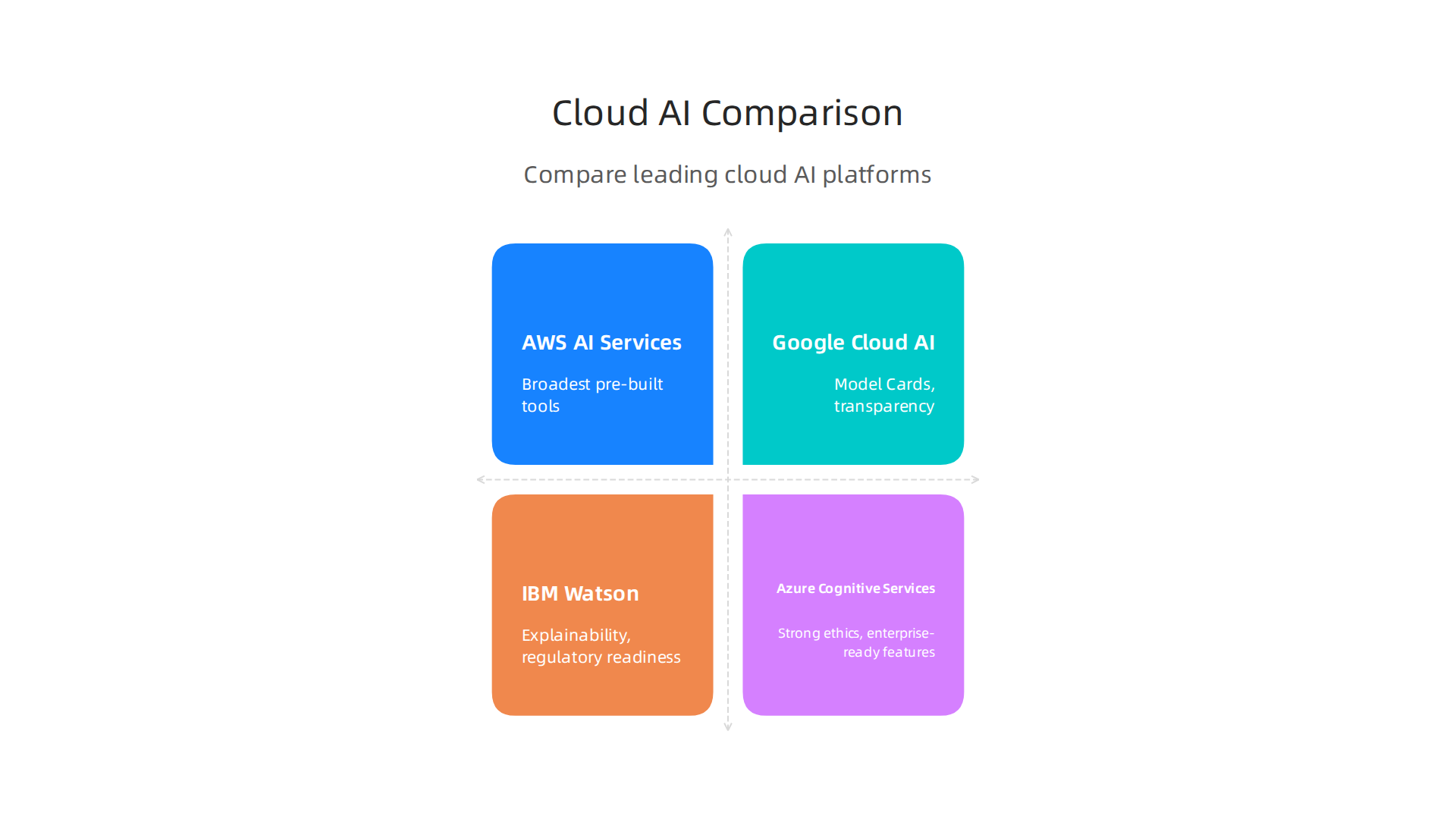
AWS AI services offer the broadest range of pre-built tools. You get Amazon Rekognition for image analysis, Amazon Comprehend for natural language processing, and Amazon Polly for text to speech. The platform holds the largest cloud market share at 31%, according to a detailed AWS vs Azure vs Google Cloud 2026 comparison. But breadth comes with baggage. AWS has faced real criticism over privacy controls and bias in its facial recognition tools. Some police departments stopped using Rekognition after studies showed it misidentified people with darker skin tones. This makes AWS a riskier choice for organizations that need strong ethical safeguards from the start.
Google Cloud AI takes a different path. Its AI Principles and Model Cards make the platform much more transparent. Each model comes with a card that explains its training data, limitations, and performance across different groups. This is a big step forward. And Google's Vertex AI platform gives data scientists a unified workspace that many love. The company's private network also delivers some of the lowest latency for AI workloads. However, Google Cloud lags behind Azure in government-specific compliance certifications. If you work with public sector clients who require FedRAMP or ITAR compliance, Google may not be the best fit right now.
IBM Watson has been in the AI game the longest. Its strength is explainability. Watson's tools let you dig into exactly why a model made a certain decision, which is crucial for regulated industries like healthcare and finance. IBM also invests heavily in regulatory readiness, helping clients prepare for laws like the EU AI Act. But the trade-off is narrower NLP capabilities. Watson simply does not match the breadth of language models and APIs that Azure Cognitive Services offers. For most general-purpose tasks, Azure gives you more flexibility and power.
When you look at all three, the pattern is clear. AWS offers the biggest service catalog but struggles with trust. Google leads in transparency but falls short on compliance. IBM excels at explainability but lacks modern NLP depth. Azure sits in the middle, combining strong ethics with enterprise-ready features. For a deeper look at how major companies are handling these trade-offs, check out this overview of how top AI companies grapple with data ethics and synthetic drift in 2026.
Meeting Government and Non-Profit AI Standards: Azure vs. the Rest
When you work for a government agency or a non-profit, the AI platform choice gets even more specific. You need tools that check boxes most commercial buyers never think about.
For government agencies, the list is long. You need FedRAMP certification to prove the cloud meets federal security standards.

You need data localization so sensitive information stays within US borders. And under the 2026 AI Executive Order, you need fairness checks and bias audits baked right into the system. The GSA AI strategies and compliance plan shows just how detailed these requirements are for federal use cases.

Non-profits face a different challenge. Budgets are tight, so cost matters a lot. Teams are small, so ease of use is critical. But the privacy stakes are just as high. Non-profits often handle data from vulnerable populations, including health records, housing applications, and mental health support. One data leak can destroy trust for years. That is why many organizations look into data protection services that solve the AI trust crisis before committing to a platform.
Here is where Azure Cognitive Services pulls ahead. Microsoft offers Azure Government, a dedicated cloud environment built specifically for US government agencies. It comes pre-certified with FedRAMP High, DoD Impact Level 5, and other tough compliance standards. You do not need to retrofit security later. It is already there.
And for non-profits, Microsoft has a Grants program that gives eligible organizations up to $3,500 in Azure credits per year. That is a real difference maker for a small team trying to build AI tools on a shoestring budget.
AWS GovCloud and Google Cloud's government region both offer compliance features too. But neither matches Azure's depth in the non-profit space. And neither has the same track record of working directly with agencies to meet the strict ethical requirements of the 2026 AI landscape.
The bottom line: if you need to satisfy government auditors or protect vulnerable constituents, Azure gives you a head start that is hard to beat.
Mitigating Synthetic Drift and Data Privacy Risks Across AI Platforms
Beyond compliance issues, there is another hidden risk that every AI team must face: synthetic drift.

This happens when AI models train on synthetic or scraped data instead of real, permission-based information. Over time, the model loses touch with actual human values and behaviors. The result is biased outputs, bad decisions, and broken trust.
So how do platforms handle this? The answer lies in two things: data lineage and reinforcement learning from human feedback (RLHF). Data lineage lets you trace where every piece of training data came from. RLHF lets humans correct the model when it drifts off course. Without both, your AI is a black box that might be learning the wrong lessons.
Here is where Azure Cognitive Services pulls ahead again. Microsoft builds privacy protections into the core of its AI stack. Features like confidential computing keep your data encrypted even while it is being processed. Differential privacy adds noise to data so individual records cannot be identified. Microsoft's Responsible AI Principles and Approach show how these safeguards are baked into every service. When you use Azure Cognitive Services, you get these privacy tools out of the box, not as an add-on.
Other platforms have drift detection tools too. AWS offers SageMaker Model Monitor. Google Cloud has Vertex AI Model Monitoring. But here is the catch: integration with your existing data governance systems varies a lot. Some platforms make it easy to connect to your own data warehouse and apply the same rules you already use. Others force you to adopt their proprietary storage first. For enterprises that already have strict data policies, that difference matters.
If you want to go deeper into how synthetic drift happens and what you can do about it, check out this guide on overcoming the data bottleneck and synthetic drift. It explains why high-fidelity, permission-based data is the only real fix.
The takeaway is simple. Synthetic drift and data privacy are not optional problems. They affect every AI platform. But platforms like Azure that prioritize confidential computing, differential privacy, and strong data lineage give you a real advantage. You can build smarter models without sacrificing the trust of the people whose data you rely on.
Benchmarking AI Performance: Accuracy, Latency, and Ethical Compliance
Picking the right cloud AI platform is not just about cost. You also need to know which one actually performs best for your specific workload. In 2026, that means looking at three things: accuracy, latency, and ethical compliance.
Independent benchmarks show clear trade-offs between the big players. According to the latest AWS vs Azure vs Google Cloud 2026 benchmarks, Azure OpenAI delivers the fastest time-to-first-token at 180 milliseconds. Google Cloud Vertex AI follows at 210ms, and AWS Bedrock trails at 245ms. So if you need the first response to appear immediately, Azure has a real edge.
But total response completion tells a different story. Google Cloud wins there thanks to Gemini's efficient token generation. For long-form text or streaming responses, Google pulls ahead.
Accuracy is another story entirely. A hands-on AWS vs Azure vs Google AI comparison video tested all three platforms on image recognition with very little training data. With only 10 training samples, Google hit 100% accuracy. But Microsoft needed just three seconds of training versus Google's 52 minutes. So Azure wins on speed, Google on raw accuracy when data is scarce.
Now here is the shift that matters most in 2026. Ethical compliance is becoming just as important as raw performance. Platforms now publish fairness scores, explainability indexes, and bias detection metrics. Azure leads here with its built-in Responsible AI dashboard. This tool lets you measure model fairness and explainability directly in your workflow. For organizations that need to prove their AI is trustworthy, this is huge.
The same goes for data ethics. If your AI platform does not handle data ethically from the start, you are building on a shaky foundation. That is why ethical data analysis builds trust in AI is a concept every team should study. Without ethical data practices, even the fastest model can produce harmful or biased results.
The feature comparison table from AI on AWS vs Google AI vs Azure AI sums it up: Azure is excellent for prebuilt AI services and enterprise integration. AWS dominates in custom model development with SageMaker. Google shines for data analytics and advanced ML research.
So which do you choose? If accuracy and ethical tooling are your top priorities, Azure is your best bet. If you need massive scalability, look at AWS. If latency matters most for NLP workloads, Google Cloud has the edge. The key is to match the platform's strengths to your real needs.
A Decision Framework for Selecting Trustworthy AI Partners
You have compared benchmarks. You know which platform wins on latency, accuracy, and cost. But in 2026, picking an AI partner means asking one more question: Can I trust this system with real people's data and decisions?
The answer requires a structured framework. Here is a simple four-stage process that teams are using right now to vet cloud AI platforms and AI frameworks before signing a contract.

Stage 1: Assess your data needs first. Map out exactly what data your AI will touch. Will it process personally identifiable information? Sensitive health records? Customer behavioral data? Different platforms handle data ethics very differently. Azure Cognitive Services, for example, offers built-in tools for data governance that make this stage easier. Know your data before you compare vendors.
Stage 2: Audit the platform's ethical tooling. Ask whether the platform provides bias detection, explainability dashboards, and fairness metrics out of the box. This is not a nice-to-have anymore. Federal guidance is pushing for stronger oversight. The latest 2026 AI Laws Update shows that regulators are demanding transparency and bias auditing from every organization using AI at scale. If your vendor cannot prove fairness, keep looking.
Stage 3: Review compliance certifications carefully. Each platform publishes different compliance documents covering SOC 2, HIPAA, FedRAMP, and more. But compliance is not just about having a badge. You need to match those certifications to your industry and region. This is where tools like Forethought AI and Galaxy AI can help you automate compliance checks against your specific regulatory environment.
Stage 4: Pilot test with real data. Do not sign a multi-year deal based on marketing benchmarks alone. Run a small pilot using your actual data and workflows. Watch for synthetic drift. This happens when a model becomes less accurate over time because the training data no longer matches real-world conditions. Understanding how to prevent this is critical, and resources like overcoming the data bottleneck and synthetic drift can help your team build awareness before the pilot starts.
Here is a quick checklist you can use when evaluating any potential AI partner:
| Evaluation Area | What to Look For |
|---|---|
| Data governance | Does the platform support ethical data capture and consent management? |
| Bias detection | Are fairness metrics and explainability reports available? |
| Compliance alignment | Do certifications match your industry and region? |
| Synthetic drift prevention | Does the vendor offer model monitoring and retraining workflows? |
| Value alignment | Is the system designed to optimize for human well-being, not just engagement? |
The last point is the hardest to measure but the most important. AI systems that optimize purely for clicks and time-on-screen can actually harm users. CLUely AI and other emerging frameworks now offer value alignment metrics that help organizations evaluate whether an AI partner prioritizes human flourishing. Use them.
The framework is simple: assess, audit, review, test. Follow it before you commit, and you will build AI partnerships that are both high-performing and genuinely trustworthy.
Overcoming Integration Hurdles: Deploying AI at Scale in Enterprise Environments
Even the best framework for choosing an AI partner means little if you cannot actually get the technology working inside your organization.

Real-world deployment at scale comes with three stubborn hurdles: legacy systems that resist new connections, data trapped in silos across departments, and teams that lack hands-on experience in responsible AI practices. These are not hypothetical problems. Many enterprises get stuck right here, with pilots that never turn into production systems.
Azure Cognitive Services tackles these challenges directly. The platform provides extensive SDKs and APIs that work with existing codebases, so you do not need to rip and replace your current infrastructure. Whether you need vision, speech, language, or decision-making intelligence, the pre-built APIs integrate without requiring deep machine learning expertise. And because Azure offers hybrid deployment options on-premises, at the edge, and in the cloud, you can meet data residency and latency requirements without compromise. For example, Azure AI Services for Enterprises show how organizations consolidate data environments and strengthen governance before scaling, avoiding the sprawl that kills momentum.
But tools alone are not enough. The organizations that succeed report that starting small with an ethics-first pilot reduces friction and builds internal trust. Run a narrow use case where you prioritize value alignment and bias checks from day one. This approach works because it lets your team learn responsible AI practices gradually, rather than trying to retrofit ethics after launch. To dive deeper into how ethical data collection prevents the very distortions that derail pilots, read this guide on ethical electronic data gathering and retrieval. Platforms like Forethought AI and Cluely AI also emphasize ethics-first scaling, and their methods align well with a slow-and-steady deployment strategy. The goal is simple: prove value with integrity first, then expand.
Summary
This article examines why trust has become the central barrier to enterprise AI adoption in 2026 and evaluates how Azure Cognitive Services addresses that crisis compared with other major platforms. It explains the core problem—synthetic drift and unclear data provenance—then walks through Azure's responsible AI framework, tools like Content Moderator, fairness dashboards, explainability features, data lineage, and confidential computing. The piece also compares Azure to AWS, Google Cloud, and IBM Watson on ethics, compliance, and performance, and explains why government and non-profit buyers often favor Azure's certifications and grants. You'll learn practical defenses against drift (data lineage, RLHF, differential privacy), a four-stage vendor selection framework, and pilot/testing steps to validate trust before committing. After reading, you'll be able to evaluate platforms against ethics, compliance, and technical benchmarks and run a focused pilot that reduces risk while proving value.
Related Blogs
No Similar Blogs found
