


The AI did the work. You forgot how to.
It writes faster than you, answers everything, and never hesitates. The slow cost has a name: Synthetic Drift.
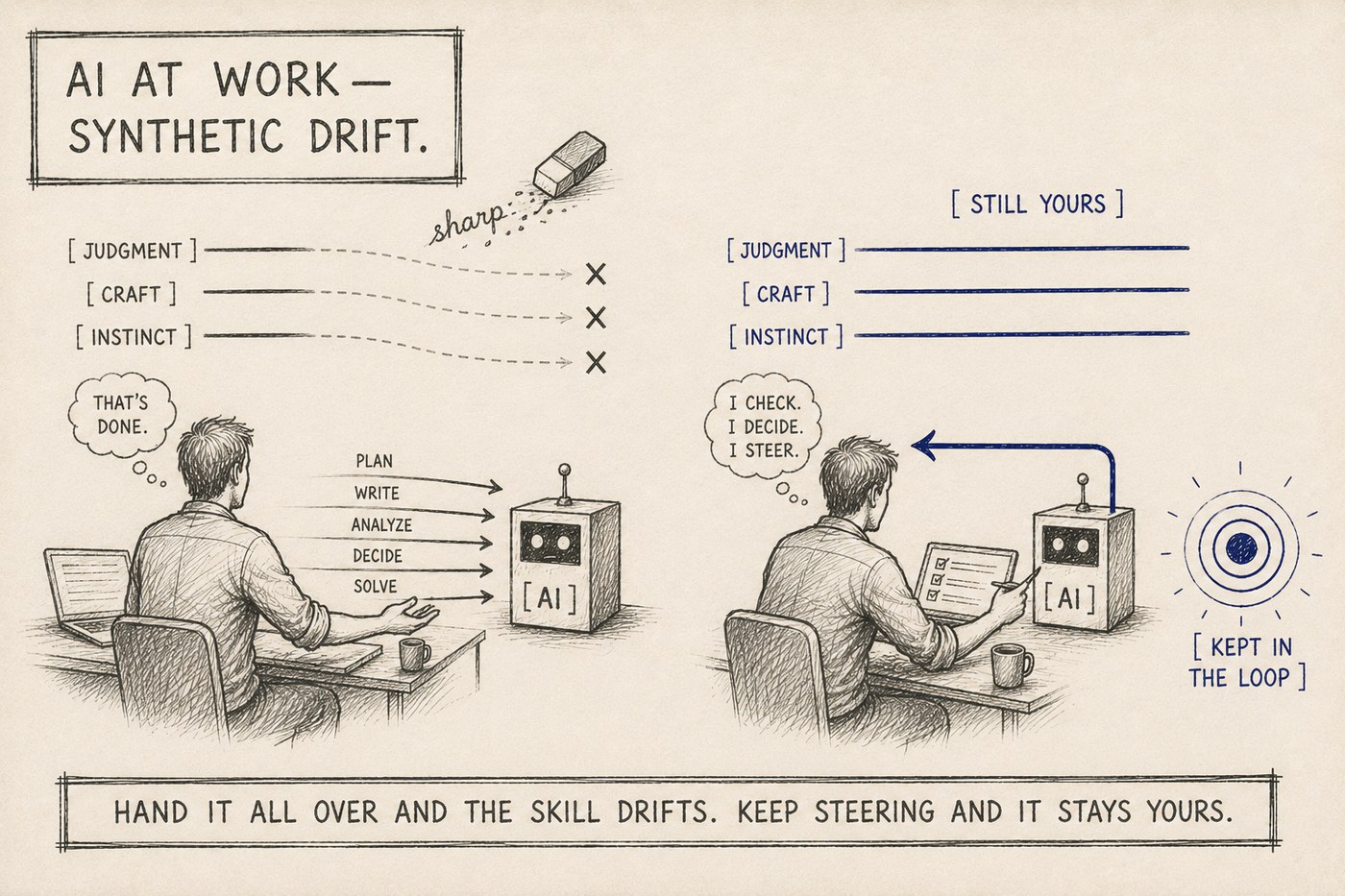
This is Synthetic Drift.
Every time you let the model decide, draft, or judge for you, you skip the rep that kept that skill alive. The output looks finished, so you stop checking. Drift isn't the AI getting worse — it's your own judgment quietly going slack while the work still ships on time.
A large model is trained on the averaged internet — it returns the most likely answer, not the right one for your situation. It can't tell a good idea from a plausible-sounding one, and it never tells you when it's unsure. So the danger isn't a wrong answer you catch. It's a fluent, confident, average answer you accept — because checking it is slower than trusting it, and trusting it feels fine right up until the judgment you needed is the one you stopped using.
-
1
Decide before you ask
Form your own answer first, then ask the AI. Now you're comparing two judgments instead of inheriting one. The gap between them is where your skill lives — and the only place you'll notice it drifting.
-
2
Make it show its work, then check it
Ask for the reasoning and the source, not just the conclusion. If it can't point to a real one, treat the answer as the average of the noise. The check is the rep — skip it and the muscle goes.
-
3
Keep one task fully by hand each week
Pick something that matters and do it without the model — a decision, a draft, a judgment call. Not nostalgia: it's how you keep proof of what you can still do when the tool is wrong.
AI can generate creative-looking outputs at speed, but they come from pattern recognition and recombination — not true invention. Human creativity relies on imagination, intuition, and the ability to challenge assumptions. Harvard Business School Online · Human Skills AI Can't Replace · 2026 · Source
New research finds human experience and judgment remain critical, because AI can't reliably tell a good idea from a mediocre one or steer long-term strategy on its own. Institute for Business in Global Society, Harvard · 2025 · Source
MIT Sloan's EPOCH framework names five capabilities AI struggles to replicate — Empathy, Presence, Opinion/judgment, Creativity, and Hope — and finds these tasks are better augmented than automated. MIT Sloan School of Management · 2025 · Source
The Value Reinforcement System was built to capture real human signal at the source — the judgment, effort, and context a model can only average over — keeping the person in the loop by design. Dean Grey · Value Reinforcement System · U.S. Patent No. 12,205,176
