


Same event, two sources, two truths. Which one do you stand on?
Same hour, opposite conclusions, and no floor under your feet. The dizziness has a name: Information Vertigo.
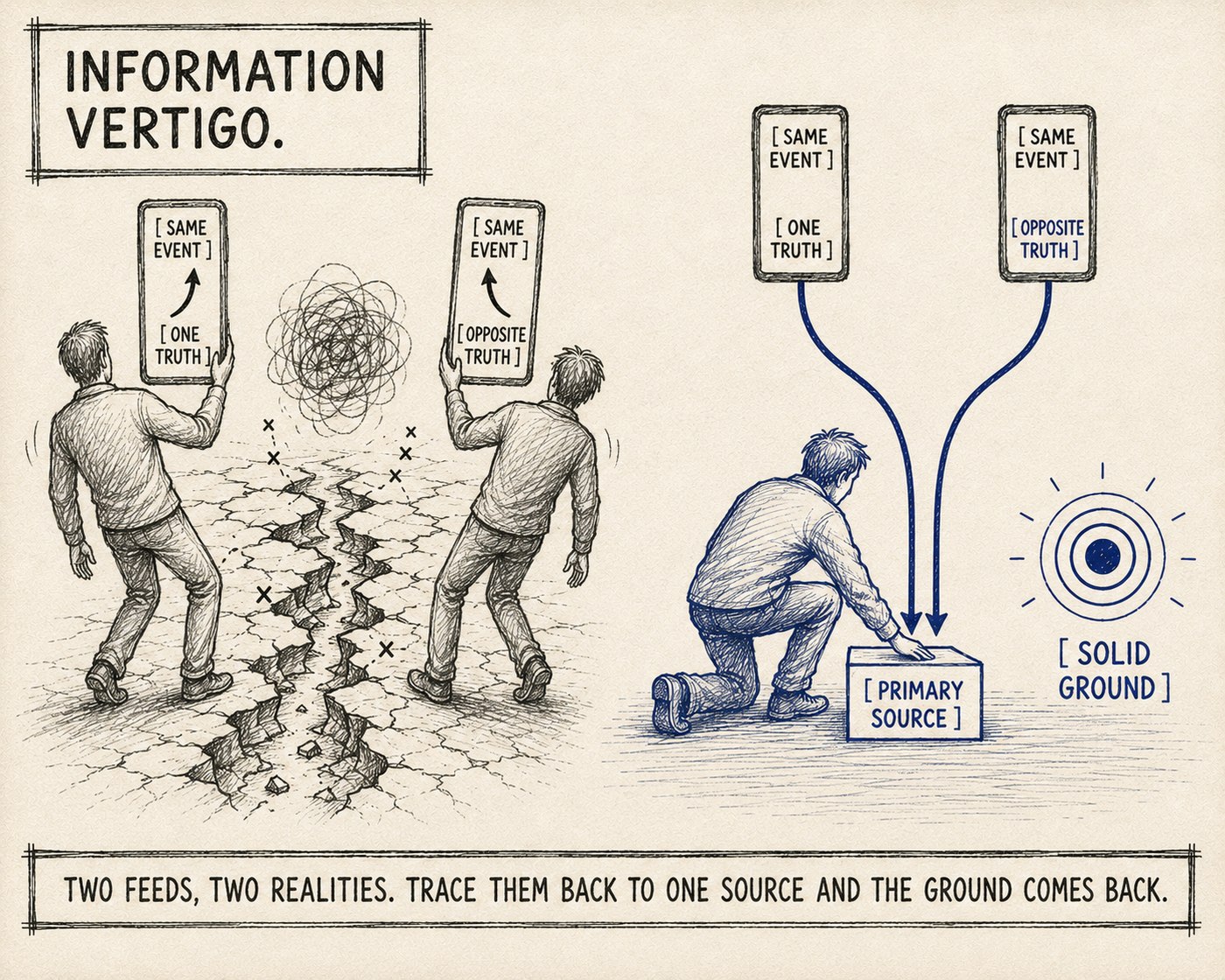
This is Information Vertigo.
It's the disorientation you feel when two accounts of the same event can't both be true — and you have no steady way to tell which one is. The vertigo isn't that you're uninformed. It's that you're over-fed two incompatible realities and left to balance on the gap between them.
Neither source handed you the event — each handed you an edit of it, shaped by what that outlet sees, leaves out, and ranks as important. Read one and you stand on its map; read the other and the map shifts under you. So when two accounts of the same hour collide, it feels like reality itself is unstable — when really you're being told two different maps are each the territory.
-
1
Go down to the primary source
Before you believe either version, find the thing itself — the full transcript, the original document, the unedited clip. The footing is always at the bottom, under the takes. If you can't reach it, treat the story as unconfirmed, not as true.
-
2
Read the source you distrust on purpose
Open the account that disagrees with the one you'd reach for and read it for what it claims, not to argue. You're not looking for who's right — you're mapping where the two versions actually diverge. That gap is the real story, and it's invisible from inside one source.
-
3
Let "I don't know yet" be a place to stand
The vertigo comes from forcing a verdict before the ground sets. Hold the question open for a day. Solid conclusions arrive late; the fast ones are usually the source's, not yours.
Personalized algorithms tend to show people content that matches their existing views, producing separate information spheres where different facts and conclusions prevail — the effect Eli Pariser first demonstrated when two people searching the same word saw entirely different results. Eli Pariser · "The Filter Bubble" · 2011 · Overview
Across 48 markets, the 2025 report finds traditional sources struggling to reach the public as audiences shift to social and video feeds, with the central worry being the blurring of truth and the erosion of a shared, objective account of events. Reuters Institute · Digital News Report · 2025 · Source
Gallup and Knight found that the great majority of Americans say their trust in the news has fallen over the past decade, with most pointing to perceived accuracy and bias as the reason — a population unsure which account to stand on. Knight Foundation & Gallup · Indicators of News Media Trust · 2018 · Source
The Value Reinforcement System was built to anchor signal to its source — capturing who acted, in what context, with what intent — so a record can be traced back to the ground truth instead of inherited from whatever version a source decided to surface. Dean Grey · Value Reinforcement System · U.S. Patent No. 12,205,176
