


You Are Not Addicted To Your Phone.You Are Starving For Recognition.
How cities became recognition systems that forgot their citizens.
Value Reinforcement System (VRS), a methodology refined across two decades and 52 countries, now applied to communities, cities, and AI alignment.
Across two decades, this methodology has been applied in three distinct phases, each marked by the technology of its era.
No tech: the human laboratory
Across 15 years in 18 countries, the patterns underlying VRS were observed, tested, and refined in the field. A full curriculum, entrepreneurship, time management, family dynamics, leadership, conflict, and personal development, was delivered across four scales of human organisation, with the practical aim of helping individuals and couples build businesses on top of their jobs. Field research at this depth is extraordinarily rare. Behavioural and data scientists can model it, simulate it, and write about it. Almost no one will live it. That is what makes the dataset uniquely difficult to duplicate.
- Stadium Speaking Years: VRS Testing Grounds, archival footage from the period. Verified in Master Press.
The always-on era: smartphones, social media, and algorithms shape daily life
To carry the methodology from the human laboratory into the digital world, Dean Grey founded Skylab, seeded it with his own capital, and raised millions more in investment, built specifically to apply VRS at scale for good, and to offset the emerging negatives of social media platforms and the surveillance-driven recognition systems on YouTube and elsewhere. Through Skylab, the patterns from Phase 1 were translated into 400+ digital communities, proving that VRS was not bound to in-person settings and that algorithms could be shaped deliberately to serve users, not extract from them.
- The transparency mechanism VRS combined with apps allowed users to leave a workplace, an organization, or a live event and capture the subtle habits, values, truths, and memories from that experience, all in a transparent manner.
- The mirror effect For the first time, individuals could see not just who they thought they were, but who they were actually being. Patterns about you, previously known only to the platform you were on (so that the platform often knew more about you than you knew about yourself), were finally placed back in your own hands.
-
The ethical-permission unlock
Because the data was given with consent rather than scraped, users were willing to share rare, private signals they would never otherwise expose. That ethical foundation opened the door to instant digital rewards, with the user fully in the loop. Years later, this turned out to be the same architecture AI itself would need.
"All the large language models, OpenAI, Anthropic, Meta, Google, xAI, they're all trained on the same data. It's all public data from the internet. So they're all basically the same. The real gold isn't public data, it's private data." Larry Ellison · Oracle Chairman · 2026 · Source
VRS had already built the permission-based architecture for that "private gold" a decade earlier. - The leap from rewards to recognition systems Because the data was permission-based, brands, sponsors, parents, and tribes could recognise and reward genuine consistency, not surveillance noise. A child who made their bed 100 days in a row, or played outside with other kids, could be seen and celebrated by celebrities and brands outside their immediate circle. This was VRS combining human behaviour, gamification, and rewards, and then jumping beyond, into recognition systems. Proven across multiple ages, demographics, and cultures.
- Werner Vogels, Chief Technology Officer of Amazon, highlighted Skylab's VRS-powered "Do Your Part" application during the AWS Summit. Verified in Master Press.
- Jeff Barr, AWS Vice President and Chief Evangelist, publicly recognised the work as "the evolution of Gamification into a Value Reinforcement System." Verified in Master Press.
- Invited into partnership talks with Donald Trump and his team on platform strategy, with the underlying Skylab/VRS architecture (FreeSpace) covered by Axios, Newsweek, Business Insider, and the New York Post. National press footprint verified in Master Press.
The AI era: methodology meets a public mandate
Phase 3 is the convergence phase. The methodology proven across the human laboratory and the always-on era now merges into smart cities, family memory infrastructure, and AI alignment, with cumulative research spanning 52+ countries. The methodology has become essential infrastructure, not optional. Three things mark the difference of this phase.
- The enemy is the erosion of fact and truth that leads to overwhelm. AI is simply the latest accelerant, not the cause. That erosion has been building for years across social media, podcasters and influencers, the daily news cycle, and even our school systems, the institutions most people assume are giving them solid ground. The result is a mental health crisis: widespread anxiety, a loneliness epidemic, and hopelessness, in adults as much as in children.
- A new capability surfaced: capturing truth at the source. Phase 3 surfaced something deeper: the ability to capture an individual's memories, their truth, and the distinction between truth and perspective, so they can be passed to future generations before Synthetic Drift erodes them. A direct answer to drift: capture at the source, not reconstruction afterward.
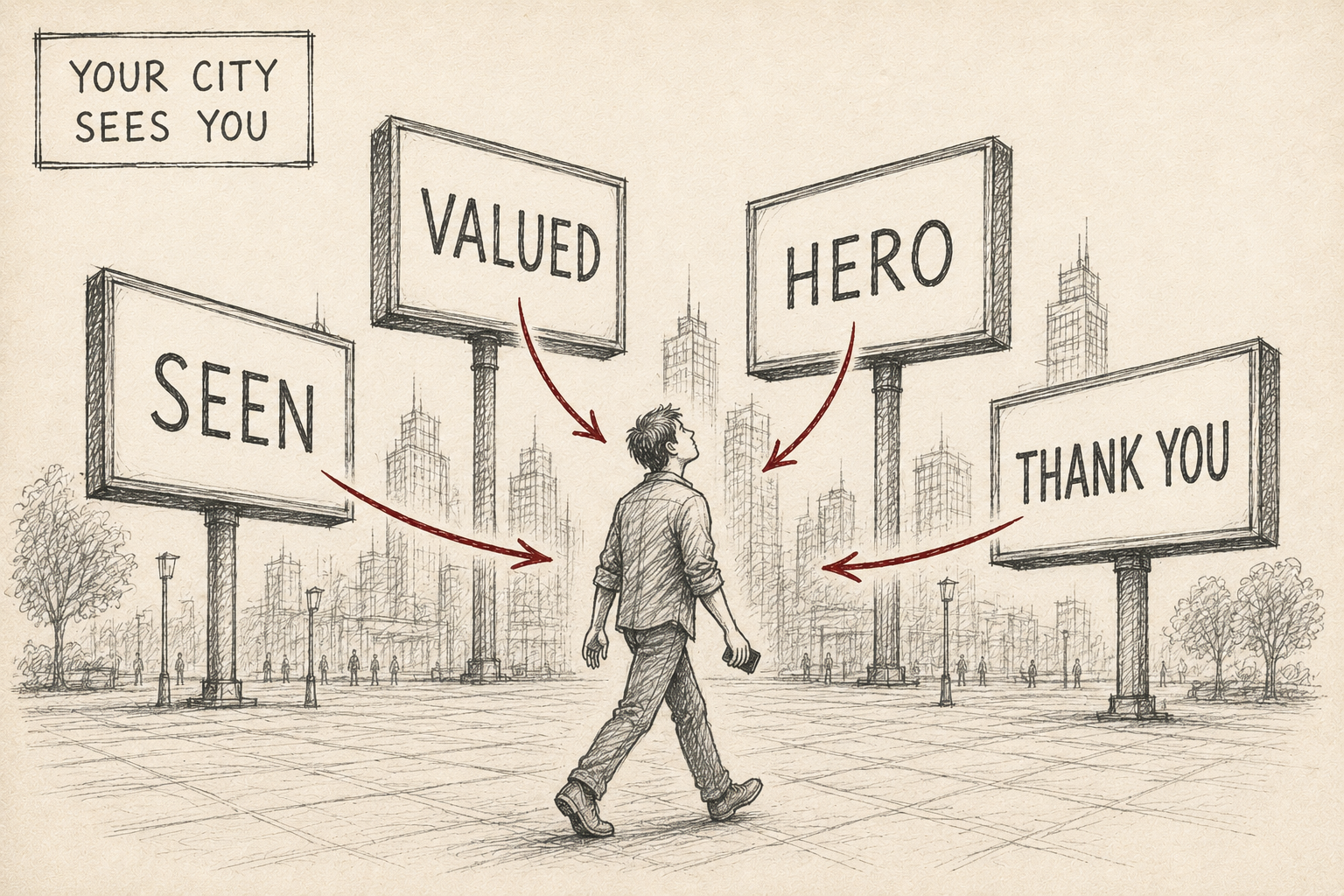
- Recognition by your community and city outweighs recognition by strangers online. Strong enough to compete with the digital addiction to likes and followers, and break it. This is attention reallocation, pulling people out of doom-scrolling and global overwhelm, back to your street, your school, your village, where life is actually lived. VRS gives communities, cities, and nations the architecture to partner with their citizens to ethically capture private, permission-based data, and then recognise them, multiple times a day, for the habits and values the community wants to reinforce. Organisations, institutions, and government officials are now in active discussions to operate VRS at this scale.
The VRS engine (U.S. Patent No. 12,205,176) is now deployed across three companies, each applying it to a different part of the diagnosis.
- Ridiculous Brand Applies the engine through social media challenges, with laughter and fun, bringing recognition to the millions of people Red Bull and similar programs have not discovered yet, and inspiring them to do the things that improve their mental and emotional health.
- Coachfax Protects youth and parents by screening the coaches who work with young people, and through fun challenges, recognises the habits and character we want to develop in our youth.
- Digital Legacy AI A life companion that captures your memories and wisdom as you live, then locks them into a Legacy Vault your descendants can explore proactively, with select assets or insights released by geo-location or life event, so an ancestor's knowledge arrives at the moment it was meant for. The outcome: every entry becomes a manipulation-resistance deposit that protects descendants from information vertigo and propaganda, what we call Synthetic Drift.
Imagine if this had existed before.
We might still know who built the pyramids and the wonders of the world. You might sit with an ancestor and hear what they actually thought.
So your story does not become someone else's mystery.
