

When the body knows before the mind does.
The gut "no" you argued yourself out of — then later wished you hadn't. That signal has a name: your Biological Truth.
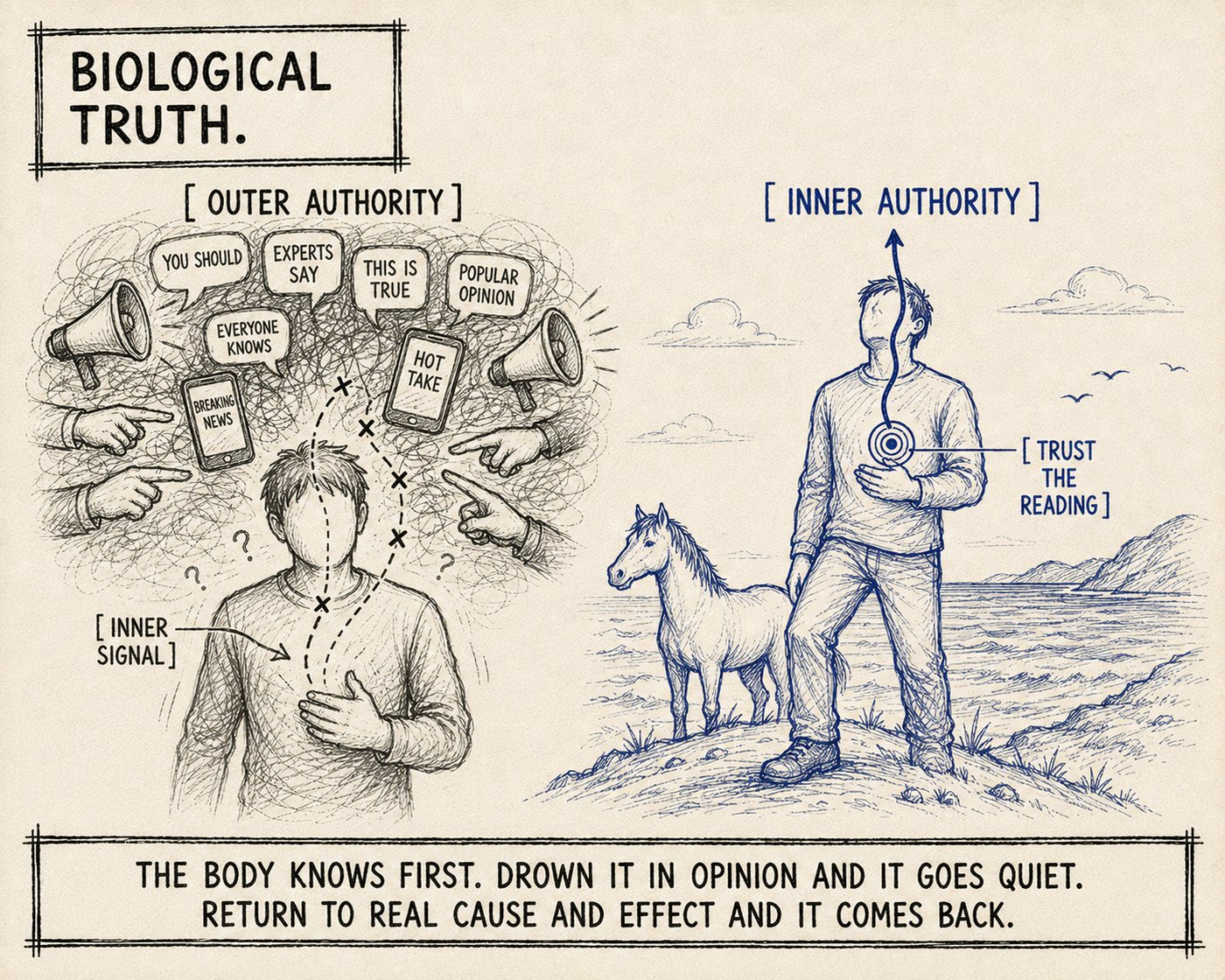
This is your Biological Truth.
It's the body's own read on what's safe, what's off, what's right — delivered as a feeling before the mind builds a reason for it. This is your inner authority, and it isn't the same thing as outer authority. Outer authority is the feed, the crowd, the expert telling you what to conclude. Biological Truth is the older, faster instrument underneath all of that — the one you were born already running.
Your nervous system reads safety and threat below conscious thought, and senses your own inner state continuously — this bodily sense is the foundation of self-awareness, the original knowing. But a world that rewards outsourcing every judgment to outside opinion trains you to override the signal: you feel the "no," can't justify it on demand, and learn to talk yourself out of it. Do that enough and the channel goes faint. That's the erosion — not your body failing, but you being taught, day after day, not to listen. The good news is the same as the bad: it's trainable. A signal you stopped hearing is a signal you can turn back up.
-
1
Log the first signal before the mind argues it away
When the body says no — the tightness, the hesitation, the "something's off" — note it before you build the case against it. You're not obeying it blindly; you're treating it as data worth checking, a flag that says look closer. Reconnecting signal to self is the whole repair.
-
2
Spend time where cause and effect is real, not opinion
Sport, nature, working with animals, building or fixing something, meditation — these give the body honest feedback. The wave doesn't care about your story; the horse responds to what you actually are; the climb is true or you fall. That's where inner authority is grown — not in the comment section, where the only feedback is other people's opinions.
-
3
For kids: protect the channel before it erodes
Children are born with this instrument intact — the job is to keep it loud. Trade some screen-fed verdicts for direct experience, and let them feel a real consequence instead of being handed the conclusion. Ask "what does your gut tell you?" before you give your own answer, so they learn their reading counts.
Interoception — the nervous system's capacity to sense and interpret the body's internal signals — is described as the foundation of self-awareness, shaping identity, self-reflection, and our sense of who we are. Trends in Neurosciences · The Emerging Science of Interoception · 2021 · Source
Stephen Porges calls neuroception the nervous system's innate ability to detect cues of safety, danger, and life-threat — a reading that happens without conscious awareness, and one we can grow more attuned to by attending to bodily experience. Stephen Porges · Polyvagal Theory · 2011 · Source
Bessel van der Kolk's work shows how profoundly the body registers and stores experience — that what we feel physically carries real information the conscious mind often catches up to only later. Bessel van der Kolk, M.D. · The Body Keeps the Score · 2014 · Source
The Value Reinforcement System was built on the same principle: the truest signal lives at the source — the real human read, in context — and the work is to protect that signal instead of letting it be overwritten by louder, secondhand noise. Dean Grey · Value Reinforcement System · U.S. Patent No. 12,205,176
