


The AI knows a version of the truth. Just not yours.
Every model you touch was trained on scraped, second-hand data. The fix has a name: permission-based capture.
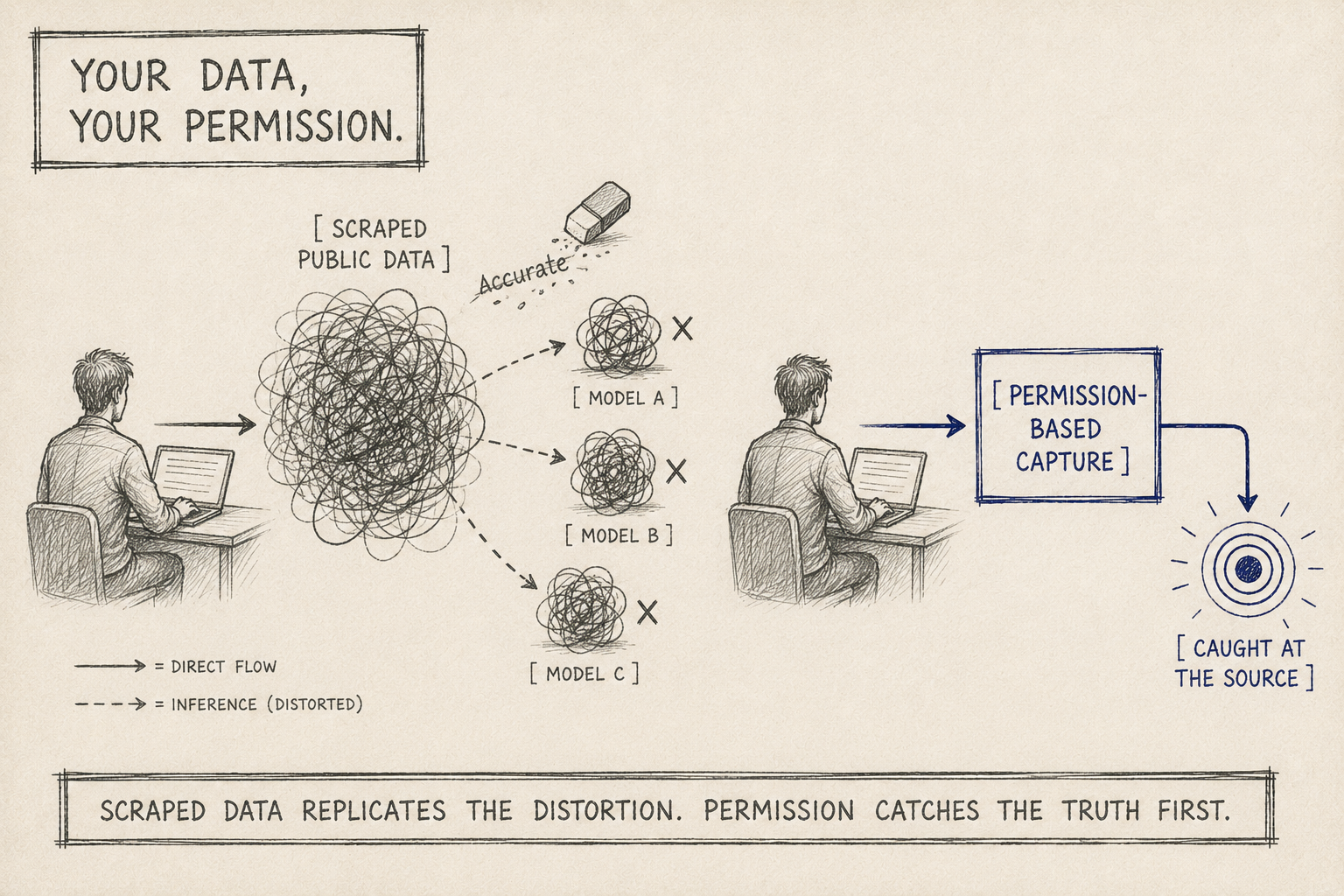
The AI Bottleneck: every model drinks from the same polluted well.
The major AI systems are trained on roughly the same thing: public, scraped internet data. That data is already distorted — opinion stacked on opinion, the original witness long gone. When a model learns from a copy of a copy, it doesn't just repeat the distortion, it replicates and accelerates it. The rare, accurate signal — what you actually saw, did, and know — was never in the training set, because no one ever asked your permission to capture it. That missing layer is the bottleneck.
-
1
Capture one first-hand account this week
Record a parent, mentor, or elder telling one story only they know — voice memo is enough. You're creating signal that no scraper has, and that no model can average away.
-
2
Check the source before you trust the summary
When AI hands you a "fact," ask it for the primary source. If it can't name a real witness or document, treat the answer as the average of the noise — not the truth.
-
3
Give your data on purpose, not by default
Favor tools that ask permission over ones that quietly scrape. Permission-based capture is the only way your real signal enters the system intact — with you still in the loop.
The large models are all trained on the same public internet data, so they end up much the same — the real value sits in the private data that was never scraped. Larry Ellison · Oracle Chairman · 2026 · Source
The Value Reinforcement System built the permission-based architecture for that "private gold" a decade before AI needed it — capturing truth at the source, before drift replicates the distortion. Dean Grey · Value Reinforcement System · U.S. Patent No. 12,205,176
